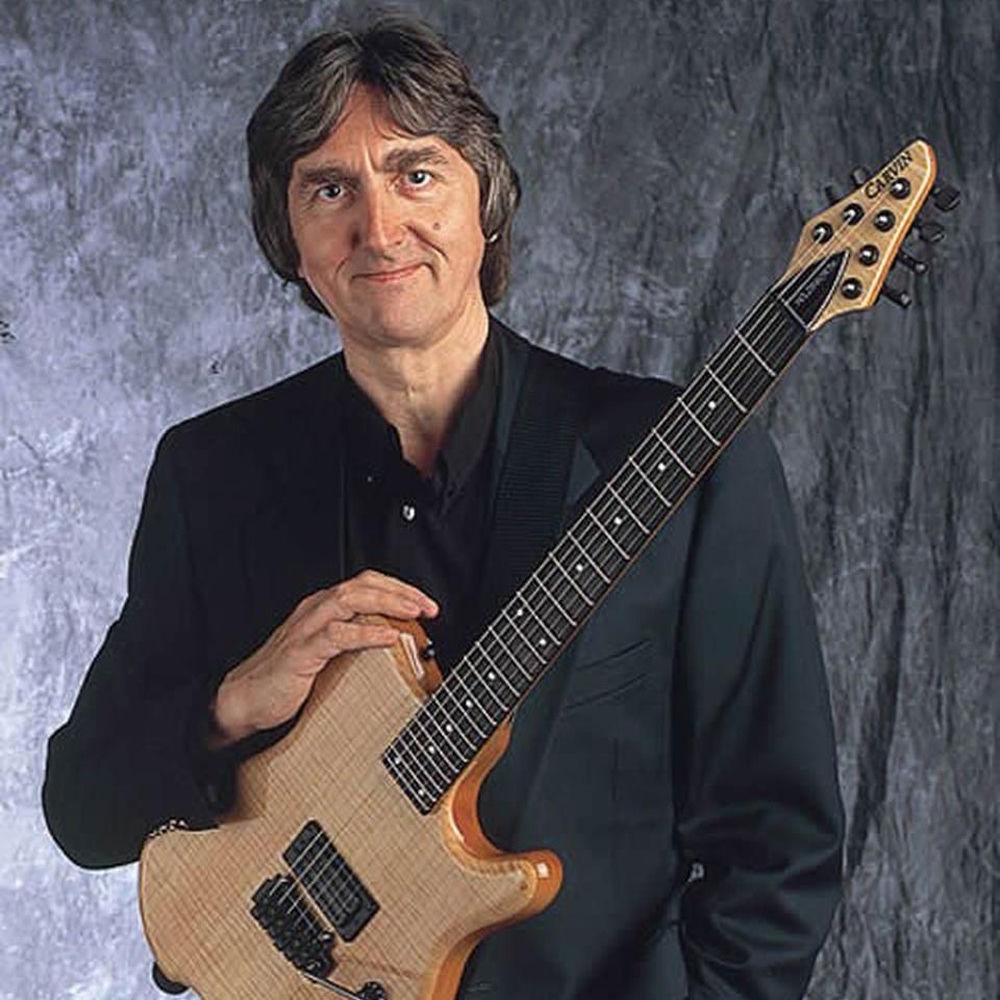
Allan Holdsworth
Listen on radio stations:
Allan Holdsworth: The Virtuoso of Avant-Garde Jazz Fusion
Allan Holdsworth was a pioneering English guitarist and composer whose revolutionary approach to the instrument left an indelible mark on jazz fusion, progressive rock, and avant-garde jazz. Renowned for his unparalleled legato technique, complex chord voicings, and use of the SynthAxe, Holdsworth cultivated a dedicated following among musicians and aficionados, releasing a series of influential solo albums throughout the 1980s and beyond.
Early Career
Born in Bradford, England in 1946, Allan Holdsworth began his professional career in the early 1970s, quickly gaining a reputation as a formidable and unconventional talent. His early work included stints with progressive rock bands like 'Igginbottom and later, a pivotal role on the 1973 album "The Sixteen Men of Tain" by the jazz group Nucleus, which showcased his emerging fusion style.
Breakthrough
Holdsworth's reputation solidified through key collaborations in the mid-to-late 1970s. His work on drummer Tony Williams' Lifetime album "Believe It" (1975) and with the jazz fusion supergroup The New Tony Williams Lifetime brought him significant attention. This led to his involvement with the progressive rock band Soft Machine on their albums "Bundles" (1975) and "Softs" (1976), further establishing him as a guitarist of extraordinary technical and harmonic invention.
Key Tracks
Road Games - This 1983 EP, featuring a vocal cameo by Jack Bruce, earned Holdsworth his only Grammy nomination and remains a concise introduction to his intense, melodic fusion style.
Metal Fatigue - The title track from his 1985 solo album is a quintessential example of his blistering legato runs and complex, shifting rhythms within a jazz rock framework.
The Sixteen Men of Tain - A later composition from the 2000 album of the same name, this track demonstrates the maturity and lyrical depth of his playing and compositional skills in an instrumental jazz context.
Throughout the 1980s, Allan Holdsworth released a string of seminal solo albums on labels like Enigma Records and Relativity Records, including "I.O.U." (1982), "Metal Fatigue" (1985), and "Atavachron" (1986). The latter was notable for his pioneering adoption of the SynthAxe, a guitar-like MIDI controller, which allowed him to trigger synthesizers and expand his already otherworldly sonic palette. His influence grew not through commercial chart success, but through the profound respect he commanded from peers and the next generation of guitarists across jazz and rock.
Artists exploring similar territories of complex instrumental fusion and avant-garde jazz include John McLaughlin, whose work with Mahavishnu Orchestra shares a foundation in high-velocity, spiritually charged fusion. Frank Zappa parallels Holdsworth in embracing compositional complexity and virtuosic improvisation across rock and jazz idioms. The innovative guitar work of Pat Metheny also explores advanced harmony and melody, though within a generally more accessible jazz framework.
Similar artists