Franz Schubert
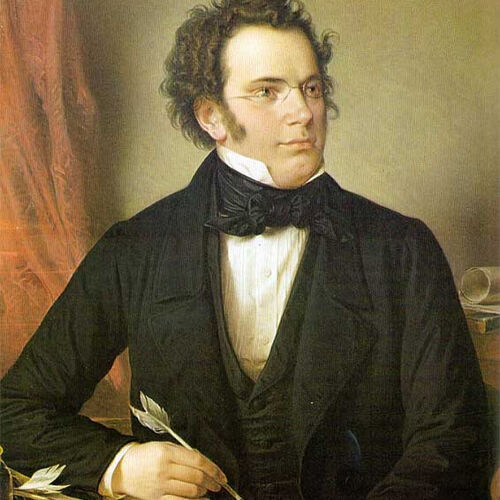
Franz Schubert: The Master of Romantic Art Song
Franz Schubert was an Austrian composer whose prolific output defined the early Romantic era in music. Despite a tragically short life, his vast catalogue of over 600 lieder, symphonies, and chamber works has achieved monumental posthumous success, with his music now a cornerstone of classical repertoire worldwide.
Early career
Born in 1797 in Vienna, Schubert displayed extraordinary musical talent from childhood, becoming a choirboy in the Imperial Court Chapel. He began composing intensively as a teenager while training as a schoolteacher, producing his first masterpiece lieder like Gretchen am Spinnrade at age 17.
His early circle of friends, who staged private concerts known as Schubertiads, became crucial supporters. By 1821, the publication of his song Erlkönig by the firm of Cappi & Diabelli marked his first significant commercial release, bringing his music to a growing public beyond Vienna.
Breakthrough
Schubert's breakthrough to wider recognition accelerated in the final years of his life, particularly with the 1827 publication of his song cycle Winterreise. While not a chart success in the modern sense, its profound emotional depth cemented his reputation among peers and connoisseurs as a genius of the art song.
His instrumental works, like the "Trout" Quintet and the "Unfinished" Symphony, began entering concert programs, though major public acclaim largely arrived after his death. The 1828 public concert of his own works, his first and only, was a critical and financial success, proving his rising stature.
Key tracks
Ave Maria — This setting of a Walter Scott poem is perhaps his most universally recognized and frequently recorded vocal work.
Erlkönig — A dramatic early lied that showcases his genius for musical storytelling and piano accompaniment.
Symphony No. 8 "Unfinished" — This revolutionary symphony remains one of his most-performed orchestral works, beloved for its lyrical melodies.
Winterreise — This bleak, profound song cycle is considered a pinnacle of the genre and a key work of Romanticism.
String Quintet in C Major — Composed in the last months of his life, this chamber work is hailed as one of the greatest in the form.
Schubert's final year, 1828, saw an astonishing burst of creativity, producing masterpieces like his last three piano sonatas and the sublime String Quintet in C Major. His death at age 31 from syphilis left a wealth of music, including his "Great" C Major Symphony, still to be discovered by the wider world.
The subsequent decades saw a steady rise in his posthumous fame, driven by champions like Robert Schumann and Felix Mendelssohn. Today, his works are essential repertoire, with countless recordings of cycles like Die schöne Müllerin achieving gold-status certifications in classical markets globally.
Robert Schumann Heavily championed Schubert's music and expanded the Romantic lied tradition. Johannes Brahms Edited Schubert's works and his lyrical style is deeply indebted to the earlier composer. Hugo Wolf Followed directly in Schubert's path, focusing intensely on the art song with complex piano parts. Gustav Mahler Inherited Schubert's gift for melody and sense of tragic beauty in symphonic writing.The music of Franz Schubert maintains heavy rotation on dedicated classical music radio stations and specialized art song programs. His lieder and symphonies are staples on public radio FM stations and online classical streams, ensuring his voice is heard daily by audiences globally.
Explore the timeless Romantic genius of Franz Schubert by tuning into the classical radio stations featured on our platform. Listeners can discover his profound song cycles and symphonies through the curated stations available on onairium.com.