Johann Joachim Quantz
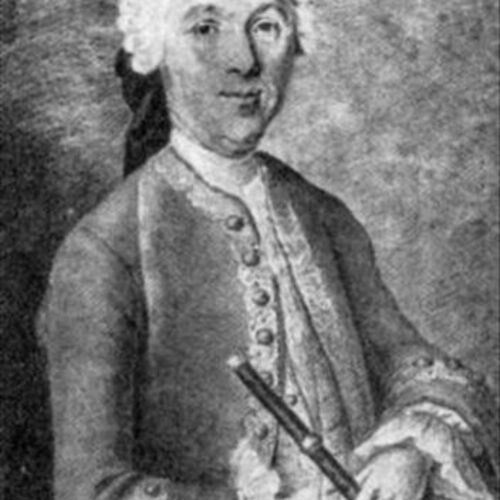
Johann Joachim Quantz: The Flute Master of the German Baroque
Johann Joachim Quantz was an 18th-century German flutist, composer, and flute maker whose influence shaped an entire era of music. His legacy is cemented by his long tenure at the court of Frederick the Great of Prussia and his monumental treatise, "On Playing the Flute," which remains a seminal text for wind players.
Early career
Born in 1697 in Oberscheden, near Göttingen, Quantz began his musical life as an apprentice to his uncle, a town musician. His early professional years were spent as an oboist in the Polish chapel of Augustus II in Dresden, a position that exposed him to a rich variety of musical styles and allowed him to study composition intensively.
He later focused on the transverse flute, studying in Paris and traveling to Italy, where he absorbed the latest techniques. His reputation as a virtuoso grew, leading to his pivotal engagement by Crown Prince Frederick of Prussia in 1728, who was an avid amateur flutist.
Breakthrough
Quantz's true breakthrough came with the ascension of his pupil to the throne as Frederick the Great in 1740. He was appointed Royal Chamber Musician with an exclusive contract, a remarkable position that forbade him from performing for any other patron without the king's permission. His primary "release" was not a commercial album but his 1752 pedagogical work, "Versuch einer Anweisung die Flöte traversiere zu spielen" (On Playing the Flute), which became an instant and enduring classic.
Key tracks
Flute Concerto in G Major, QV 5:174 — This concerto exemplifies Quantz's elegant, singing style and was likely performed frequently for the Prussian court.
Sonata for Flute and Basso Continuo in C Minor, QV 1:15 — A work showcasing the empfindsamer Stil (sensitive style) with its dramatic contrasts and expressive depth.
Triosonata in E Minor for Two Flutes and Basso Continuo — Highlights his skill in intricate part-writing and chamber music, a popular genre of the time.
Flute Concerto in D Major, QV 5:45 — A bright and technically demanding piece that demonstrates the capabilities of the Baroque flute.
Quantz composed hundreds of flute concertos and sonatas, most for the king's daily performances. He also innovated instrument design, adding a second key to the flute to improve its intonation, and his instruments were highly sought after. His treatise provided exhaustive instruction on technique, ornamentation, and musical taste, effectively defining performance practice for his generation.
Similar artists include Georg Philipp Telemann, who shared Quantz's prolific output and cosmopolitan style. Discover Johann Sebastian Bach for the profound compositional depth of the German Baroque era. Listen to Carl Philipp Emanuel Bach for the expressive, empfindsamer Stil that Quantz also championed. Explore Frederick the Great to hear the royal patron and flutist for whom Quantz composed.Johann Joachim Quantz's music is a staple on dedicated classical and Baroque music radio stations. His flute concertos and sonatas are regularly featured in programming blocks focusing on 18th-century masters and instrumental virtuosity, providing listeners with a direct link to the sound of the Prussian court.
The music of Johann Joachim Quantz, a cornerstone of the German Baroque flute repertoire, can be heard on specialty radio stations featured on our website. Listeners can discover his elegant concertos and historically significant works through the classical music stations available on onairium.com.