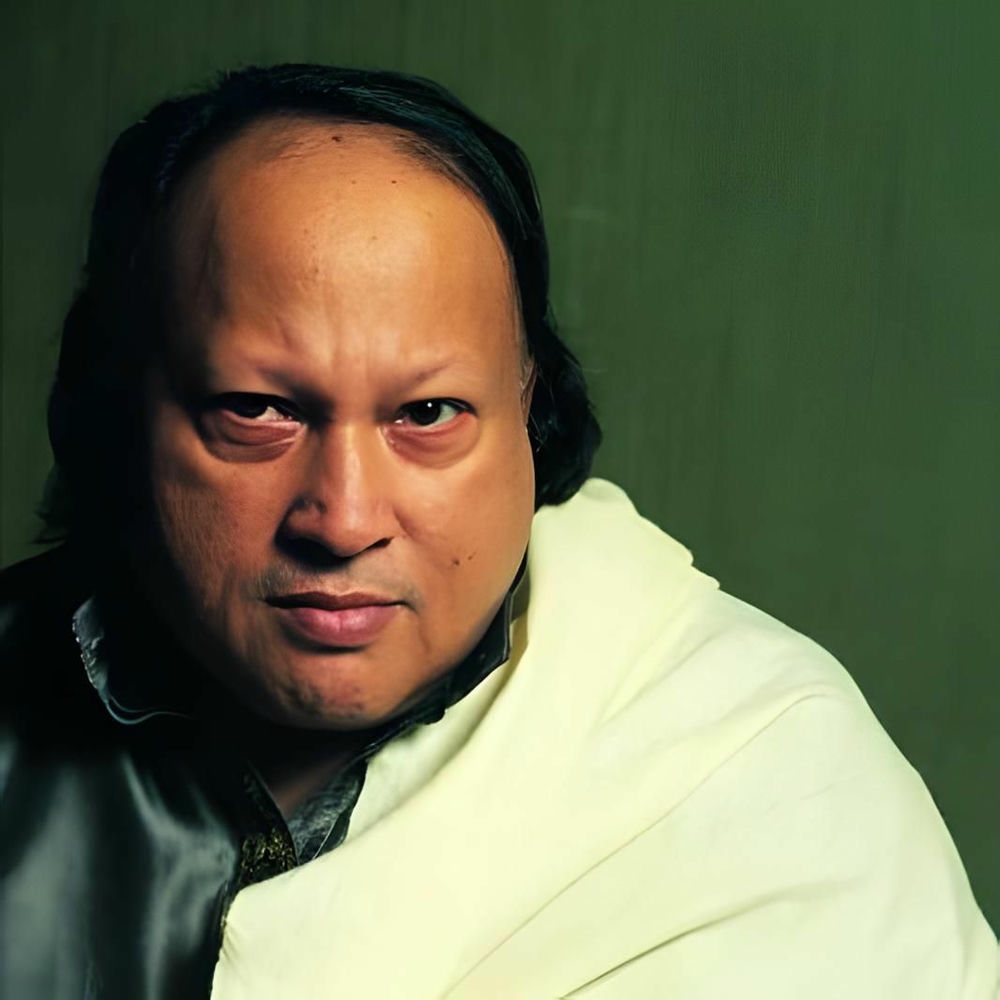
Nusrat Fateh Ali Khan
 Pakistan
Listen Nusrat Fateh Ali Khan on radio stations:

Nusrat Fateh Ali Khan: The Voice of Qawwali
Nusrat Fateh Ali Khan was a Pakistani vocalist and musician who brought the devotional Sufi music of Qawwali to a global audience. His powerful voice and intense performances led to international tours, major label albums, and collaborations with artists across genres, selling millions of records worldwide.
Early career
Born in 1948 in Lyallpur, British India (now Faisalabad, Pakistan), Nusrat came from a family of Qawwali musicians. He began rigorous vocal training at age sixteen, succeeding his father as leader of the family Qawwali party in 1971. His early recordings, like the 1974 album Haq Ali Ali on the Pakistani label EMI, quickly established his formidable talent within South Asia.
Breakthrough
Nusrat Fateh Ali Khan's international breakthrough accelerated in the late 1980s. The 1989 album Shahen-Shah, released by Real World Records, became a massive global seller, introducing his music to Western audiences. This partnership with Peter Gabriel's label was pivotal, leading to widespread festival appearances and cementing his status as a world music superstar.
Key tracks
Mustt Mustt — This 1990 track was remixed by Massive Attack, becoming a groundbreaking fusion of Qawwali and electronic music that topped club charts.
Yeh Jo Halka Halka Saroor Hai — A classic Qawwali rendition that showcases his ability to build emotional and spiritual intensity over extended performances.
Tum Ek Gorakh Dhanda Ho — A spiritually complex piece that demonstrates the technical prowess and deep classical knowledge of Nusrat and his ensemble.
Allah Hoo Allah Hoo — A powerful, trance-inducing devotional song that remains one of his most recognizable and frequently played recordings.
His later career saw ambitious collaborations and film work. He recorded with Eddie Vedder on the Dead Man Walking soundtrack and contributed to the Bandit Queen and The Last Temptation of Christ scores. His vocals were featured on several tracks with Canadian musician Michael Brook, and his posthumous 1997 album Night Song with Brook fused Qawwali with ambient music. Nusrat Fateh Ali Khan's influence extended to Bollywood, where his songs like Afreen Afreen were later re-popularized.
Fans of Nusrat Fateh Ali Khan's transcendent Qawwali music also explore the work of Abida Parveen, another Pakistani Sufi singer known for her profound spiritual renditions. The traditional ensemble work can be heard in the recordings of Sabri Brothers, a leading Qawwali party from Pakistan. For a contemporary fusion approach, listeners seek out Rahat Fateh Ali Khan, Nusrat's nephew who continues his musical lineage. The devotional intensity is also found in the music of Aziz Mian, a Qawwali performer famous for his raw, energetic style.
Nusrat Fateh Ali Khan's catalog maintains a strong presence on radio stations featured on this website. His recordings are staples on world music radio stations, dedicated Asian music channels, and specialty programs focusing on spiritual and devotional music across the globe.
The music of Nusrat Fateh Ali Khan continues to inspire listeners and can be heard on radio stations available on onairium.com. Discover the power of Qawwali and his vast discography by tuning into the world music and specialty stations featured on our platform.