

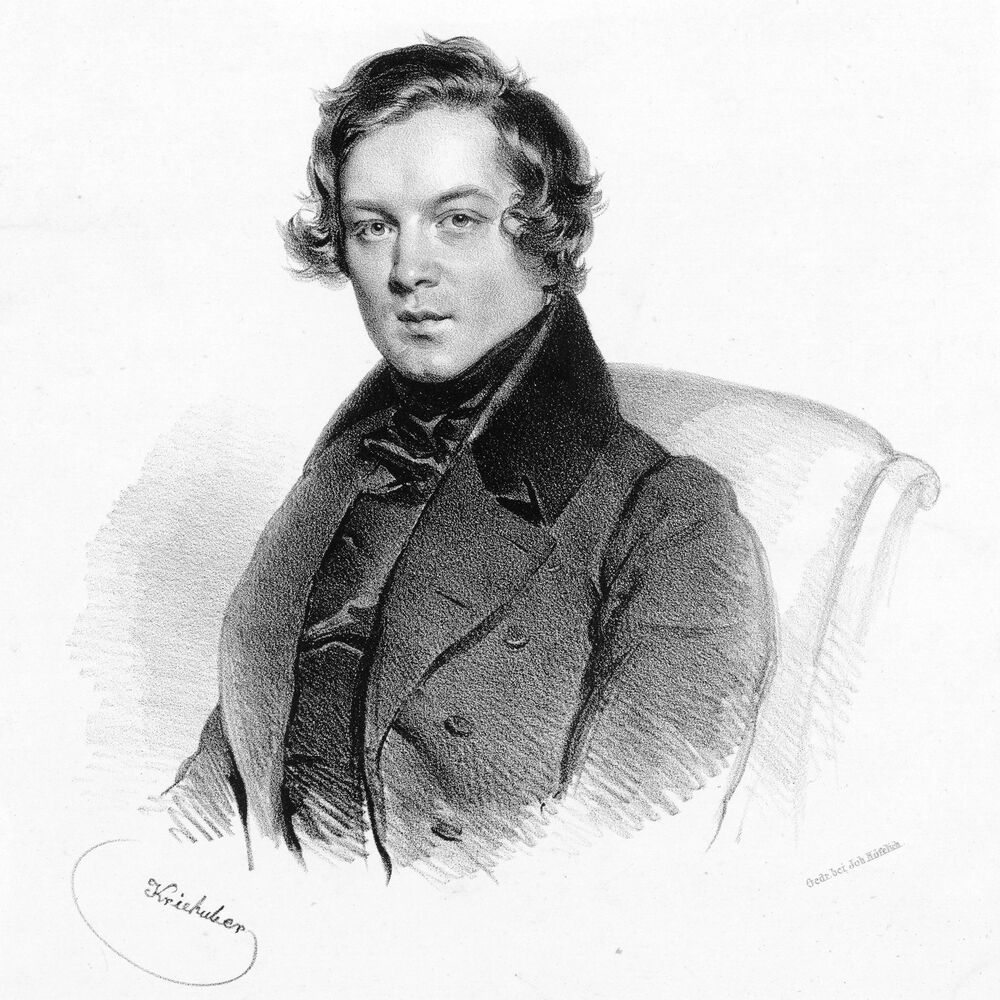
Robert Schumann
Listen Robert Schumann on radio stations:








Robert Schumann: The Heart of German Romanticism
Robert Schumann was a German composer and influential music critic of the Romantic era. His work, primarily for the piano and in the form of art song, remains a cornerstone of 19th-century classical music.
Early Career
Born in Zwickau, Saxony in 1810, Schumann initially studied law before dedicating himself entirely to music. His early ambition to become a virtuoso pianist was thwarted by a hand injury, leading him to focus on composition and writing.
Breakthrough
Schumann's early compositions for piano, such as the cycles "Papillons" and "Carnaval," established his reputation. His founding of the influential music journal "Neue Zeitschrift für Musik" in 1834 provided a platform for his critical writing and advocacy for new composers like Chopin and Brahms.
Key Tracks
Dichterliebe - This song cycle on poems by Heinrich Heine is considered one of the supreme achievements of the German Lied, perfectly marrying poetry and music.
Carnaval - A suite of twenty-one short pieces for piano portraying a masked ball, showcasing Schumann's characteristically imaginative and fragmentary style.
Piano Concerto in A minor - His only completed piano concerto, a staple of the Romantic repertoire known for its lyrical and dramatic interplay between soloist and orchestra.
Kinderszenen - A set of thirteen short piano pieces evoking the world of childhood, including the famous "Träumerei."
Symphony No. 3 "Rhenish" - His final symphony, inspired by the landscape and culture of the Rhineland, is celebrated for its grandeur and vitality.
Schumann's prolific output in the 1840s included symphonies, chamber music, and many Lieder, often inspired by his wife, the pianist Clara Wieck. His later years were marked by mental health struggles, but his music continued to flow until his death in 1856.
Schumann's legacy is defined by his intensely expressive and poetic music, which captures the full spectrum of Romantic emotion. His critical writings also left an indelible mark on the musical culture of his time.
