Roy Eldridge
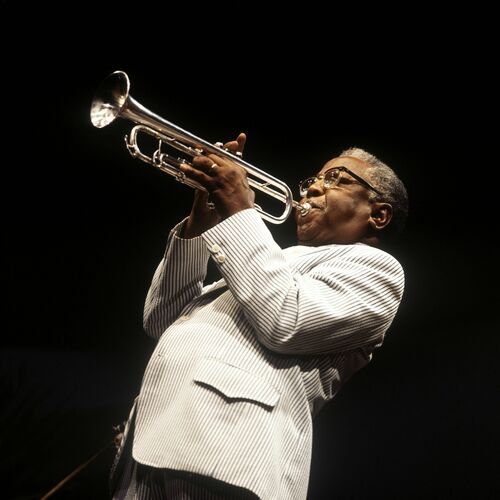
Roy Eldridge: The Fiery Virtuoso of Swing and Bebop
Roy "Little Jazz" Eldridge was a revolutionary American jazz trumpeter whose blistering technique and emotional intensity bridged the gap between the swing era and bebop. Hailing from Pittsburgh, Pennsylvania, his explosive style and competitive spirit directly influenced the next generation of jazz giants, cementing his legacy as one of the most important brass players in music history.
Early career
Born in 1911, Roy Eldridge began his musical journey as a drummer before switching to trumpet, inspired by the rapid-fire style of saxophonist Coleman Hawkins. He honed his craft in the late 1920s and early 1930s with territory bands, developing a powerful, high-note approach that pushed the technical limits of the instrument at the time.
Breakthrough
Eldridge's national breakthrough came in the mid-1930s through his recordings with the Teddy Hill Orchestra and as a leader for the Vocalion and Brunswick labels. His 1937 recording of Wabash Stomp with his own band showcased his astonishing range and harmonic daring, making him a star attraction and a formidable competitor in Harlem's famed "cutting contests."
Key tracks
Wabash Stomp — This 1937 showcase became his early signature, demonstrating his unprecedented command of the trumpet's upper register.
Rockin' Chair — His 1941 interpretation of the Hoagy Carmichael standard with the Gene Krupa Orchestra became a major hit and a career-defining performance.
After You've Gone — Recorded live in 1943 with Krupa's band, this track captures Eldridge's raw, passionate energy and improvisational genius at its peak.
I Can't Get Started — His poignant, trumpet-as-voice balladry on this standard proved his mastery extended far beyond sheer speed and power.
Eldridge's tenure with Gene Krupa's big band from 1941 to 1943 brought him immense popularity, with hits like Let Me Off Uptown featuring singer Anita O'Day. He later led his own successful big band and became a star of Norman Granz's Jazz at the Philharmonic concert tours, where his legendary musical battles with fellow trumpeters like Dizzy Gillespie were historic. His later career included prolific recordings for labels like Verve and Pablo, where he collaborated with everyone from Ella Fitzgerald to Oscar Peterson.
For fans of Roy Eldridge's fiery, transitional style, explore similar architects of brass innovation. Dizzy Gillespie directly cited Eldridge as his primary influence, building upon his harmonic ideas. Louis Armstrong was Eldridge's own foundational hero, whose emotive power he channeled through a more complex, modern lens. Charlie Shavers was a fellow trumpet virtuoso and contemporary known for a similarly dazzling, technically formidable approach. Clifford Brown later embodied the pure, burning tone and flawless execution that Eldridge helped pioneer.
Roy Eldridge's catalog remains a staple on jazz radio stations and dedicated swing-era FM channels. His recordings are frequently featured on programs highlighting the evolution of the trumpet and the golden age of big band music, ensuring new audiences discover his explosive contributions.
The music of Roy Eldridge, a pivotal force in American jazz, can be heard regularly on the radio stations featured on our website. Listeners can explore his groundbreaking work across decades by tuning into the classic jazz and swing stations available on onairium.com.