Schubert
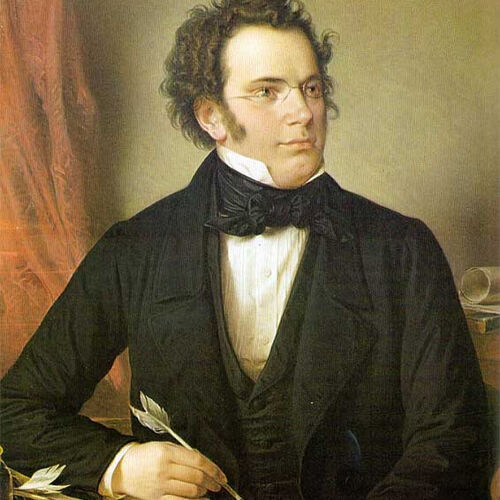
Schubert: The Prolific Master of Romantic Art Song
Franz Schubert was an Austrian composer whose vast output defined the early Romantic era in music. Despite a tragically short life, his melodic genius produced over 600 lieder (art songs) and major symphonic works that achieved posthumous fame and enduring critical acclaim.
Early career
Born in 1797 in Vienna, Schubert displayed prodigious talent from childhood, becoming a choirboy in the Imperial Court Chapel. His formal studies were brief, and by 1814 he was working as a schoolteacher while composing at a feverish pace, producing his first masterpiece, the song Gretchen am Spinnrade, at age seventeen.
This period, sometimes called his "Schubertiads," involved private performances for a circle of friends in Vienna. His early works, including his first three symphonies and hundreds of songs, were circulated in manuscript but received little public recognition or major label involvement, as the publishing industry of the time was slow to embrace him.
Breakthrough
While widespread fame eluded him in his lifetime, his 1821 song cycle Die schöne Müllerin, published by the firm Cappi & Diabelli, marked a turning point in critical recognition. His later years saw the composition of monumental works like the "Unfinished" Symphony and the String Quintet in C major, solidifying his reputation among Vienna's artistic elite.
Posthumously, his 1827 song cycle Winterreise and the "Great" C major Symphony achieved legendary status. The discovery and first performance of his Symphony No. 9 in 1839, over a decade after his death, led to a surge in popularity and cemented his place in the standard orchestral repertoire.
Key tracks
Erlkönig — This dramatic 1815 lied, based on Goethe's poem, remains a technical and expressive benchmark for singers and pianists.
Ave Maria — Originally titled "Ellens Gesang III," this 1825 setting of a Walter Scott poem transcended its origins to become one of the world's most recognizable classical melodies.
Winterreise — This bleak, profound 1827 song cycle is considered a pinnacle of the genre, exploring psychological depth unprecedented in its time.
Symphony No. 8 "Unfinished" — Its haunting beauty and mysterious two-movement structure have made it one of the most frequently performed symphonies in the world.
String Quintet in C major — Featuring two cellos, this 1828 chamber work is widely regarded as one of the greatest compositions in all of classical music.
Schubert's final year, 1828, was one of astonishing productivity, seeing the completion of his last three piano sonatas, the Mass in E-flat, and the song cycle Schwanengesang. He died in November 1828 at the age of 31, leaving a legacy that would only grow in stature, with his works now achieving "platinum" status through countless recordings and performances globally.
For a similar focus on lyrical melody and intimate expression, explore Schumann. His song cycles and piano music deeply channel the Romantic spirit. The dramatic lieder of Hugo Wolf continue the art song tradition Schubert perfected. For the Viennese classical foundation he built upon, listen to Mozart. The expansive harmonic language of Gustav Mahler is unthinkable without Schubert's pioneering symphonic and song structures.Schubert's music is a staple on classical radio stations and dedicated art song channels featured on this website. His works are regularly programmed on independent music radio stations focusing on historical repertoire and on online classical radio streams that celebrate foundational composers.
You can hear the timeless music of Franz Schubert on the classical and art song radio stations available through our network. Listeners can discover the depth of his Romantic genre catalog by tuning into the dedicated stations featured on onairium.com.