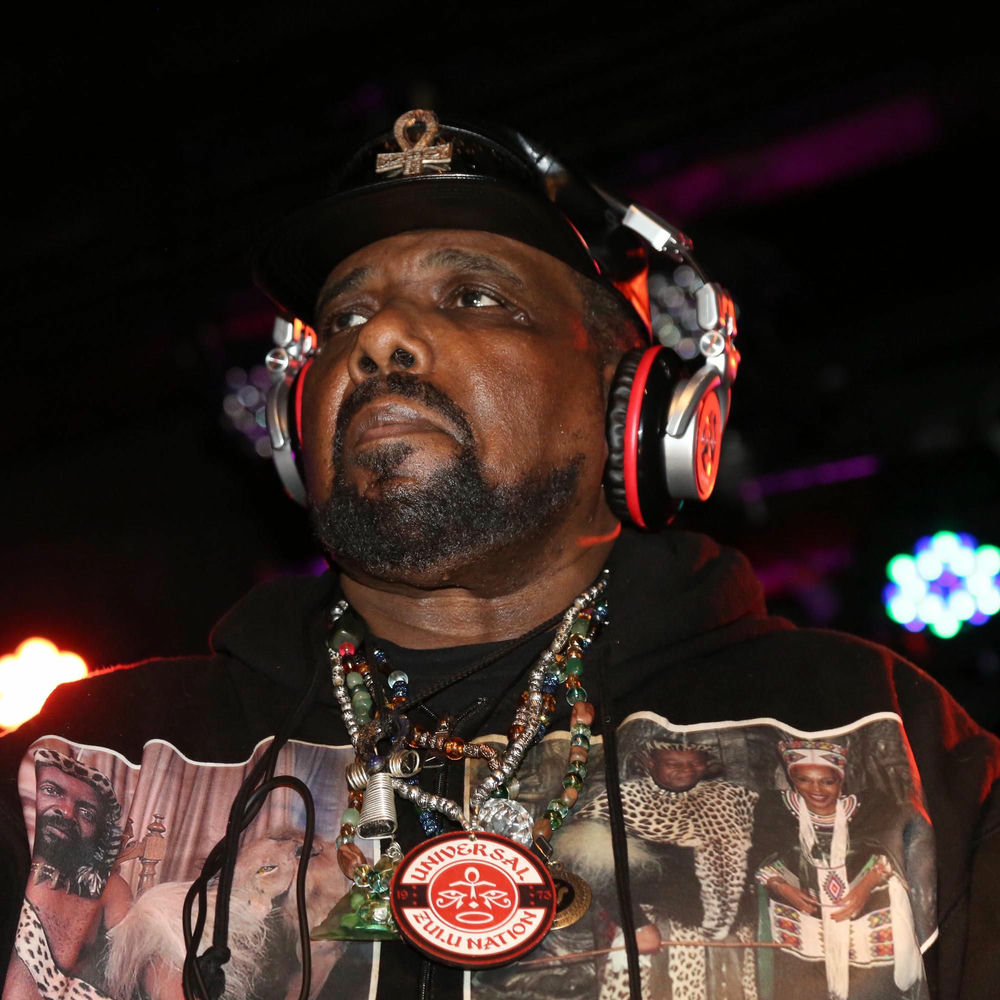
Afrika Bambaataa
 United States
Listen Afrika Bambaataa on radio stations:


Afrika Bambaataa: The Godfather of Hip-Hop
Afrika Bambaataa is a pioneering American DJ and producer from the South Bronx, New York, credited as a foundational architect of hip-hop culture. His most significant achievement was the 1982 electro-funk classic "Planet Rock," which sold over 620,000 copies in its first year and became a platinum-certified landmark that revolutionized electronic music.
Early career
Born Lance Taylor in 1957, Bambaataa's musical journey began as a DJ for the Black Spades street organization in the early 1970s. He famously transformed his experiences by founding the Universal Zulu Nation, a collective promoting peace and unity through the core elements of hip-hop: DJing, MCing, breaking, and graffiti.
His early notoriety came from his eclectic DJ sets at community centers like the Bronx River Houses, where he blended funk, rock, and electronic music. This led to his first major label signing with Tommy Boy Records, setting the stage for a seismic shift in popular music.
Breakthrough
Afrika Bambaataa's breakthrough arrived in 1982 with the release of "Planet Rock" with his group Soulsonic Force. The single, released on Tommy Boy, peaked at No. 48 on the Billboard Hot 100 and No. 4 on the Hot Black Singles chart, achieving gold status swiftly and later platinum.
The track's success was propelled by its revolutionary synthesis of the Kraftwerk melody from "Trans-Europe Express" with the beat from "The Mexican" and funk rhythms. This fusion defined the electro-funk sound and influenced countless producers across hip-hop, dance, and pop genres worldwide.
Key tracks
Planet Rock — This 1982 electro anthem is arguably Bambaataa's most important record, pioneering the use of the Roland TR-808 drum machine and synthesizers in hip-hop.
Looking for the Perfect Beat — A 1983 follow-up that further refined the electro sound and became another cornerstone of the genre's early development.
Renegades of Funk — Released in 1983, this track with Soulsonic Force combined militant lyrics with a driving electro beat, showcasing Bambaataa's thematic depth.
Unity — His landmark 1984 collaboration with James Brown, recorded for the movie "Beat Street," directly bridged the gap between funk's past and hip-hop's future.
Zulu Nation Throwdown — An earlier 1980 release that served as a powerful, raw manifesto for the Zulu Nation and the burgeoning hip-hop scene.
Following this era, Afrika Bambaataa continued to innovate and collaborate. He worked with artists like John Lydon and Bill Laswell in the group Time Zone, and later formed Shango Funk Theology. His 1986 album "Beware (The Funk Is Everywhere)" on Capitol Records expanded his sonic explorations, though it did not match the commercial peak of "Planet Rock."
His influence as a cultural ambassador grew through the 1980s and 1990s, with the Zulu Nation expanding globally. Bambaataa's production and DJing are documented on compilations like "Looking for the Perfect Beat 1980-1985" and the seminal "Death Mix" live tape from 1983.
Fans of Afrika Bambaataa's foundational electro and hip-hop sound should also explore Grandmaster Flash, another pioneer from the Bronx known for innovative turntablism. The futuristic funk of George Clinton was a direct and major influence on Bambaataa's eclectic style. The electronic hip-hop of Man Parrish emerged directly from the electro scene Bambaataa helped create. Furthermore, the early work of Run DMC carries the energy and cultural force that Bambaataa's Zulu Nation championed.
Afrika Bambaataa's music maintains a constant presence on dedicated old-school hip-hop radio stations, classic beats channels, and specialty shows focusing on the roots of electronic dance music. His