
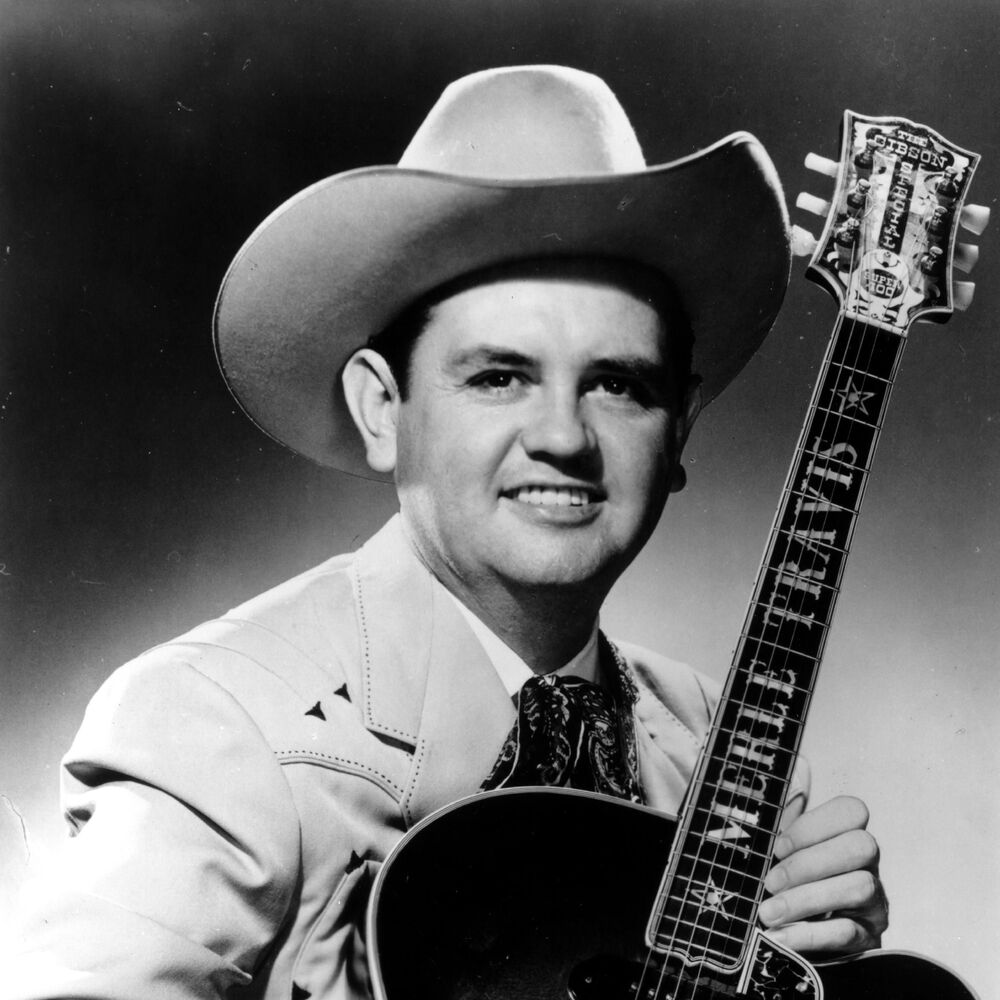
Merle Travis
 United States
Listen Merle Travis on radio stations:
Merle Travis: The Architect of American Country Guitar
Merle Travis was a pioneering American guitarist, singer, and songwriter whose innovative fingerpicking style became a cornerstone of country and folk music. Hailing from Muhlenberg County, Kentucky, his legacy is cemented by timeless songs like "Sixteen Tons," which became a multi-million selling #1 pop hit for Tennessee Ernie Ford in 1955.
Early career
Born in 1917 in Rosewood, Kentucky, Merle Travis was immersed in the musical traditions of the Western Kentucky coal fields. He began his professional career in the late 1930s, playing with bands like the Drifting Pioneers on WLW radio in Cincinnati, where his technical prowess on the guitar quickly distinguished him.
His early recording work for the small label Syd Nathan in the 1940s, which later evolved into King Records, captured his developing "Travis picking" technique. This syncopated style, using the thumb for bass notes and fingers for melody, was a revolutionary approach to the acoustic guitar.
Breakthrough
Merle Travis's national breakthrough arrived in 1946-1947 with a series of hits for Capitol Records. His own recording of "Divorce Me C.O.D." reached #1 on the Billboard country chart, while "So Round, So Firm, So Fully Packed" also hit the top spot, establishing him as a major star.
His 1947 album for Capitol, "Folk Songs of the Hills," was a landmark collection featuring narrative songs about Appalachian life. Though not a major commercial smash initially, it included originals like "Sixteen Tons" and "Dark as a Dungeon" that would become American standards.
Key tracks
Sixteen Tons — This Travis-penned coal mining anthem became a cultural phenomenon after Tennessee Ernie Ford's 1955 cover sold over four million copies and spent ten weeks at #1 on the pop chart.
Dark as a Dungeon — Another mining song from "Folk Songs of the Hills," it is revered as a masterpiece of folk storytelling and has been covered by countless artists including Johnny Cash.
Divorce Me C.O.D. — Travis's first #1 country hit in 1946 showcased his warm vocal style and clever songwriting, solidifying his chart success.
Cannonball Rag — An instrumental tour de force, this piece demonstrated the breathtaking speed and complexity of his fingerpicking technique, influencing generations of guitarists.
Throughout the 1950s and 1960s, Travis remained a vital figure, collaborating with stars like Hank Thompson and appearing in Hollywood films. His guitar design work with Paul Bigsby and later Leo Fender led to the iconic solid-body "Merle Travis" model, a favorite among rock and country players.
He enjoyed a career resurgence in the 1970s, winning Grammy Awards for his instrumental prowess on albums like "The Atkins-Travis Traveling Show" with Chet Atkins. Merle Travis was inducted into the Nashville Songwriters Hall of Fame in 1970 and the Country Music Hall of Fame in 1977, passing away in 1983.
Artists who share the intricate guitar work and roots-oriented storytelling of Merle Travis include Chet Atkins who collaborated with Travis and helped popularize the Nashville sound. Doc Watson also mastered a deep well of American folk and country music with phenomenal flatpicking guitar. Tommy Emmanuel carries the torch of complex acoustic fingerstyle guitar performance into the modern era. The narrative depth of his songwriting echoes in the work of John Prine, another keen observer of American life.
Merle Travis's catalog remains a staple on classic country and Americana radio stations, as well as on dedicated folk and guitar music programs. His influential recordings are frequently featured in programming blocks highlighting the pioneers of American roots music.
Listeners can explore the enduring sound of Merle Travis on radio stations featured on onairium.com, where his pioneering guitar work and iconic songs continue to be celebrated on airwaves dedicated to country and folk music's rich history.