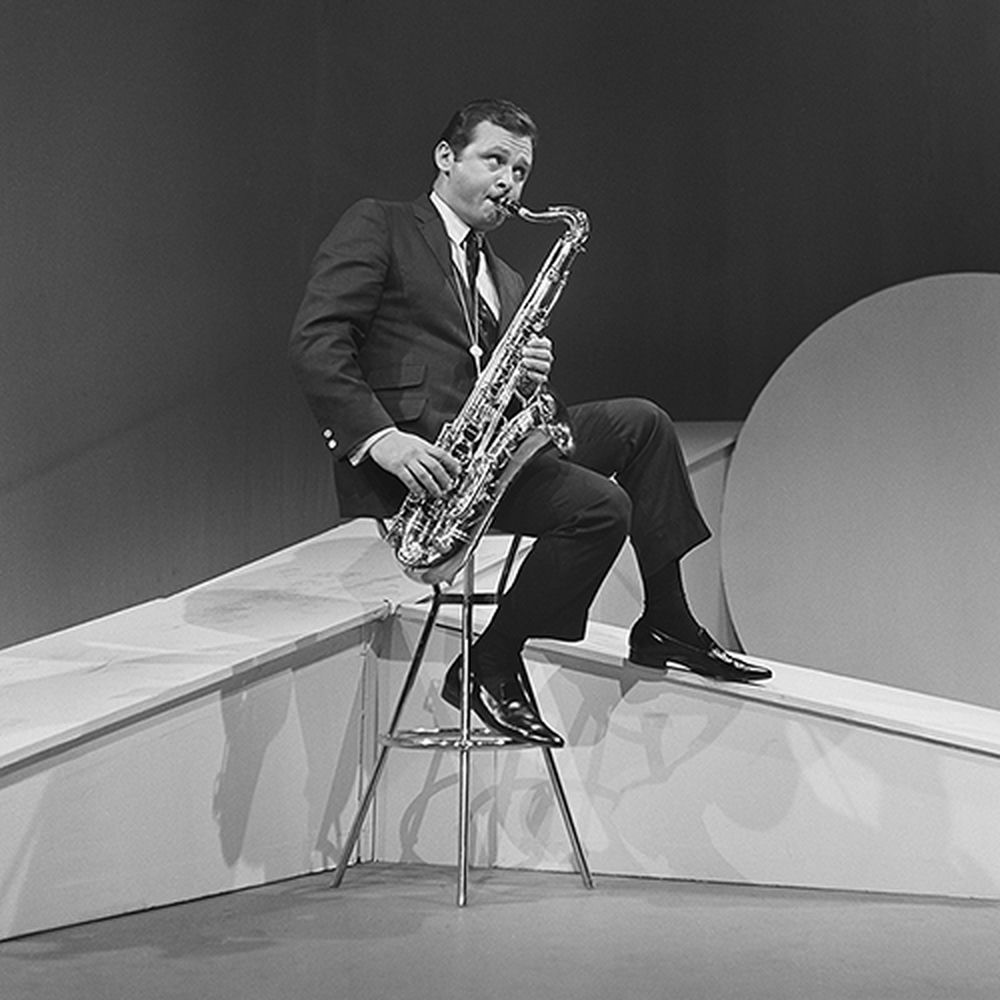
Stan Getz
 United States
Listen Stan Getz on radio stations:









Stan Getz: The Velvet Sound of Cool Jazz
Stan Getz was an American jazz saxophonist whose lyrical and warm tenor tone became one of the most recognizable sounds in music. Hailing from Philadelphia, his career pinnacle was the global bossa nova craze ignited by his 1964 chart-topping single "The Girl from Ipanema," which sold millions of records and won a Grammy for Record of the Year.
Early career
Born in 1927, Stan Getz quickly rose as a prodigious talent, playing in the big bands of Jack Teagarden, Stan Kenton, and Benny Goodman while still a teenager. His first major step as a leader came with a series of 78 RPM recordings for Savoy Records in the late 1940s, where his smooth, melodic style began to crystallize.
Getz's early fame arrived with the "Four Brothers" sound of Woody Herman's Second Herd, where his solo on the 1948 hit "Early Autumn" made him a star. This led to a prolific recording period for Roost and Verve in the 1950s, establishing him as a leading voice of the cool jazz movement.
Breakthrough
Stan Getz's true commercial and cultural breakthrough arrived in the early 1960s with his fusion of jazz and Brazilian bossa nova. The 1962 album Jazz Samba, recorded with guitarist Charlie Byrd for Verve, unexpectedly climbed to number one on the Billboard pop chart, a rare feat for a jazz album.
This success was massively amplified by the 1964 album Getz/Gilberto, a collaboration with João Gilberto and Antônio Carlos Jobim. Featuring the vocals of Astrud Gilberto, the single "The Girl from Ipanema" became a worldwide phenomenon, topping the pop charts and earning multiple Grammy Awards, including Album of the Year.
Key tracks
Early Autumn — This 1948 solo with Woody Herman's band announced Getz as a major new voice in jazz and became his signature early piece.
Desafinado — The lead track from 1962's Jazz Samba, it introduced the bossa nova sound to American audiences and won a Grammy.
The Girl from Ipanema — This global smash single defined the bossa nova craze, won Record of the Year, and remains one of the best-selling jazz songs of all time.
Moonlight in Vermont — A prime example of Getz's 1950s cool jazz period, showcasing his impeccable ballad style from a celebrated session with guitarist Johnny Smith.
Windows — From his 1967 album Sweet Rain, this track illustrates Getz's successful adaptation to modern post-bop harmonies later in his career.
Following the bossa nova years, Stan Getz continued to evolve, exploring fusion and returning to his hard bop roots with the 1981 album Billy Highstreet Samba. He maintained a rigorous touring and recording schedule until his death in 1991, leaving behind a vast catalog for labels like Verve, Concord, and EmArcy.
His later work included notable collaborations with pianist Chick Corea on the 1972 album Captain Marvel and with vibraphonist Gary Burton. Getz's influence is cemented by his consistent chart presence and gold certifications for albums like Getz/Gilberto, which remains a cornerstone of any jazz collection.
For listeners who appreciate the melodic sophistication of Stan Getz, explore similar artists featured on our site. Gerry Mulligan shared Getz's affinity for the cool, contrapuntal sound of the 1950s. Antonio Carlos Jobim was the essential composer and architect of the bossa nova sound Getz popularized. Paul Desmond offered another take on a dry, witty, and melodically focused saxophone style. Lee Konitz represents a more exploratory but equally lyrical approach to the