Maslows Hierarchy of Logging Needs

Maslows Hierarchy of Logging Needs

Author: Noah Gift February 27, 2025 Duration: 7:37

Maslow's Hierarchy of Logging - Podcast Episode Notes

Core Concept

  • Logging exists on a maturity spectrum similar to Maslow's hierarchy of needs
  • Software teams must address fundamental logging requirements before advancing to sophisticated observability

Level 1: Print Statements

  • Definition: Raw output statements (printf, console.log) for basic debugging
  • Limitations:
    • Creates ephemeral debugging artifacts (add prints → fix issue → delete prints → similar bug reappears → repeat)
    • Zero runtime configuration (requires code changes)
    • No standardization (format, levels, destinations)
    • Visibility limited to execution duration
    • Cannot filter, aggregate, or analyze effectively
  • Examples: Python print(), JavaScript console.log(), Java System.out.println()

Level 2: Logging Libraries

  • Definition: Structured logging with configurable severity levels
  • Benefits:
    • Runtime-configurable verbosity without code changes
    • Preserves debugging context across debugging sessions
    • Enables strategic log retention rather than deletion
  • Key Capabilities:
    • Log levels (debug, info, warning, error, exception)
    • Production vs. development logging strategies
    • Exception tracking and monitoring
  • Sub-levels:
    • Unstructured logs (harder to query, requires pattern matching)
    • Structured logs (JSON-based, enables key-value querying)
    • Enables metrics dashboards, counts, alerts
  • Examples: Python logging module, Rust log crate, Winston (JS), Log4j (Java)

Level 3: Tracing

  • Definition: Tracks execution paths through code with unique trace IDs
  • Key Capabilities:
    • Captures method entry/exit points with precise timing data
    • Performance profiling with lower overhead than traditional profilers
    • Hotspot identification for optimization targets
  • Benefits:
    • Provides execution context and sequential flow visualization
    • Enables detailed performance analysis in production
  • Examples: OpenTelemetry (vendor-neutral), Jaeger, Zipkin

Level 4: Distributed Tracing

  • Definition: Propagates trace context across process and service boundaries
  • Use Case: Essential for microservices and serverless architectures (5-500+ transactions across services)
  • Key Capabilities:
    • Correlates requests spanning multiple services/functions
    • Visualizes end-to-end request flow through complex architectures
    • Identifies cross-service latency and bottlenecks
    • Maps service dependencies
    • Implements sampling strategies to reduce overhead
  • Examples: OpenTelemetry Collector, Grafana Tempo, Jaeger (distributed deployment)

Level 5: Observability

  • Definition: Unified approach combining logs, metrics, and traces
  • Context: Beyond application traces - includes system-level metrics (CPU, memory, disk I/O, network)
  • Key Capabilities:
    • Unknown-unknown detection (vs. monitoring known-knowns)
    • High-cardinality data collection for complex system states
    • Real-time analytics with anomaly detection
    • Event correlation across infrastructure, applications, and business processes
    • Holistic system visibility with drill-down capabilities
  • Analogy: Like a vehicle dashboard showing overall status with ability to inspect specific components
  • Examples:
    • Grafana + Prometheus + Loki stack
    • ELK Stack (Elasticsearch, Logstash, Kibana)
    • OpenTelemetry with visualization backends

Implementation Strategies

  • Progressive adoption: Start with logging fundamentals, then build up
  • Future-proofing: Design with next level in mind
  • Tool integration: Select tools that work well together
  • Team capabilities: Match observability strategy to team skills and needs

Key Takeaway

  • Print debugging is survival mode; mature production systems require observability
  • Each level builds on previous capabilities, adding context and visibility
  • Effective production monitoring requires progression through all levels

🔥 Hot Course Offers:

🚀 Level Up Your Career:

Learn end-to-end ML engineering from industry veterans at PAIML.COM


Noah Gift guides you through a year-long journey with 52 Weeks of Cloud, a weekly exploration designed for anyone building, managing, or simply curious about modern cloud infrastructure. Each episode digs into a specific technical topic, moving beyond surface-level explanations to offer practical insights you can apply. You’ll hear detailed discussions on the platforms that power the industry-like AWS, Azure, and Google Cloud-and how to navigate multi-cloud strategies effectively. The conversation regularly delves into the orchestration of these systems with Kubernetes and the specialized world of machine learning operations, or MLOps, including the integration and implications of large language models. This isn't just theory; it's a focused look at the tools and methodologies shaping how software is deployed and scaled today. By committing to this podcast, you're essentially getting a structured, expert-led curriculum that breaks down complex subjects into manageable weekly segments, all aimed at building a comprehensive and practical understanding of the cloud ecosystem.
Author: Language: English Episodes: 225

52 Weeks of Cloud
Podcast Episodes
The Pragmatic AI Labs Alternative University [not-audio_url] [/not-audio_url]

Duration: 14:04
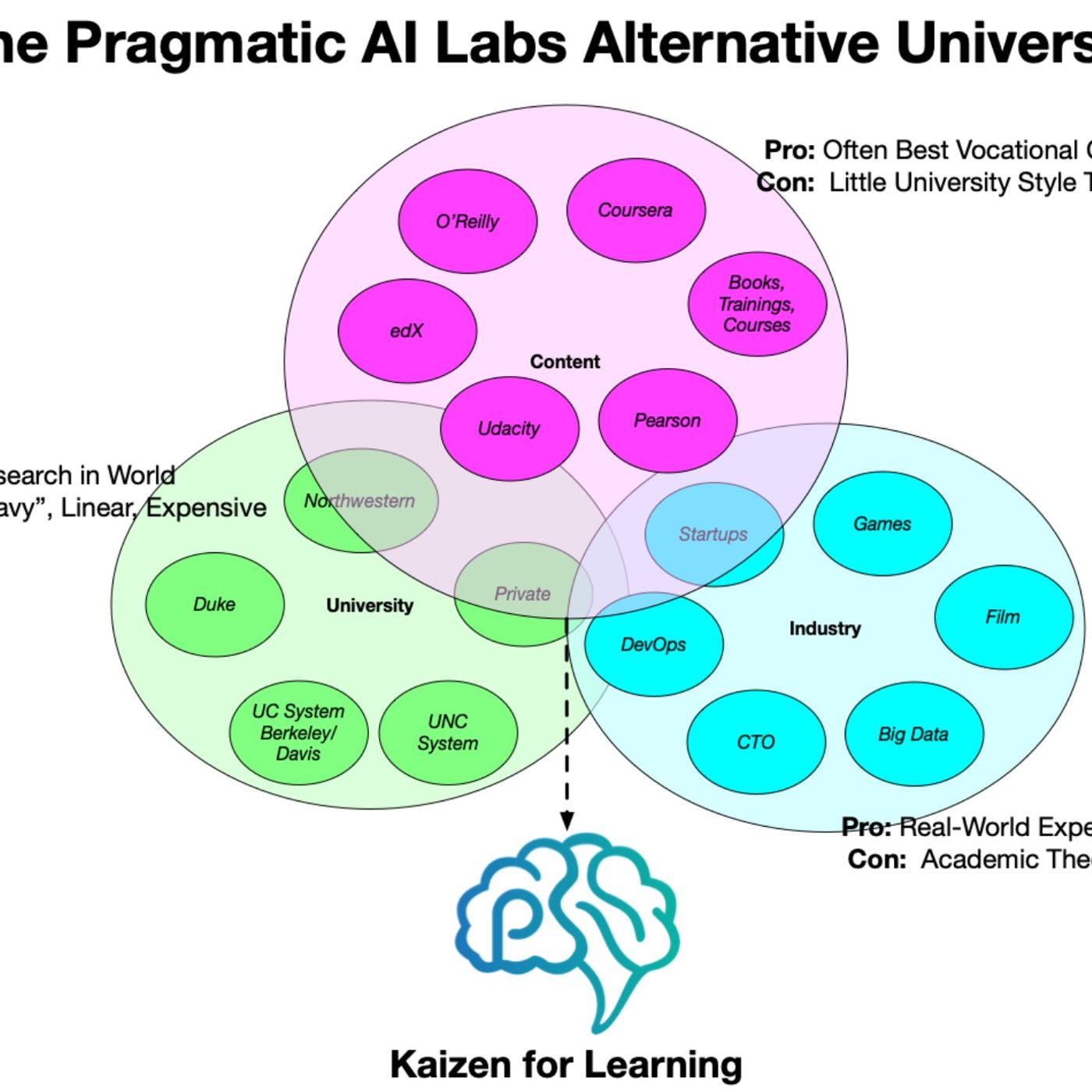
Noah Gift, founder of Pragmatic AI Labs, shares his personal journey from working in TV/film to building an alternative university that combines the best of academia, content creation, and industry experience to provide…
Title: Cloud Computing Fundamentals: Models, Services, and AWS Overview [not-audio_url] [/not-audio_url]

Duration: 25:30
🔥 Hot Course Offers:🤖 Master GenAI Engineering - Build Production AI Systems🦀 Learn Professional Rust - Industry-Grade Development📊 AWS AI & Analytics - Scale Your ML in Cloud⚡ Production GenAI on AWS - Deploy at Enterpr…
AWS Billing and Support: Managing Costs and Leveraging Expertise [not-audio_url] [/not-audio_url]

Duration: 7:16
edX ✨I build courses: https://insight.paiml.com/d69 📚edX Professional Certificate in Rust Programming: https://insight.paiml.com/tkg📚edX Rust Data Engineering: https://insight.paiml.com/fhd 📚edX Professional Certificate…
AWS Cloud Security: Shared Responsibility and Best Practices [not-audio_url] [/not-audio_url]

Duration: 24:57
edX ✨I build courses: https://insight.paiml.com/d69 📚edX Professional Certificate in Rust Programming: https://insight.paiml.com/tkg📚edX Rust Data Engineering: https://insight.paiml.com/fhd 📚edX Professional Certificate…
AWS Elastic Services: Scaling and Load Balancing in the Cloud [not-audio_url] [/not-audio_url]

Duration: 12:49
edX ✨I build courses: https://insight.paiml.com/d69 📚edX Professional Certificate in Rust Programming: https://insight.paiml.com/tkg📚edX Rust Data Engineering: https://insight.paiml.com/fhd 📚edX Professional Certificate…
AWS Database Services: Managed Solutions for Diverse Needs [not-audio_url] [/not-audio_url]

Duration: 14:18
edX ✨I build courses: https://insight.paiml.com/d69 📚edX Professional Certificate in Rust Programming: https://insight.paiml.com/tkg📚edX Rust Data Engineering: https://insight.paiml.com/fhd 📚edX Professional Certificate…
AWS Virtual Private Cloud (VPC) and CloudFront [not-audio_url] [/not-audio_url]

Duration: 10:17
AWS Virtual Private Cloud (VPC) enables the creation of logically isolated virtual networks on the AWS Cloud, offering security, flexibility, and integration with various AWS services. CloudFront, a global content delive…
AWS Storage Services: EBS, S3, EFS, and Glacier [not-audio_url] [/not-audio_url]

Duration: 23:12
edX ✨I build courses: https://insight.paiml.com/d69 📚edX Professional Certificate in Rust Programming: https://insight.paiml.com/tkg📚edX Rust Data Engineering: https://insight.paiml.com/fhd 📚edX Professional Certificate…