Pattern Matching Systems like AI Coding: Powerful But Dumb

Pattern Matching Systems like AI Coding: Powerful But Dumb

Author: Noah Gift March 13, 2025 Duration: 7:01

Pattern Matching Systems: Powerful But Dumb

Core Concept: Pattern Recognition Without Understanding

  • Mathematical foundation: All systems operate through vector space mathematics

    • K-means clustering, vector databases, and AI coding tools share identical operational principles
    • Function by measuring distances between points in multi-dimensional space
    • No semantic understanding of identified patterns
  • Demystification framework: Understanding the mathematical simplicity reveals limitations

    • Elementary vector mathematics underlies seemingly complex "AI" systems
    • Pattern matching ≠ intelligence or comprehension
    • Distance calculations between vectors form the fundamental operation

Three Cousins of Pattern Matching

  • K-means clustering

    • Groups data points based on proximity in vector space
    • Example: Clusters students by height/weight/age parameters
    • Creates Voronoi partitions around centroids
  • Vector databases

    • Organizes and retrieves items based on similarity metrics
    • Optimizes for fast nearest-neighbor discovery
    • Fundamentally performs the same distance calculations as K-means
  • AI coding assistants

    • Suggests code based on statistical pattern similarity
    • Predicts token sequences that match historical patterns
    • No conceptual understanding of program semantics or execution

The Human Expert Requirement

  • The labeling problem

    • Computers identify patterns but cannot name or interpret them
    • Domain experts must contextualize clusters (e.g., "these are athletes")
    • Validation requires human judgment and domain knowledge
  • Recognition vs. understanding distinction

    • Systems can group similar items without comprehending similarity basis
    • Example: Color-based grouping (red/blue) vs. functional grouping (emergency vehicles)
    • Pattern without interpretation is just mathematics, not intelligence

The Automation Paradox

  • Critical contradiction in automation claims

    • If systems are truly intelligent, why can't they:
      • Automatically determine the optimal number of clusters?
      • Self-label the identified groups?
      • Validate their own code correctness?
    • Corporate behavior contradicts automation narratives (hiring developers)
  • Validation gap in practice

    • Generated code appears correct but lacks correctness guarantees
    • Similar to memorization without comprehension
    • Example: Infrastructure-as-code generation requires human validation

The Human-Machine Partnership Reality

  • Complementary capabilities

    • Machines: Fast pattern discovery across massive datasets
    • Humans: Meaning, context, validation, and interpretation
    • Optimization of respective strengths rather than replacement
  • Future direction: Augmentation, not automation

    • Systems should help humans interpret patterns
    • True value emerges from human-machine collaboration
    • Pattern recognition tools as accelerators for human judgment

Technical Insight: Simplicity Behind Complexity

  • Implementation perspective

    • K-means clustering can be implemented from scratch in an hour
    • Understanding the core mathematics demystifies "AI" claims
    • Pattern matching in multi-dimensional space ≠ artificial general intelligence
  • Practical applications

    • Finding clusters in millions of data points (machine strength)
    • Interpreting what those clusters mean (human strength)
    • Combining strengths for optimal outcomes

This episode deconstructs the mathematical foundations of modern pattern matching systems to explain their capabilities and limitations, emphasizing that despite their power, they fundamentally lack understanding and require human expertise to derive meaningful value.

🔥 Hot Course Offers:

🚀 Level Up Your Career:

Learn end-to-end ML engineering from industry veterans at PAIML.COM


Noah Gift guides you through a year-long journey with 52 Weeks of Cloud, a weekly exploration designed for anyone building, managing, or simply curious about modern cloud infrastructure. Each episode digs into a specific technical topic, moving beyond surface-level explanations to offer practical insights you can apply. You’ll hear detailed discussions on the platforms that power the industry-like AWS, Azure, and Google Cloud-and how to navigate multi-cloud strategies effectively. The conversation regularly delves into the orchestration of these systems with Kubernetes and the specialized world of machine learning operations, or MLOps, including the integration and implications of large language models. This isn't just theory; it's a focused look at the tools and methodologies shaping how software is deployed and scaled today. By committing to this podcast, you're essentially getting a structured, expert-led curriculum that breaks down complex subjects into manageable weekly segments, all aimed at building a comprehensive and practical understanding of the cloud ecosystem.
Author: Language: English Episodes: 225

52 Weeks of Cloud
Podcast Episodes
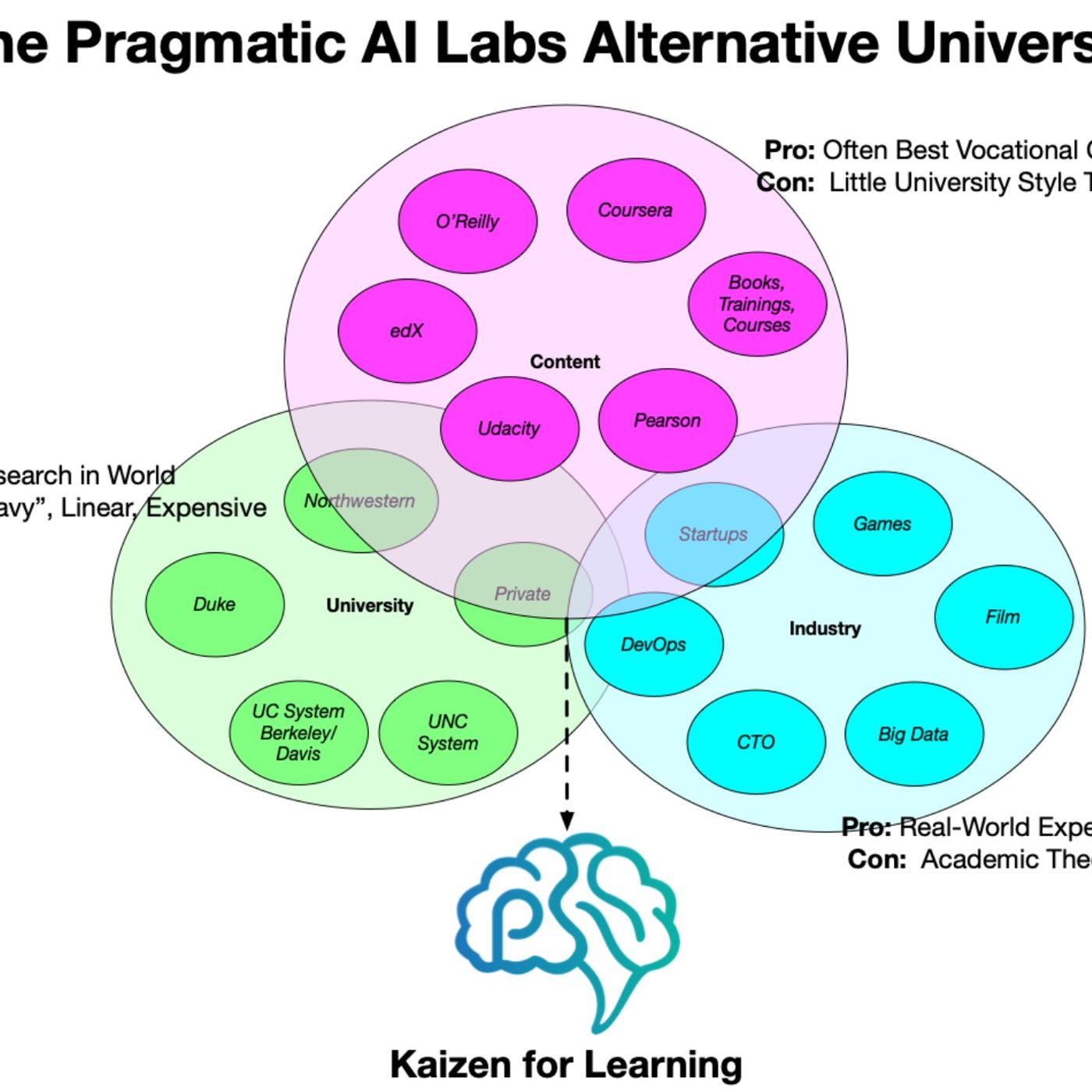
The Pragmatic AI Labs Alternative University [not-audio_url] [/not-audio_url]

Duration: 14:04
Noah Gift, founder of Pragmatic AI Labs, shares his personal journey from working in TV/film to building an alternative university that combines the best of academia, content creation, and industry experience to provide…
Title: Cloud Computing Fundamentals: Models, Services, and AWS Overview [not-audio_url] [/not-audio_url]

Duration: 25:30
🔥 Hot Course Offers:🤖 Master GenAI Engineering - Build Production AI Systems🦀 Learn Professional Rust - Industry-Grade Development📊 AWS AI & Analytics - Scale Your ML in Cloud⚡ Production GenAI on AWS - Deploy at Enterpr…
AWS Billing and Support: Managing Costs and Leveraging Expertise [not-audio_url] [/not-audio_url]

Duration: 7:16
edX ✨I build courses: https://insight.paiml.com/d69 📚edX Professional Certificate in Rust Programming: https://insight.paiml.com/tkg📚edX Rust Data Engineering: https://insight.paiml.com/fhd 📚edX Professional Certificate…
AWS Cloud Security: Shared Responsibility and Best Practices [not-audio_url] [/not-audio_url]

Duration: 24:57
edX ✨I build courses: https://insight.paiml.com/d69 📚edX Professional Certificate in Rust Programming: https://insight.paiml.com/tkg📚edX Rust Data Engineering: https://insight.paiml.com/fhd 📚edX Professional Certificate…
AWS Elastic Services: Scaling and Load Balancing in the Cloud [not-audio_url] [/not-audio_url]

Duration: 12:49
edX ✨I build courses: https://insight.paiml.com/d69 📚edX Professional Certificate in Rust Programming: https://insight.paiml.com/tkg📚edX Rust Data Engineering: https://insight.paiml.com/fhd 📚edX Professional Certificate…
AWS Database Services: Managed Solutions for Diverse Needs [not-audio_url] [/not-audio_url]

Duration: 14:18
edX ✨I build courses: https://insight.paiml.com/d69 📚edX Professional Certificate in Rust Programming: https://insight.paiml.com/tkg📚edX Rust Data Engineering: https://insight.paiml.com/fhd 📚edX Professional Certificate…
AWS Virtual Private Cloud (VPC) and CloudFront [not-audio_url] [/not-audio_url]

Duration: 10:17
AWS Virtual Private Cloud (VPC) enables the creation of logically isolated virtual networks on the AWS Cloud, offering security, flexibility, and integration with various AWS services. CloudFront, a global content delive…
AWS Storage Services: EBS, S3, EFS, and Glacier [not-audio_url] [/not-audio_url]

Duration: 23:12
edX ✨I build courses: https://insight.paiml.com/d69 📚edX Professional Certificate in Rust Programming: https://insight.paiml.com/tkg📚edX Rust Data Engineering: https://insight.paiml.com/fhd 📚edX Professional Certificate…