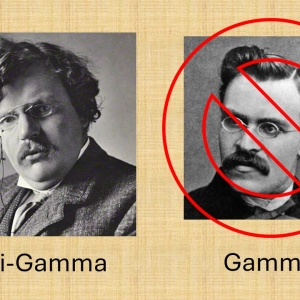
Welcome back to another episode of the regular A Ghost in the Machine Podcast. As many of you already know, I’ve started doing a separate podcast series called “Paging the Everlasting Man,” in which I read chapters of G. K. Chesterton books, starting with Heretics, and give some commentary after each reading. If you like Chesterton, check it out.
While not reading Chesterton, I have I recently read (or rather, listened to the audio books of) a couple of vampire novels: The Delicate Dependency, by Michael Talbot (who also wrote The Holographic Universe), and Dracula by Bram Stoker. I figured Talbot would infuse the story with esoteric symbolism, and he delivered on that expectation in some interesting ways. For better or worse, it is a thoroughly Gnostic-ish novel, but while I am sympathetic to some aspects of the Gnostic perspective, I have noticed that Gnosticism has a dark side: it has a disturbingly high correlation with LGBT-adjacent perversions and inversions. (Speaking of, I guess it’s Pride-Goeth-Before-the-Fall-Month now.) Case in point, the Wachowski sisters, formerly known as the Wachowski brothers, directors of that most explicitly Gnostic-themed movie of them all, The Matrix. While I think you can certainly adopt a Gnostic perspective without becoming a tranny or a fruitcake, the correlation is nonetheless there. And although there is nothing explicitly gay about The Delicate Dependency, there are definitely gay-ish overtones, with male vampires being depicted as youthful in appearance, physically attractive, and androgynous — something that appears to have become the norm in contemporary vampire literature (because what could possibly be more romantically appealing than a parasitic entity that drinks blood and avoids sunlight?). There’s a spirit behind the LGBT movement and lifestyle that represents an inversion of Human Nature, that takes what is bad and false and ugly and tries to pass it off as good and true and beautiful. Talbot was openly gay. He wrote thoughtfully and artfully, but there’s a bit of that unnatural spirit that permeates The Delicate Dependency.
So I reread Dracula. I know people have argued for an interpretation of Dracula as an allegory for Bram Stoker’s supposed struggle with his identity as a deeply closeted gay man. (Sure Stoker was married, but he managed a theater, which is basically the same thing as sodomy; plus, if you want to get published in literary journals and get tenure and all that, you can’t go wrong by reinterpreting nineteenth-century novels like Dracula through the postmodern lens of “queerness.”) Be that as it may, Dracula was refreshingly clear and orthodox in its morality. That’s not to say that the vampires aren’t compelling and well-developed characters in the novel, just that they’re not meant to deceive us into calling good “evil” or evil “good.” They may strike their victims as enticing, but it is a sinister kind of allure that is unmistakably evil and will lead to ruin.
To clarify what I mean, consider narcotics instead of vampirism. The contemporary treatment of vampires as elegant and attractive is like making a movie of a 70s rock band on tour, partying, snorting, and shooting up, and making it all look so glamorous and carefree, but never really showing what that kind of lifestyle can (and often does) lead to. Dracula, on the other hand, is like showing an addict’s life spiraling out of control; maybe there are moments where the rock-and-roll party lifestyle seems alluring, but we see the devastating ruin that awaits people who venture too close to the edge.
Anyway, as I thought about the evolution of vampire literature from Dracula (1897) to The Delicate Dependency (1982) and beyond (it appears to have gotten more inverted since then), I was struck by the way in which the trend in vampire literature maps onto the trend towards moral inversion in the culture more broadly.
With all that being said, I still would recommend reading both The Delicate Dependency and Dracula. Each novel is engaging and thought-provoking on its own, but they are really profound when taken together.
A Ghost in the Machine is a reader and listener supported publication. To receive new posts and support my work, consider becoming a free or paid subscriber.
This is a public episode. If you'd like to discuss this with other subscribers or get access to bonus episodes, visit
aghostinthemachine.substack.com/subscribe