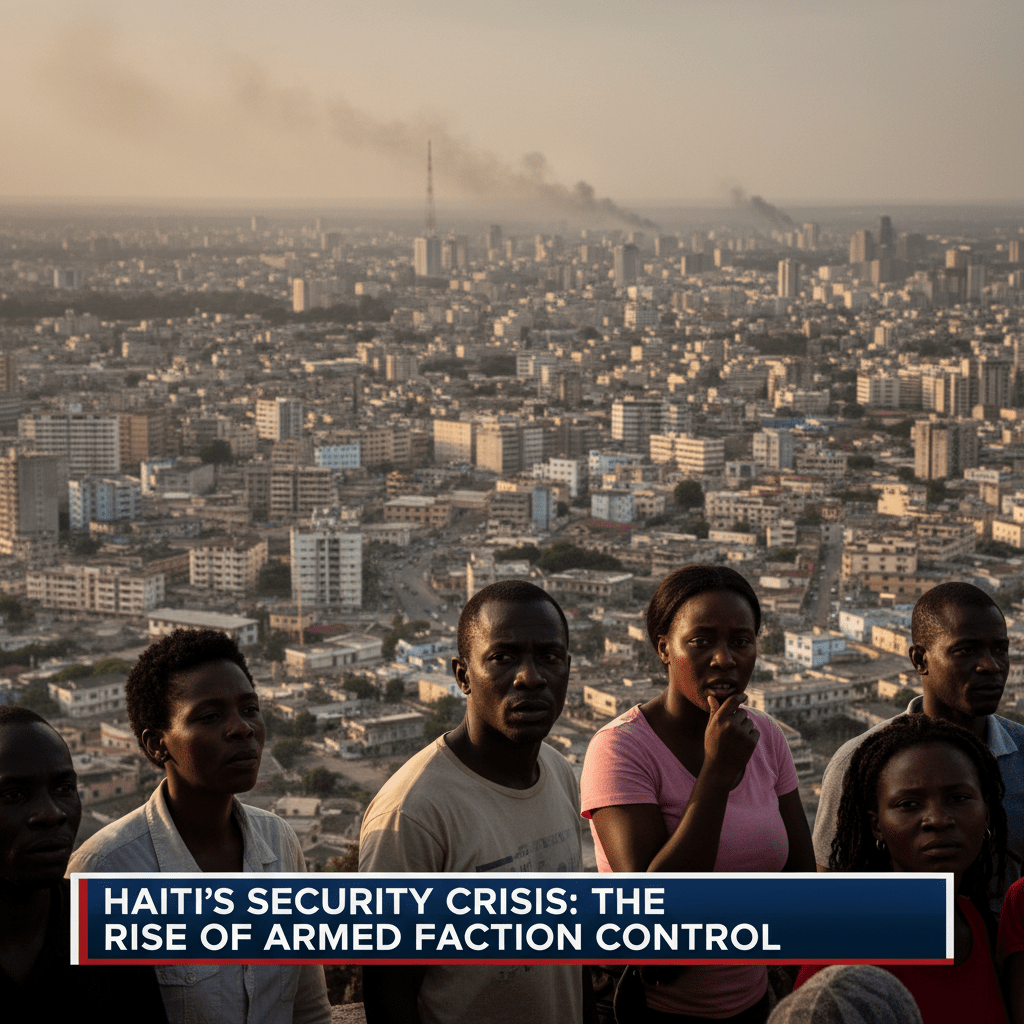
Haiti’s Security Crisis: The Rise of Armed Faction Control
Author: African Elements
May 13, 2026
Duration: 13:41
Deep dive into Haiti's Security Crisis: Major developments in Haiti show that despite international intervention efforts, local community groups are reporting a spike in territorial control by armed factions, leading to a total breakdown of essential services in several Port-au-Prince neighborhoods..
Haiti's Security Crisis: The Rise of Armed Faction Control
By Darius Spearman (africanelements)
Support African Elements at patreon.com/africanelements and hear recent news in a single playlist. Additionally, you can gain early access to ad-free video content.
Understanding the Modern Security Crisis in Haiti
In 2026, the nation faces a severe and historic turning point. Armed factions now control nearly ninety percent of Port-au-Prince. This level of territorial control causes a total breakdown of essential services. Over 1.4 million people have fled their homes in terror. The capital city remains in a complete state of chaos.
Two major gang coalitions formed a dangerous alliance in 2024. They called this group Viv Ansanm, meaning "Living Together." This alliance shifted from neighborhood turf wars to an organized insurgency. The group seized international airports and major maritime ports. They also attacked the national penitentiary and released thousands of inmates. They established a shadow government that currently collects taxes. The alliance now controls the distribution of food and medicine (spheresofinfluence.ca, aljazeera.com).
The situation demands immediate global attention and deep historical understanding. The mainstream headlines rarely explain the origins of this massive conflict. People must look beyond the simple labels of modern gang warfare. They need to understand the complex historical timeline driving the violence. This deep understanding provides the only path toward meaningful solutions (marxist.com, debatmagazine.nl).
Port-au-Prince Territorial Control by Armed Factions
2023 Control Levels
60%
2026 Control Levels
90%
The Elite Roots of Private Armed Factions
The current crisis certainly did not emerge from nowhere. It stems from a long history of deep political corruption. For decades, the wealthy elite used private militias to maintain power. This small ruling class historically controlled most of the national wealth. They often marginalized the darker-skinned Black peasant majority. The elite maintained a stranglehold on essential goods for generations (aaihs.org, reliefweb.int).
Dictator François Duvalier created a notorious paramilitary force in 1959. People widely called them the Tonton Macoutes. This group killed tens of thousands of citizens with absolute impunity. Later leaders adopted very similar violent tactics. They funded neighborhood groups known as chimères to suppress political opposition. Eventually, these armed factions completely outgrew the politicians who created them (wikipedia.org, wikipedia.org).
The destructive relationship between politicians and gangs continued into modern times. Former President Jovenel Moïse faced a severe political legitimacy crisis. His administration actively encouraged local gangs to federate into one group. They wanted to streamline negotiations and violently suppress anti-corruption protests. This terrible decision eventually led to the current catastrophic security collapse (greydynamics.com, greydynamics.com).
The Heavy Burden of the Independence Debt
To understand the lack of state infrastructure, one must look backward. The nation secured freedom through the Haitian Revolution. However, this massive victory came with a crushing financial penalty. France demanded a massive indemnity payment in 1825. They forced the formerly enslaved to pay for their own freedom. The demand equaled one hundred and fifty million gold francs (ucpress.edu, elpais.com).
This enormous financial demand completely drained the national treasury. The country spent over a century repaying French and American banks. The debt severely hindered any functional s