
15. Money and the Balance of Payments

15. Money and the Balance of Payments

Author: Murray N. Rothbard February 20, 2010 Duration: 0:00
Presented by Rothbard at New York Polytechnic University in 1972.

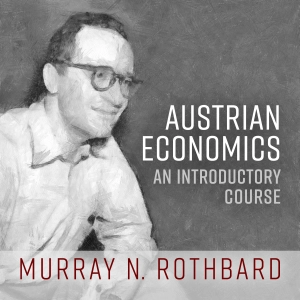
Imagine stepping into a university lecture hall over fifty years ago, the air thick with ideas challenging the economic mainstream. That's the experience preserved in Austrian Economics: An Introductory Course, a direct recording of Murray N. Rothbard's seminal 1972 lectures at New York Polytechnic University. Here, Rothbard's distinctive voice guides you through the foundational principles of the Austrian School, from subjective value and marginal utility to the critical analysis of business cycles and government intervention. This isn't a modern studio production with slick editing; it's the raw, intellectual journey as it happened, capturing the clarity and fervor of Rothbard's teaching. Each session builds a coherent framework for understanding human action in the marketplace, emphasizing individual choice and the unintended consequences of political control over the economy. Listening to this archival podcast feels like accessing a master class from one of the tradition's most provocative thinkers, offering timeless insights into economic phenomena that remain fiercely relevant today. The series stands as a vital primary source, allowing a new generation to engage with these arguments in the lecturer's own words.
Author: Language: en-us Episodes: 16

Austrian Economics: An Introductory Course
Podcast Episodes
5. The Profit Motive [not-audio_url] [/not-audio_url]

Duration: 0:00
Presented by Rothbard at New York Polytechnic University in 1972.
4. Price Controls [not-audio_url] [/not-audio_url]

Duration: 0:00
Price controls — triangular interventions — occur when an intervener (generally government) either compels a pair of people to make an exchange or prohibits them from making an exchange.
3. Advertising [not-audio_url] [/not-audio_url]

Duration: 0:00
Advertising has always had bad press with economists, but consumers discover that a product either works and works well, or it doesn't. Consumer wants are not artificially created by business itself.
2. Supply and Demand [not-audio_url] [/not-audio_url]

Duration: 0:00
In this lecture in 1972, supply and demand concepts included: preferences of consumers, prices, quantity, quality, elasticity, equilibrium, marginal utility, present goods, and production processes.
1. Choice, Utility, and Demand [not-audio_url] [/not-audio_url]

Duration: 0:00
Economics begins with the concepts of scarcity and choice. If there was no scarcity it would all be free. Resources like time and materials need to be allocated to economically feasible uses. This will depend on the cons…
