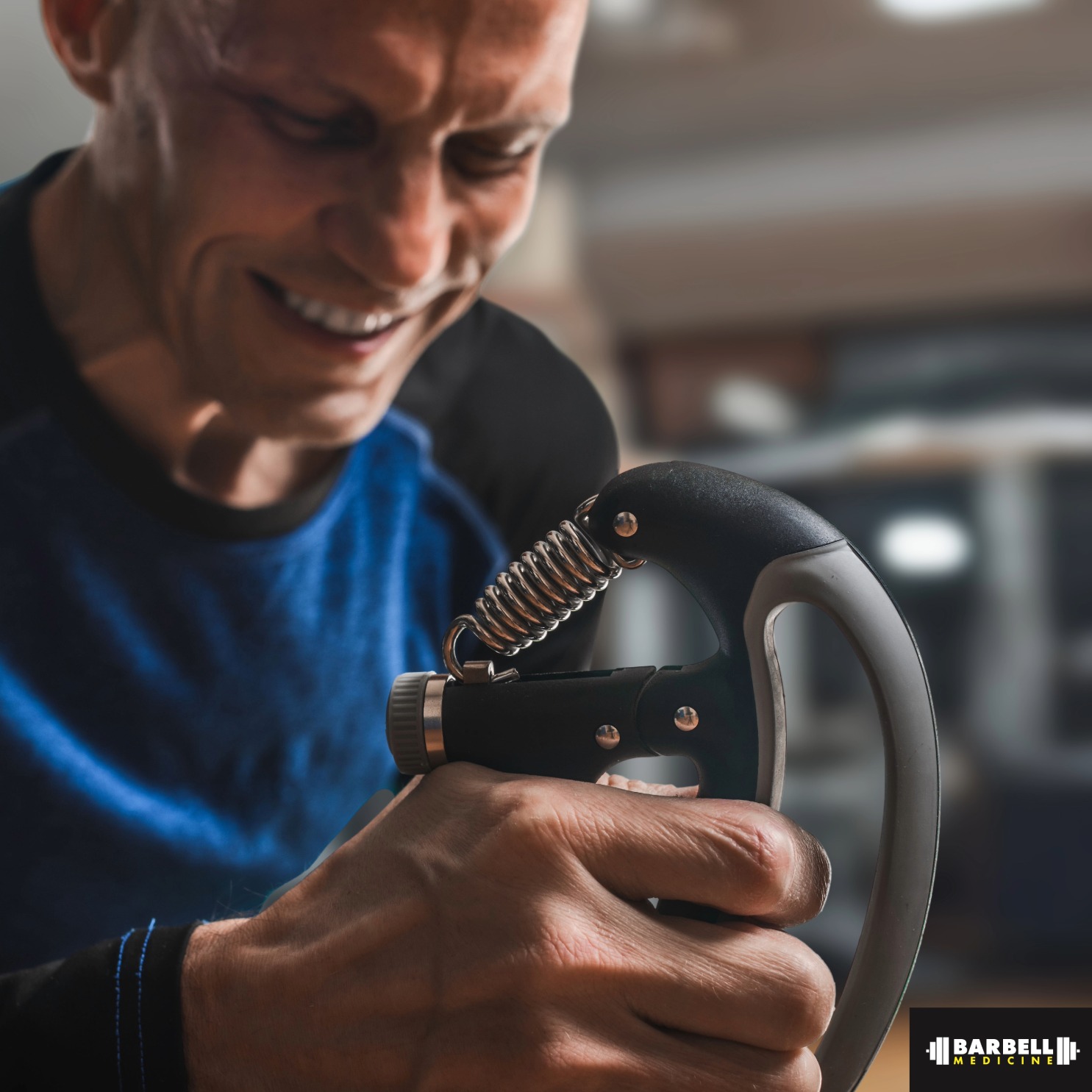
Episode #385- Why Grip Strength Predicts Death (And Why You Shouldn't Train It)

Episode #385- Why Grip Strength Predicts Death (And Why You Shouldn't Train It)

Author: Barbell Medicine January 30, 2026 Duration: 53:17

Can a simple one-second squeeze predict your risk of cardiovascular disease, cognitive decline, and all-cause mortality? Dr. Jordan Feigenbaum and Dr. Austin Baraki explore why grip strength has become the go-to metric for the longevity industry and why most people are interpreting the data incorrectly.

Timestamps:

  • [00:00] Intro: The Longevity Industry’s Thermometer Error
  • [01:42] The Neuro-Axis: Anatomy of a Maximal Squeeze
  • [06:43] The 35-3-5 Rule: Biomechanics of Grip
  • [09:12] Asymmetries and Clinical Red Flags
  • [17:31] Dynapenia vs. Sarcopenia: Why the Hand Fails First
  • [18:41] Normative Data and the PURE Study Statistics
  • [27:16] Genetics, Lean Body Mass, and Predictive Power
  • [31:44] Absolute vs. Relative Grip Strength (The Metabolic Signal)
  • [37:03] Bro-Science Beatdown: Neural Jitter and Training Readiness
  • [42:19] The Extensor Training and "Grip Maxing" Myth
  • [45:13] Programming: Systemic Training vs. Indirect Grip Work
  • [48:10] The Straps Debate: Are You Killing Your Gains?
  • [52:03] Final Verdict: Hierarchy and Health Priorities


Key Takeaways:

  • Grip is Systemic: Handgrip strength tests the integrity of the entire system, from the motor cortex in the brain down to the tendons and bones. It is a proxy for overall muscular quality and neurological health.
  • Predictive Power: According to the PURE study, for every 5 kg decrease in grip strength, there is a 17% increased risk of cardiovascular death and a 7% increased risk of non-cardiovascular death.
  • The Sarcopenia Floor: Clinical "red zones" for probable sarcopenia are <27 kg for men and <16 kg for women.
  • Relative Strength Matters: Relative grip strength (Grip Strength ÷ BMI) is a more accurate predictor of hypertension, diabetes, and dyslipidemia than absolute grip strength alone.
  • Don't Chase the Test: Direct grip training (crushers, etc.) obscures the predictive power of the test. To improve health, focus on indirect systemic resistance training (training the whole body) rather than "gaming" the thermometer.


Next Steps

For evidence-based resistance training programs: barbellmedicine.com/training-programs

For individualized medical and training consultation: barbellmedicine.com/coaching

Explore our full library of articles on health and performance: barbellmedicine.com/resources

To join Barbell Medicine Plus and get ad-free listening, product discounts, exclusive content, and more: https://barbellmedicine.supercast.com/


RESOURCES:


Our Sponsors:
* Check out FIGS and use my code FIGSRX for a great deal: https://wearfigs.com
* Check out Factor: http://factormeals.com/bbm50off
* Check out Quince: https://quince.com/bbm


Advertising Inquiries: https://redcircle.com/brands

Privacy & Opt-Out: https://redcircle.com/privacy

Hosted by the team at Barbell Medicine, the Barbell Medicine Podcast delves into the complex intersection of health, fitness, and medical science. Rather than offering quick fixes, the discussions here are grounded in evidence-based practice, exploring how training, nutrition, and lifestyle intersect with long-term well-being. You’ll hear nuanced conversations that challenge common fitness myths and provide practical insights applicable to both everyday lifters and clinical populations. Episodes often feature deep dives into rehabilitation, strength programming, pain science, and metabolic health, all delivered with a focus on applying robust scientific principles to real-world scenarios. This podcast serves as a valuable resource for anyone looking to move beyond oversimplified advice and understand the “why” behind effective training and sustainable health practices. Tune in for thoughtful analysis and accessible explanations that make the latest research relevant to your own goals.
Author: Language: English Episodes: 100

Barbell Medicine Podcast
Podcast Episodes
Episode #331: Severe Hip Pain After Exercise [not-audio_url] [/not-audio_url]

Duration: 31:18
In this podcast, Drs. Baraki and Feigenbaum review a mystery case where the patient presented with 3 days of progressively worsening left hip pain. He had a similar episode about a year ago that required surgery. Dr. Bar…
Episode #330: How-To Train While Losing Weight [not-audio_url] [/not-audio_url]

Duration: 1:15:00
In this podcast, Drs. Baraki and Feigenbaum discuss training during weight loss. While increased exercise can support health, dietary restriction is the primary method for weight loss. They note that strength, muscle mas…
Episode #329: Severe Bilateral Knee Pain After Squatting 600 pounds [not-audio_url] [/not-audio_url]

Duration: 1:10:33
In this podcast, Drs. Miles and Feigenbaum review a mystery case where thee patient presented with severe bilateral leg pain after attempting a 620 lb squat. We discuss anabolic steroid use, knee pathology, rehab strateg…
Episode #328: December 2024 Research Review [not-audio_url] [/not-audio_url]

Duration: 41:30
In this podcast, Drs. Baraki and Feigenbaum review a misleading social media post from Comp Train regarding VO2 max, a new study on using heart rate variability (HRV) to guide resistance training programming in older wom…
Episode #327: Untamed Strength Update ft. Alan Thrall [not-audio_url] [/not-audio_url]

Duration: 1:07:13
Alan Thrall joins Dr. Jordan Feigenbaum on this episode of the Barbell Medicine podcast. Alan, a gym owner and strongman competitor, shares his life update, including his children's activities and gym involvement. They d…
Episode #326: Doctors vs. The Internet (Bonus Episode) [not-audio_url] [/not-audio_url]

Duration: 31:46
Dr. Jordan Feigenbaum and Dr. Austin Baraki discuss the challenges and benefits of unilateral exercises like Bulgarian split squats, refute Dr. Gabriel Lyon's claim that obesity is due to insufficient muscle mass, and mo…
#325: Highly Effective Training With Limited Time [not-audio_url] [/not-audio_url]

Duration: 1:26:11
The podcast discusses what happens when people stop exercising, how much exercise is necessary, and how to program exercise with limited time.Recommendations for training on limited time: Resistance training: 3-5 sets pe…
Episode #324: Out of Breath on the Treadmill (Mystery Case) [not-audio_url] [/not-audio_url]

Duration: 50:47
In this episode, Drs. Feigenbaum and Baraki discuss a complex case of a 60-year-old female with a history of type 2 diabetes, hypertension, high cholesterol, and pulmonary sarcoidosis presenting with exertional shortness…
Episode #323: Joint Pain (Osteoarthritis) Teaching Rounds [not-audio_url] [/not-audio_url]

Duration: 57:36
Dr. Jordan Feigenbaum and Dr. Baraki discuss osteoarthritis (OA), emphasizing its complexity and the importance of a holistic approach. OA affects joints, causing pain, stiffness, and reduced function, with knees being t…
Episode #322: November 2024 Research Review [not-audio_url] [/not-audio_url]

Duration: 1:05:31
In the November 2024 research review, Drs. Jordan Feigenbaum and Austin Baraki discuss the effects of de-training periods in resistance training and the potential benefits of carbon monoxide supplementation for enhancing…
