Ok - for the last and final time: Patents are good. And Patents are bad. A 3D printer project to prove it. (gpn24)

Ok - for the last and final time: Patents are good. And Patents are bad. A 3D printer project to prove it. (gpn24)

Author: CCC media team June 5, 2026 Duration: 49:14
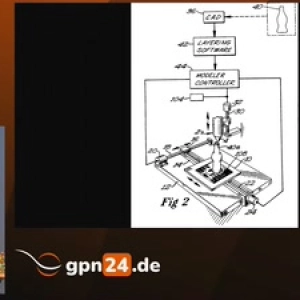
One last time: Patents are good. And Patents are bad. And using the example of an ancient commercial 3D printer, we can finally prove it. After getting hold of a defective 15 year old 3D printer, manufactured by the inventor of filament based 3D printing, we knew right away that we were not going to bring it back to its original working state. The reason is simple: the control board made sure that the printer would only accept filament from the manufacturer. A little chip inside the cartridges in which the filament can be obtained, made sure you would not by accident fill the cartridge with an unworthy material that might end you up in a bad printing experience. The only worthy filament is priced at around 10 times the price of regular (so called!) premium filament on the market. Which again was the only reason the manufacturer was able to sell the very solid machine at a laughable 40.000 € back in 2009. So, we decided to replace all of the electronics. And the print head. And while we were at it, the print bed had to go too. And the bed leveling sensor. We ended up with a printer that has current 3D printing features like: Klipper firmware, BL Touch, a heated print bed, an integrated OBC and an 8" touch display. But why was this possible at all (and how can we get back on topic from this point of the story)? Well - easy! Being the inventor of the technology the manufacturer had their inventions patented. Which does not only result in the - obvious - protection of their IP but also means that there is plenty of detailed documentation available that allowed someone some 20 years later to start an open source project that basically gave birth to the "prime father" of all modern filament based 3D printers we know today: the RepRap printer. Most of the components we used to upgrade the ancient printer only exist because they were, in the first place: patented (boo!), documented, and then rebuilt and published (yay!) as open source hardware. Therefore patents were the tool to give the inventor a chance to make money from its invention for years and thus refinancing the development of the technology. And those same patents made the open source project possible, giving all of us high-tech affordable 3D printing! The talk will mainly focus on the changes we made to the printer to bring it to current technology in terms of hardware and software. It will also discuss the role the patents play in this whole picture and draw a beautiful circle from the original printer to all of the printers we know today. If all goes well we might even bring the printer to the GPN. The distance won't be the problem - it's more the weight which is around 128 kg... Licensed to the public under https://creativecommons.org/licenses/by/4.0/ about this event: https://cfp.gulas.ch/gpn24/talk/XSQCPR/
Tune into the Chaos Computer Club-recent events feed for a direct line to the forefront of digital culture and critical technology discourse. Curated by the CCC media team, this podcast channels the raw, insightful atmosphere of Europe's most influential hacker association, bringing you recordings from their major gatherings and community events. Each episode is a deep dive into talks and presentations from the last two years, covering topics from cryptography and privacy rights to hardware hacking, societal impacts of surveillance, and open-source philosophy. You'll hear from researchers, activists, and engineers who are actively shaping our digital future, offering perspectives rarely found in mainstream tech conversations. This isn't a produced show with hosts; it's an archival audio stream of genuine conference sessions, complete with audience questions and the spontaneous energy of the live event. For anyone interested in the technical details and ethical debates at the heart of modern technology, this feed serves as an essential, unfiltered resource. Subscribe to this podcast to keep your finger on the pulse of the Chaos Computer Club's ongoing dialogue, where complex ideas are broken down and the tools for a more empowered digital life are openly discussed.
Author: Episodes: 100

Chaos Computer Club - recent events feed
Podcast Episodes
Infrastructure Review & Closing (gpn24) [not-audio_url] [/not-audio_url]

Duration: 1:16:35
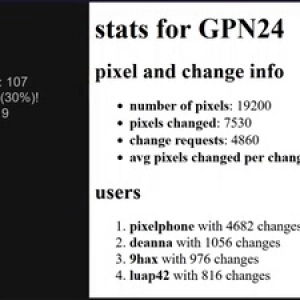
Große Zahlen und ganz viel WOW Licensed to the public under https://creativecommons.org/licenses/by/4.0/ about this event: https://cfp.gulas.ch/gpn24/talk/MTP7YB/
WAF: Wrong Approach Firewall (gpn24) [not-audio_url] [/not-audio_url]

Duration: 1:01:42
Web Application Firewalls (WAFs) for filtering based on HTTP and payload are omnipresent. In this talk an argument will be made that, in many cases, the wrong approach for implementing WAFs is chosen: They are implemente…
Building video games with 20 year old tech (gpn24) [not-audio_url] [/not-audio_url]

Duration: 19:10
The market is full of high-performance graphics APIs like Vulkan and fantastic engines like Unreal and Unity. So, why not use DirectX 9 and a self-built engine instead? ;) In this talk we'll take a quick stroll down memo…
Three Languages, Triple the Confusion (gpn24) [not-audio_url] [/not-audio_url]

Duration: 20:21
This code runs without errors, but still confuses. In this talk, we explore some subtle quirks of C, Python, and Java (and others) that catch even experienced developers off guard. No bugs, no typos - just the language d…
MMO-CHIP: From Microscope to Verilog in an hour (gpn24) [not-audio_url] [/not-audio_url]

Duration: 58:45
Reverse engineering old custom chips from microscope pictures is cool, but oh so painfully slow! Last time I did this (talk at 38C3), I spent two weeks waking up, annotating wires in Inkscape, going to bed, and then drea…
DI.Days as Anarchist Practice/Anarchist Practices for DI.Days (gpn24) [not-audio_url] [/not-audio_url]

Duration: 44:54
Digital Independence Days are a response to the growing monopolization of technology and the recent loss of trust in US-based tech firms after the USA's shift towards authoritarianism. The (communicated) goal is to prote…