
219: Sorbs Not Sulfites

219: Sorbs Not Sulfites

Author: Ria Windcaller: Award-winning Cidermaker, Podcaster | Craft Beer Columnist April 15, 2020 Duration: 1:19:06

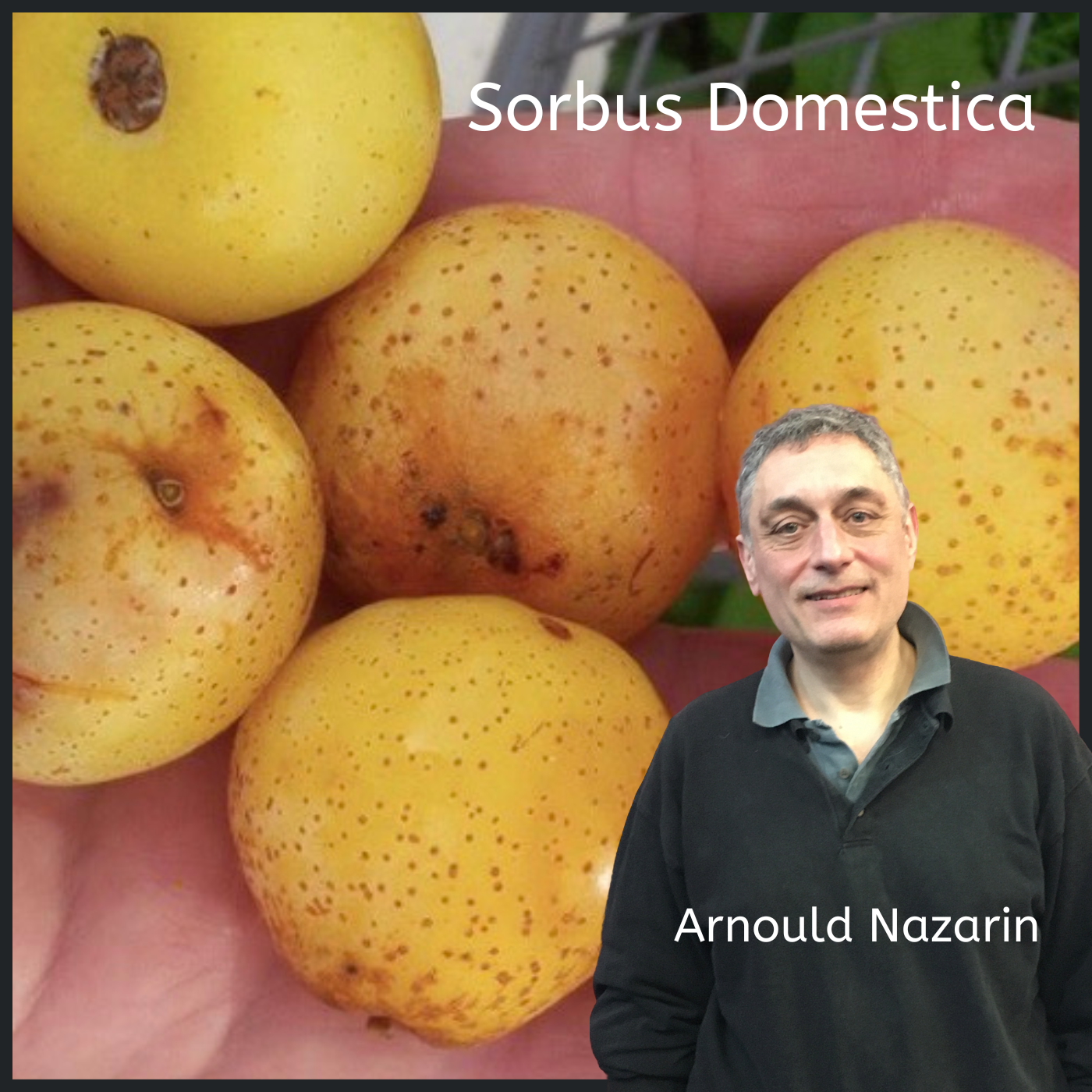
Sorbus Domestica enthusiast Arnould Narazian of Paris France, shares his knowledge and passion for this King of all Pommes. This "Service Tree's wood was used for wooden screws used in wine presses and the fruit to help cure ailing cider and wine.

This chat was recorded at Cidrexpo in February 2020 in Caen France.

The main chat begins at 9:20 minutes

Arnould Nazarian Arnould Nazarian

What are some of the cultural/traditional name for Sorbus Domestica?

  • North of France it is called "Cormé"
  • South of France it is referred to as "Sorb"
  • Service Tree
  • Spierling - German

What inspired Arnould's affection for Sorbus Domestica

A dream and a visit to a train station in the north of Paris called Gare d'Achères–Grand-Cormier based to the North west of Paris in the town of Achères

What are the special attributes of Sorbus Domestica?

  • Sorb was used for making mechanical devices such as cog wheels for mills. This was very important for milling up corn and grains for food. These mechanisms came about in the Middle Ages of the 11-12th century
  • The wood was also used for the main screw used to press both wine and olives for olive oil. And, early printing presses used Sorb wood too!

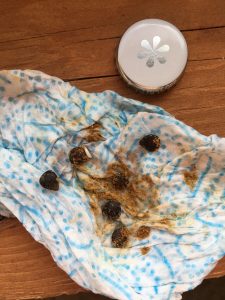
germinating Sorbus Domestica seeds

Germinating Sorbus Domestica seeds

Germinating Sorbus Domestica

For the seeds to geminate they must be eaten by a bird or rabbit first.

But Arnould has since found some other ways to germinate this King of Pommes.

  • Source seeds in October/November - they must be immediately be placed into moist sand.
  • Then placed in a refrigerator at 2degree Celsius or 35 degrees Fahrenheit.
  • Then the seeds are put outdoors in March
  • The odds of the seed germinating is 95%.

Sorbs like

  • Sandy soil
  • Sun light
  • Not a lot of water
  • And the roots can be 6-8 meters down which translate to 26 feet!

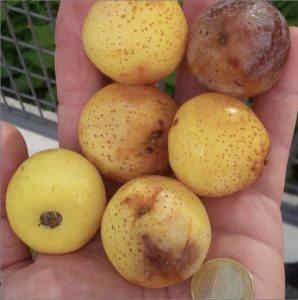
Sorb Fruit Sorb Fruit

What does the Sorb fruit look like?

The fruit of a Sorbus Domestica look like miniature apples and pears and have a range of colors from red, green, yellow and orange. The shape can be round or pear like.

Are there different varieties of Sorbus Domestica?

Arnould says yes, but those varieties are now lost.

Sorbs though large have a special attribute that enables farmers to plant these trees in crop fields

Arnould calls the leaves "Peanut Leaves" which means they are small and thus cast a very light shadow for the surrounding area

The Day of the Cormé - a celebration of Sorb held in November

Buy trees, marmalade, wood products, held in Normandy.

Contact Arnould

Mentions in this Chat

Sorbus Domestica -t shirt at Cider Chat Teepublic Store

Sorbus Domestica -t shirt
at Cider Chat Teepublic Store

Find this episode and all episodes at the page for Cider Chat's podcasts.


There’s a whole world in a glass of cider, and Cider Chat is your invitation to explore it. Hosted by award-winning cidermaker and writer Ria Windcaller, this podcast travels far beyond the bottle to meet the people who make the global cider culture so vibrant. Each conversation is a journey-you might find yourself in a heritage orchard learning the history of forgotten apple varieties, in a bustling taproom with an importer explaining regional traditions, or in a kitchen with a chef pairing cider with unexpected foods. The discussions get into the delightful nuances, too, whether that’s the semantics of what we even call this drink or how the concept of terroir translates from soil to sip. It’s not just about production; it’s about the community, the travel, and the stories that fermentation unlocks. This is for anyone curious about the craft, history, and sheer enjoyment of fermented apple juice in all its forms. So, pour a glass and settle in for a series that feels like a wide-ranging, informative, and genuinely good-humored chat with friends who happen to be obsessed with cider. You’ll come away with a deeper appreciation for every effervescent, tart, or sweet sip, hearing directly from the growers, makers, and enthusiasts who are shaping this drink’s exciting present and future.

Author: Language: English Episodes: 501

Cider Chat
Podcast Episodes
139: New Zealand's Cidermaking Calendar w/Alex Peckham [not-audio_url] [/not-audio_url]

Duration: 1:17:04
New Zealand's Peckham Cider is featured in this podcast episode #139. I was able to sit down with Alex Peckham at CiderCon2018 held in Baltimore, Maryland. CiderCon is the annual trade conference put on by the United Sta…
138: Chairman Richard Liu | Ontario Craft Cider Association [not-audio_url] [/not-audio_url]

Duration: 59:32
Richard Liu is the Chair of the Ontario Craft Cider Association and owner of Ironwood Cider and Sunnybrook Winery. This chat was recorded while I was on tour with Ryan Monkman of Fieldbird Cider (Prince Edward County) wh…
137 Ontario's County Cider Story | Jenifer Dean [not-audio_url] [/not-audio_url]

Duration: 1:14:08
County Cider based in Prince Edward County in the Canadian Province of Ontario began selling cider in 1996. It was launched by Grant Howes a formidable man considered the Grandfather of Cider in Ontario. In 2000 Jenifer…
136: Cidermaker of the Year 2018 - Tells All [not-audio_url] [/not-audio_url]

Duration: 27:29
This is a mini version of the main podcast this week - as I am super duper busy - so I call this "Cider Chat Live" which is a mini me version of the main podcast - Subscribe to Cider Chat Live too via https://anchor.fm/c…
135: Viejo High Pours in Fishtown | Philadelphia [not-audio_url] [/not-audio_url]

Duration: 25:40
Viejo is a barrel aged cider made by Joe Getz of Kurant Cider. This cider is a single varietal cider made with Winchester apples. Described on Kurants website as: "a blend of wild fermented ciders created by using some o…
134: Medlars "Pomme Rock Stars" &  Judging Cider [not-audio_url] [/not-audio_url]

Duration: 42:38
What are Medlars? Medlars are pommes. It can be either a tree or a large bush. The small brown medlars are picked in the fall. Because Medlars are eaten in the winter months they were very popular at a time when fruit wa…
133: Cider's Chemical Fingerprints [not-audio_url] [/not-audio_url]

Duration: 1:05:15
Attention Cider Makers! Understand Your Cider's Chemical Fingerprints John Edwards presented "Cider's Chemical Fingerprints" at the United States Association of Cider Makers (now referred to as the American Cider Associa…
132: Barrels & Bâtonnage [not-audio_url] [/not-audio_url]

Duration: 58:25
Bâtonnage is a winemaking technique that is also used in Cidermaking. It involves raking the lees or what is seen as the heavy particulars of yeast cells that fall out of solution and down to the bottom of the barrel dur…
131: Cider Barrels with a Cooper, a Maker & Thierry Lemaire [not-audio_url] [/not-audio_url]

Duration: 1:21:16
Cider Barrel Maintenance The craft of making an oak barrel is called "cooperage" and the person who applies this craft is called a "cooper". The skills of this trade have been passed down through the centuries. The tree…
130: Cider Voices from Grand Rapids & #2GLINTCAPorBUST [not-audio_url] [/not-audio_url]

Duration: 1:00:07
Cider Voices from Grand Rapids Cider Week and the Great Lakes International Cider and Perry Competition On the evening of May 14th Joby Willson, Mark Gryska, Charlie Olchowski and William Grote and myself headed out in a…