221: Ask Ryan | Quarantine Quad Pt1 Q&A

221: Ask Ryan | Quarantine Quad Pt1 Q&A

Author: Ria Windcaller: Award-winning Cidermaker, Podcaster | Craft Beer Columnist April 29, 2020 Duration: 40:20

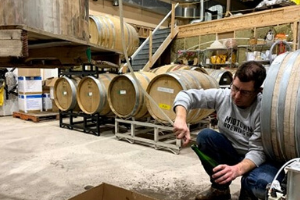
"Ask Ryan" features Ryan Monkman of FieldBird Cider, Ontario Canada answering questions from Cider Chat listeners. Ryan expertise with oak barrel ferments and oak barrels in general inspired this 4 part series. The fact that he also makes mighty fine cider and perry is also a factor.

[caption id="attachment_5059" align="aligncenter" width="300"]Ryan Monkman in the barrel room Ryan in the barrel room[/caption]
Ryan has been featured in the following Cider Chat episodes:

132: Barrels & Bâtonnage

168: Barrel Aging Cider Inspiration

218: FieldBird Cider | Canada Covid Time Update

In this segment Ryan answers the following questions from Cider Chat listener: Michael

  1. Is there a general aging graph for size and barrel Barrel Char to achieving a standard level of Tannins and oak flavor? I'm assuming that your answer will probably be no due to so many variables wood, level of char if any, temperatures, rankings etc.

Ryan discusses the difference between French Oak vs American Oak

  • French Oak barrels which provide more tannin and less aromatic vs American oak with more aromatic and flavor but less tannin
  • The way a barrel is charred
    • The more toasted - the less tannin vs less toasted more tannin

The FieldBird Cider Barrel program manages the wide range of flavor profiles in oak by having a Large Barrel program that provides a mix of barrel types.

What to look for in a barrel

  • Size - look at surface area ratios
  • How much of the cider is touching the barrel at any point.
    • The more touching the more flavor you will get from the barrel

2 standard sizes of barrels

  • Burgundian barrels - 228 liter / 60 gallons
  • Bordeaux - skinny and longer hold 225 liters - just under 60 gallons. These barrels provide more cider in contact with wood.

The higher the % of cider touching the barrel - the quicker you are going to extract.

Oak Tannin is called - sacrificial tannin and it happens to bind with proteins, whereas the tannin in Apples are much slower to react.

Recommend temperature for barrel aging?

Ryan breaks it down into 3 stages to consider.

1 Primary Fermentation

2. Secondary or Malolactic Fermentation

3. Tertiary

What to consider for each stage:

  • Depends on what stage you are at during the cidermaking process and what you are trying to say with your cider
  • Where will the barrel be stored
  • A cooler ferment: 14-16 celsius - rich flora, pretty aromatic, but won't have a lot of body
  • At 20-23 celsius - 70-75 F - more body less aromatic

Note: Yeast produces alcohol and it also produces heat. It is hard to cool down a barrel.

Ferment at a cooler temperature until fermentation is over.

MLF-   convert the acid in the apples into Lactic acid which provides a creamy bitterness - you need about 70 F. If cooler it will take a really long time. This long time leaves your cider at risk for bacteria.

3. Tertiary or aging from 3days to 3 years

Store at 65 Farhenheit is ideal, but takes a long time to extract

FieldBird uses a Submersible Aquarium heater

  • Make sure it is a fully immersible heater.
  • Have a couple different sizes.

In the next episode 222: Ask Ryan - he will answer:

2. Do you see a large difference in profiles when stacking barrels on racks of the same batch of cider due to temperature changes from say a rack of barrels 3-4 high. And Barrel cleaning

Mentions in this chat

Help Support Cider Chat Please donate today. Help keep the chat thriving!

Find this episode and all episodes at the page for Cider Chat's podcasts.

There’s a whole world in a glass of cider, and Cider Chat is your invitation to explore it. Hosted by award-winning cidermaker and writer Ria Windcaller, this podcast travels far beyond the bottle to meet the people who make the global cider culture so vibrant. Each conversation is a journey-you might find yourself in a heritage orchard learning the history of forgotten apple varieties, in a bustling taproom with an importer explaining regional traditions, or in a kitchen with a chef pairing cider with unexpected foods. The discussions get into the delightful nuances, too, whether that’s the semantics of what we even call this drink or how the concept of terroir translates from soil to sip. It’s not just about production; it’s about the community, the travel, and the stories that fermentation unlocks. This is for anyone curious about the craft, history, and sheer enjoyment of fermented apple juice in all its forms. So, pour a glass and settle in for a series that feels like a wide-ranging, informative, and genuinely good-humored chat with friends who happen to be obsessed with cider. You’ll come away with a deeper appreciation for every effervescent, tart, or sweet sip, hearing directly from the growers, makers, and enthusiasts who are shaping this drink’s exciting present and future.
Author: Language: English Episodes: 501

Cider Chat
Podcast Episodes
029: At The Hop | Oliver's Cider and Perry, UK [not-audio_url] [/not-audio_url]

Duration: 1:07:49
Tom Oliver shares his approach to hopped cider and the best of what the US and UK have to look forward to in the cider market. What he saw in US hopped ciders back in 2013 ignited his desire to try his hand at adding hop…
028: John Bunker | Apple Identification [not-audio_url] [/not-audio_url]

Duration: 42:48
When John Bunker talks or teaches Apple Identification he doesn't begin with the apple. He always goes back to the root of the tree…unless it is one of the Eric Clapton apples, i.e., you immediately recognize it as a var…
027: Aaron Anderson | Austin Eastciders, Texas [not-audio_url] [/not-audio_url]

Duration: 37:14
Austin Eastciders is helping to make Austin Texas a cider mecca in a land where the apple root faces harsh growing conditions. Aaron Anderson is the R&D Coordinator at this growing cidery. He sat down for a chat with me…
026: Neil Worley | Worleys Cider, UK [not-audio_url] [/not-audio_url]

Duration: 59:28
Keeving Made Simple, but oh so Dandy at Worleys Cider Neil Worley's makes cider in the area of Great Britain called Somerset. Climb the high hill at the farm and your can see the Bristol Channel. It is a remote location…
025: Jim Wallace | Cider Pairing with a Cheese Maker [not-audio_url] [/not-audio_url]

Duration: 58:51
Jim Wallace is a cheese maker and cheese tech a.k.a the "Cheese Guru" at New England Cheesemaking Supply in Ashfield Massachusetts. When not helping the cheese world sort through problematic cheeses, he teaches classes a…
024: Leonard Koningswijk | Bear Cider, Netherlands [not-audio_url] [/not-audio_url]

Duration: 39:29
Leonard Koningswijk owner/cidermaker of Bear Cider in the Netherlands is turning his country towards cider one palate at a time. The idea was sprouted at his family home in the rural village of Beerze on the border of Ge…
023: Alec Steinmetz | Buskey Cider, Virginia [not-audio_url] [/not-audio_url]

Duration: 50:04
Alec Steinmetz, Will Correll and Matthew Meyer are sharing their story of starting an urban cidery. This is Part 1 of what will be an ongoing story of the start-up Buskey Cider of Richmond, Virginia. The cidermaking tank…
022: Gregory Hall | Virtue Cider, Michigan [not-audio_url] [/not-audio_url]

Duration: 51:17
Getting to cider for Gregory Hall, was one part luck and a whole lot of beer. When his father John Hall founded the Chicago based Goose Island Brewery in 1988, it took only 3 years before Greg was at the helm of brewing.…
021: Bill Bradshaw | Bill Bradshaw Photography, UK [not-audio_url] [/not-audio_url]

Duration: 1:01:21
Bill Bradshaw is a photographer, an author of three cider books and consider by many to be a Cider Ambassador for UK ciders. I met with Bill at the United States Association of Cider Makers annual conference in Portland…
020: Curtis Sherrer | Millstone Cellars, Maryland [not-audio_url] [/not-audio_url]

Duration: 1:00:58
Curtis Sherrer is barreling aging single variety apples at Millstone Cellars. An old grist mill dating back to the 1850s houses the Tasting Room. "We will have 50 barrels and then settle on 15 to pick from to blend for t…