Episode 162.0 – Stevens-Johnson Syndrome/Toxic Epidermal Necrolysis

Episode 162.0 – Stevens-Johnson Syndrome/Toxic Epidermal Necrolysis

Author: Core EM May 6, 2019 Duration: 9:50

A look at this deadly mucocutaneous reaction and how to best manage these patients in the ED

Download Leave a Comment Tags: ,

Show Notes

Episode Produced by Audrey Bree Tse, MD


  • Rash with dysuria should raise concern for SJS with associated urethritis
    • Dysuria present in a majority of cases
  • SJS is a mucocutaneous reaction caused by Type IV hypersensitivity
    • Cytotoxic t-lymphocytes apoptose keratinocytes → blistering, bullae formation, and sloughing of the detached skin
  • Disease spectrum
    • SJS = <10% TBSA
    • TEN = >30% TBSA
    • SJS/ TEN Overlap = 10-30% TBSA
  • Incidence is estimated at around 9 per 1 million people in the US
  • Mortality is 10% for SJS and 30-50% for TEN
    • Mainly 2/2 sepsis and end organ dysfunction.
  • SJS can occur even without a precipitating medication
    • Infection can set it off especially in patients with risk factors including HIV, lupus, underlying malignancy, and genetic factors
    • SATAN for the most common drugs
      • Sulfa, Allopurinol, Tetracyclines, Anticonvulsants, and NSAIDS
    • Anti-epileptics include carbamazepine, lamictal, phenobarb, and phenytoin
  • Can have a curious course
    • Hypersensitivity reaction can develop while taking medication, or even one to four weeks after exposure
    • In pediatric population, mycoplasma pneumonia and herpes simplex have been identified as precipitating infections
  • Patients often have a prodrome 1-3 days prior to the skin lesions appearing
    • May complain of fever, myalgias, headaches, URI symptoms, and malaise
  • Rash may be the sole complaint
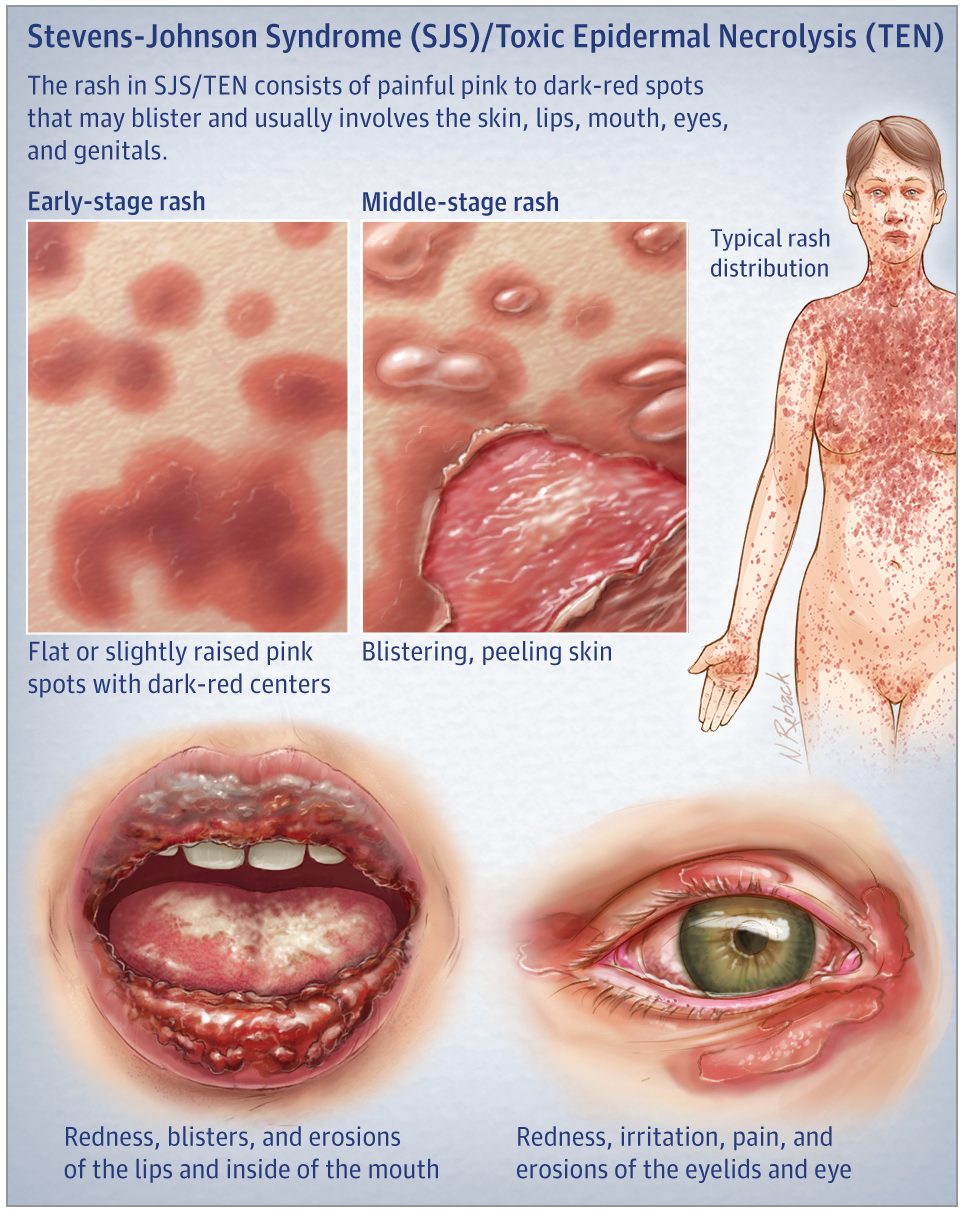
    • Starts as dark purple or erythematous lesions with purpuric centers that progress to bullae
    • Skin surrounding the lesions detaches from the dermis with just light pressure (Nikolsky Sign)
    • Up to 95% of patients will have mucous membrane lesions
    • ~85% will have conjunctival lesions
    • Symptoms: Burning or itching eyes, a cough or sore throat, pain with eating, pain with urinating or defecating
Source: JAMA Dermatol. 2017

  • Differential Diagnosis: SSSS, autoimmune bullous diseases, bullous fixed drug eruption, erythema multiforme, thermal burns, phototoxic reactions, and TSS
  • SJS is a clinical diagnosis
    • Basic workup: CBC, chemistry panel, LFTs, and a UA
  • Treatment
    • Supportive care
      • IV fluid repletion guided by TBSA affected, as well as electrolyte, protein, and energy supplementation
    • Consider protecting airway if significant oral mucosal involvement
    • Stop the offending agent (if there is one)
    • Advanced wound care and pain control
    • Consults: Derm to do a biopsy, +/- ophthalmology, gyn / urology to prevent strictures or contractures
    • Consider transferring to a burn center
  • Dispo:
    • Low threshold for ICU admission
    • SCORTEN ( max of 7 points)
      • 1 point each for
        • Age over 40
        • Current cancer
        • >30% body surface area affected
        • HR >120
        • BUN >28
        • Glucose >240
        • Bicarb <20
        • Score of 2 points or higher should -> ICU

Take Home Points

  • SJS may begin like the flu, with lesions appearing 1-3 days after the prodrome starts
  • Have to have a high suspicion for SJS because it is deadly. It’s a clinical diagnosis — derm biopsy is supportive
  • A thorough history and physical exam are key.  Remember the characteristic rash and bullae, and always look in the mouth and eyes.  Ask about dysuria, sore throat, and eye irritation, as well as preceding medications or infections.  Think SATAN!
  • Prompt supportive care focused on ABCs and IVF repletion are critical.  These patients can get sick really fast, so consider an ICU or burn unit.

References:

Barrett W.  Quick Consult: Symptoms: Rash, Dysuria, and Mouth Sores.  Emergency Medicine News.  41(4): 15-16, April 2019.

Bivins H, Comes J.  Stevens-Johnson Syndrome.  Rosen and Barkin’s 5-Minute Emergency Medicine Consult.  2015; 1076-1077.

Ergen EN, Hughey LC. Stevens-Johnson Syndrome and Toxic Epidermal Necrolysis. JAMA Dermatol.2017;153(12):1344. doi:10.1001/jamadermatol.2017.3957

Gerull R, Nelle M, Schaible T.  Toxic epidermal necrolysis and Stevens-Johnson syndrome: A review.  Crit Care Med.  2011; 39:1521-1532.

Lerch M, Mainetti C, Terziroli Beretta-Piccoli B, Harr T. Current Perspectives on Stevens-Johnson Syndrome and Toxic Epidermal Necrolysis. Clin Rev Allergy Immunol. 2018;54(1):147-76.

McNeil, D. (2019). Measles Cases Surpass 700 as Outbreak Continues Unabated. [online] Nytimes.com. Available at: https://www.nytimes.com/2019/04/29/health/measles-outbreak-cdc.html [Accessed 6 May 2019].

Mustafa SS, Ostrov D, Yerly D. Severe Cutaneous Adverse Drug Reactions: Presentation, Risk Factors, and Management. Curr Allergy Asthma Rep. 2018;18(4):26.

Read More

There’s a particular kind of pressure that comes with working in an emergency department, where decisions need to be both swift and sound. Core EM-Emergency Medicine Podcast exists in that space, offering a direct line to the essential knowledge and clinical reasoning that emergency medicine demands. Created by the team at Core EM, each episode feels less like a formal lecture and more like a focused conversation with a trusted colleague. You’ll hear discussions that break down critical topics, from managing common presentations to unraveling complex, high-acuity cases, all grounded in current evidence and practical reality. This podcast serves as a reliable resource for physicians, residents, and advanced practice providers looking to solidify their foundation or stay sharp on the latest evidence. It’s about cutting through the noise to deliver core content that’s immediately applicable at the bedside. Tune in for a clear, concise, and always relevant dive into the principles that define emergency care, designed to fit into a busy clinician’s life between shifts or during a commute.
Author: Language: en-us Episodes: 100

Core EM - Emergency Medicine Podcast
Podcast Episodes
Episode 141.0 – Journal Update [not-audio_url] [/not-audio_url]

Duration: 11:17
This week we discuss some recent publications relevant to EM: ADRENAL, Idarucizumab and Time to Furosemide. https://media.blubrry.com/coreem/content.blubrry.com/coreem/Podcast_Episode_141_0_Final_Cut.m4a Download Leave a…
Episode 140.0 Disutility of Orthostatics in volume Loss [not-audio_url] [/not-audio_url]

Duration: 7:23
This week we discuss the disutility of orthostatic vital signs as a diagnostic tool in patients with suspected volume loss. https://media.blubrry.com/coreem/content.blubrry.com/coreem/Podcast_140_0_Final_Cut.m4a Download…
Episode 139.0 – Ear Foreign Body Removal [not-audio_url] [/not-audio_url]

Duration: 13:06
This week we welcome back Andy Little from Doctors Hospital in Columbus, Ohio to chat about ear foreign body removal. https://media.blubrry.com/coreem/content.blubrry.com/coreem/Podcast_139_0_Final_Cut.m4a Download Leave…
Episode 138.0 – EEMCrit Pearls [not-audio_url] [/not-audio_url]

Duration: 11:07
This week we review pearls from the EEMCrit conference back in January 2018. https://media.blubrry.com/coreem/content.blubrry.com/coreem/Podcast_Episode_138_0_Final_Cut.m4a Download Leave a Comment Tags: BRASH, Hyperkale…
Episode 137.0 – How to Build a Great Presentation [not-audio_url] [/not-audio_url]

Duration: 35:11
This podcast discusses an 8 step process for building better presentations. https://media.blubrry.com/coreem/content.blubrry.com/coreem/Podcast_Episode_137_0_Final_Cut.m4a Download One Comment Show Notes Resources: P Cub…
Episode 136.0 HIV Related Infections in the ED [not-audio_url] [/not-audio_url]

Duration: 9:56
This week we discuss some pearls and pitfalls when caring for HIV+ patients in the ED. https://media.blubrry.com/coreem/content.blubrry.com/coreem/Podcast_Episode_136_0_Final_Cut.m4a Download One Comment Tags: AIDS, HIV,…
Episode 135.0 – Occult Causes of Non-Response to Vasopressors [not-audio_url] [/not-audio_url]

Duration: 10:25
This podcast reviews how clinicians should think about patients who's shock isn't responding to our typical management options. https://media.blubrry.com/coreem/content.blubrry.com/coreem/Episode_135_0_Final_Cut.m4a Down…
Episode 134.0 – Morning Report Pearls III [not-audio_url] [/not-audio_url]

Duration: 7:22
More pearls from our fantastic morning report series. https://media.blubrry.com/coreem/content.blubrry.com/coreem/Podcast_Episode_134_0_Final_Cut.m4a Download 2 Comments Tags: ALL, Altered Mental Status, Hyperleukocytosi…
Episode 133.0 – Initial Trauma Assessment [not-audio_url] [/not-audio_url]

Duration: 18:08
This week we dive in to the initial trauma assessment. https://media.blubrry.com/coreem/content.blubrry.com/coreem/Episode_133_0_Final_Cut.m4a Download Leave a Comment Tags: ABCDEs, Trauma Show Notes Take Home Points Dev…
Episode 132.0 – Air Embolism [not-audio_url] [/not-audio_url]

Duration: 8:58
This week we dive into the rare but potentially fatal, and difficult to diagnose, air embolism. https://media.blubrry.com/coreem/content.blubrry.com/coreem/Episode_132_0_Final_Cut.m4a Download 2 Comments Tags: Air Emboli…
