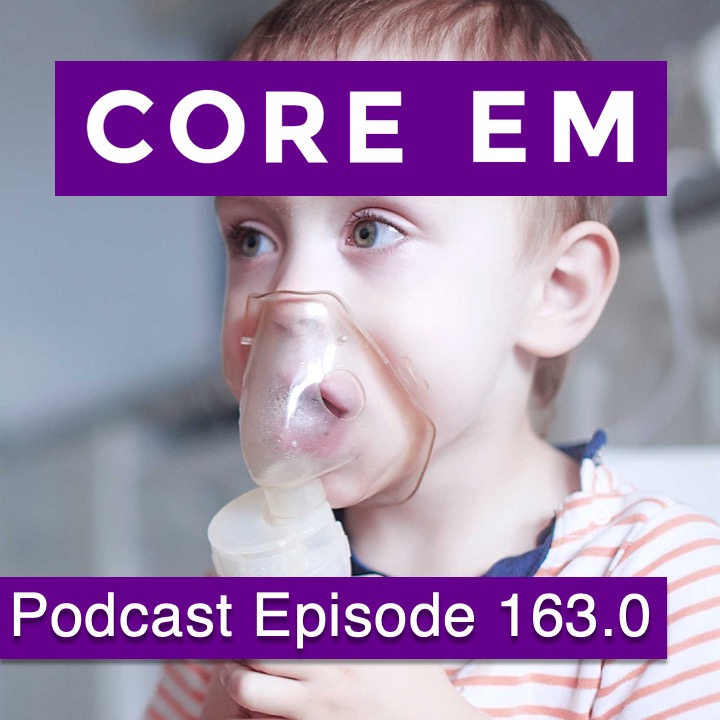
Episode 163.0 – Croup

Episode 163.0 – Croup

Author: Core EM May 20, 2019 Duration: 6:13

A look at one of the most common and potentially concerning upper respiratory infections in children.

Host:
Brian Gilberti, MD

Download One Comment Tags: , ,

Show Notes

Background

  • Croup is a viral infection starts in the nasal and pharyngeal mucosa but spreads to the larynx and trachea
    • Subglottic narrowing from inflammation
    • Dynamic obstruction
    • Barking cough
    • Inspiratory stridor
  • Causes:
    • Parainfluenza virus (most common)
    • Rhinovirus
    • Enterovirus
    • RSV
    • Rarely: Influenza, Measles
  • Age range: 6 months to 36 months
  • Seasonal component with high prevalence in fall and early winter
  • Differential
    • Bacterial tracheitis
    • Acute epiglottitis
    • Inhaled FB
    • Retropharyngeal abscess
    • Anaphylaxis

Presentation & Diagnosis

  • Classically a prodrome of nonspecific symptoms for 1-3 days with low grade fevers, congestion, runny nose.
  • Symptoms reach peak severity on the 4th day
  • “Steeple sign” on Xray (subglottic narrowing) present in only 50% of patients with croup
  • Assess air entry, skin color, level of consciousness, for tachypnea, if there are retractions / nasal flaring (if present at rest or with agitation) & coughing
  • “Westley Croup Score” (https://www.mdcalc.com/westley-croup-score)
    • Chest wall retractions
    • Stridor
    • Cyanosis
    • Level of consciousness
    • Air entry

Management

  • Mild Croup
    • Occasional barking cough, but no stridor at rest and mild to no retractions
    • Tx: Single dose of dex
      • Has been shown to improve severity and duration of symptoms
      • Route is not particularly important, whether it’s PO, IV or IM
      • Chosen route should aim to minimize agitation in the patient that might worsen their condition
    • May be managed at with supportive care
      • Humidifiers (NB: there isn’t good evidence supporting the use of humidifiers)
      • Antipyretics
      • PO fluids
    • Moderate Group
      • May have stridor at rest, mild-moderate retractions but no AMS and will not be in distress.
      • Tx: Dex + Racemic Epinephrine
        • Racemic epinpehrine will start to work in about 10 minutes
        • Effects last for more than an hour
      • Severe group
        • Receives the same initial therapy as the moderate group with dex and race epi
        • Pts with worrisome signs: stridor at rest, marked retraction, cyanosis and/or lethargy
        • Heliox (a combinations of 70-80% helium + 20-30% oxygen) may be attempted
          • There is limited evidence to support the role of heliox in croup,
          • NB: Pt may require higher levels of oxygen than the 20-30% mixture may provide
        • Intubation
          • Anticipate edema narrowing the airway
          • Consider starting with a tube that is 0.5 to 1 mm smaller than size typically used

Disposition:

  • Patients without stridor at rest or respiratory distress can be generally discharged from the ED
  • If epinephrine is given, patients should be monitored for 2-4 hours for reemergence of symptoms as the medication wears off

Take Home Points

  • Croup usually affects children within the age range of 6 months to 36 months with the most common cause being parainfluenza virus
  • Given the symptom overlap, we must consider more concerning diagnoses, including bacterial tracheitis, in these patients, especially if they are ill appearing or traditional therapies are ineffective
  • All patients benefit from a one-time dose of dexamethasone and, if racemic epinephrine is given, the patient should be observed for at least 3 hours
  • If intubation is required, anticipate a narrowed airway


Parent Article: https://coreem.net/core/croup/ by Dr. Pankow


Read More

There’s a particular kind of pressure that comes with working in an emergency department, where decisions need to be both swift and sound. Core EM-Emergency Medicine Podcast exists in that space, offering a direct line to the essential knowledge and clinical reasoning that emergency medicine demands. Created by the team at Core EM, each episode feels less like a formal lecture and more like a focused conversation with a trusted colleague. You’ll hear discussions that break down critical topics, from managing common presentations to unraveling complex, high-acuity cases, all grounded in current evidence and practical reality. This podcast serves as a reliable resource for physicians, residents, and advanced practice providers looking to solidify their foundation or stay sharp on the latest evidence. It’s about cutting through the noise to deliver core content that’s immediately applicable at the bedside. Tune in for a clear, concise, and always relevant dive into the principles that define emergency care, designed to fit into a busy clinician’s life between shifts or during a commute.
Author: Language: en-us Episodes: 100

Core EM - Emergency Medicine Podcast
Podcast Episodes
Episode 151.0 – Cauda Equina Syndrome [not-audio_url] [/not-audio_url]

Duration: 5:04
This week we discuss the difficult to diagnose and high morbidity cauda equina syndrome. https://media.blubrry.com/coreem/content.blubrry.com/coreem/Podcast_Episode_151_0_Final_Cut.m4a Download Leave a Comment Tags: Back…
Episode 150.0 – Journal Update [not-audio_url] [/not-audio_url]

Duration: 8:17
This week we review some recent publications on steroids in pharyngitis and the VAN assessment in stroke. https://media.blubrry.com/coreem/content.blubrry.com/coreem/Podcast_Episode_150_0_Final_Cut.m4a Download Leave a C…
Episode 149.0 – Simplified Approach to Peds Trauma [not-audio_url] [/not-audio_url]

Duration: 15:40
This week the podcast features a lecture from Dr. Frosso Admakos - Assistant Residency Director at Metropolitan Hospital in NYC https://media.blubrry.com/coreem/content.blubrry.com/coreem/Episode_149_0_Final_Cut.m4a Down…
Episode 148.0 – ACEP VTE Clinical Policy 2018 [not-audio_url] [/not-audio_url]

Duration: 10:16
This episode reviews the highlights from the recent ACEP clinical policy on acute VTE management in the ED. https://media.blubrry.com/coreem/content.blubrry.com/coreem/Podcast_Episode_148_0_Final_Cut.m4a Download Leave a…
Episode 147.0 – Salicylate Toxicity [not-audio_url] [/not-audio_url]

Duration: 10:05
This episode reviews the identification and management of patients with salicylate toxicity. https://media.blubrry.com/coreem/content.blubrry.com/coreem/Podcast_Episode_147_0_Final_Cut.m4a Download 4 Comments Tags: Aspir…
Episode 146.0 – Morning Report Pearls V [not-audio_url] [/not-audio_url]

Duration: 7:33
More pearls from our fantastic morning report series at Bellevue. https://media.blubrry.com/coreem/content.blubrry.com/coreem/Podcast_Episode_146_0_Final_Cut.m4a Download Leave a Comment Tags: Endocarditis, Ludwig's Angi…
Episode 145.0 – All NYC EM 14 Pearls [not-audio_url] [/not-audio_url]

Duration: 10:27
This week we discuss some pearls from the 14th All NYC EM Conference. https://media.blubrry.com/coreem/content.blubrry.com/coreem/Podcast_Episode_145_0_Final_Cut.m4a Download Leave a Comment Tags: Documentation, Major Tr…
Episode 144.0 – Acute Rhinosinusitis [not-audio_url] [/not-audio_url]

Duration: 9:58
This week we dive into rhinosinusitis exploring the recommendations of who needs antibiotics and who doesn't. https://media.blubrry.com/coreem/content.blubrry.com/coreem/Episode_144_0_Final_Cut.m4a Download Leave a Comme…
Episode 143.0 – Testicular Torsion [not-audio_url] [/not-audio_url]

Duration: 9:22
This week we review the presentation, examination and diagnosis of testicular torsion. https://media.blubrry.com/coreem/content.blubrry.com/coreem/Podcast_Episode_143_0_Final_Cut.m4a Download Leave a Comment Tags: Acute…
Episode 142.0 – Morning Report Pearls IV [not-audio_url] [/not-audio_url]

Duration: 7:48
This week we discuss more pearls from our morning report conference on APE, SAH and caustic ingestions. https://media.blubrry.com/coreem/content.blubrry.com/coreem/Podcast_Episode_142_0_Final_Cut.m4a Download Leave a Com…