Episode 209: Blast Crisis

Episode 209: Blast Crisis

Author: Core EM May 1, 2025 Duration: 0:00

We dive into the recognition and management of blast crisis.

Hosts:
Sadakat Chowdhury, MD
Brian Gilberti, MD

Download 2 Comments Tags: ,

Show Notes

Topic Overview

  • Blast crisis is an oncologic emergency, most commonly seen in chronic myeloid leukemia (CML).
  • Defined by:
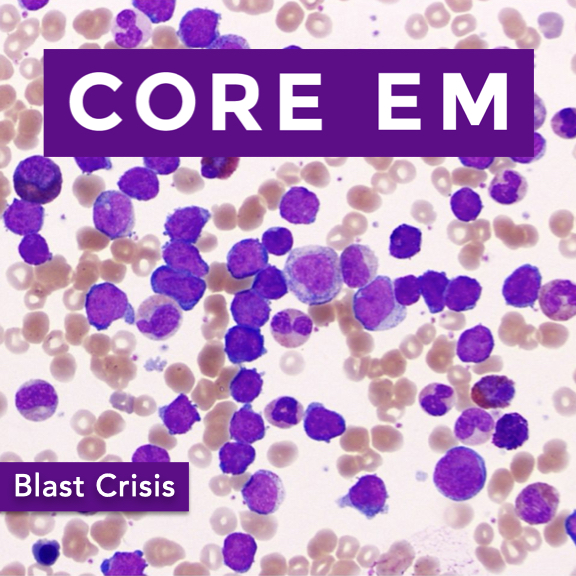
    • >20% blasts in peripheral blood or bone marrow.
    • May include extramedullary blast proliferation.
  • Without treatment, median survival is only 3–6 months.

Pathophysiology & Associated Conditions

  • Usually occurs in CML, but also in:
    • Myeloproliferative neoplasms (MPNs)
    • Myelodysplastic syndromes (MDS)
  • Transition from chronic to blast phase often reflects disease progression or treatment resistance.

Risk Factors

  • 10% of CML patients progress to blast crisis.
  • Risk increased in:
    • Patients refractory to tyrosine kinase inhibitors (e.g., imatinib).
    • Those with Philadelphia chromosome abnormalities.
    • WBC >100,000, which increases risk for leukostasis.

Clinical Presentation

  • Symptoms often stem from pancytopenia and leukostasis:
    • Anemia: fatigue, malaise.
    • Functional neutropenia: high WBC count, but increased infection/sepsis risk.
    • Thrombocytopenia: bleeding, bruising.
  • Leukostasis/hyperviscosity effects by system:
    • Neurologic: confusion, visual changes, stroke-like symptoms.
    • Cardiopulmonary: ARDS, myocardial injury.
    • Others: priapism, limb ischemia, bowel infarction.
  • Rapid deterioration is common — early recognition is critical.

Diagnostic Workup

  • CBC with differential: assess blast % and cytopenias.
  • Peripheral smear and manual diff: confirm immature blasts.
  • CMP: screen for tumor lysis syndrome:
    • Elevated potassium, phosphate, uric acid.
    • Low calcium.
  • LDH & uric acid: markers of high cell turnover.
  • Coagulation studies (PT, PTT): assess for DIC.
  • Definitive tests (done inpatient): bone marrow biopsy, flow cytometry.

Emergency Department Management

  • Resuscitation & ABCs: oxygen, IV fluids, vitals monitoring.
  • Avoid aggressive transfusions:
    • Risk of hyperviscosity with PRBCs and platelets.
  • Initiate broad-spectrum antibiotics early:
    • High suspicion for sepsis in functionally neutropenic patients.
  • Consider antifungals for prolonged febrile neutropenia.
  • Cytoreduction strategies:
    • Hydroxyurea to lower WBCs quickly.
    • Tyrosine kinase inhibitors (TKIs).
    • High-dose chemotherapy.
  • Early consultation with hematology/oncology is essential.
  • Mutation testing may guide targeted therapy.

Prognosis

  • Without treatment: median survival ~3 months.
  • With treatment:
    • Potential survival >1 year.
    • Best outcomes in patients who enter a second chronic phase and undergo allogeneic stem cell transplant.

Ethical & Logistical Considerations

  • Treatment may involve aggressive interventions with serious side effects.
  • Important to assess:
    • Patient goals of care.
    • Capacity for informed consent.
  • Resource limitations:
    • Not all hospitals have oncology services.
    • Patients may require transfer over long distances.
  • Emphasize early, transparent discussions with patients and families.

Top 3 Take-Home Points

  • Recognize early: Look for cytopenias, leukostasis, and rapid clinical decline.
  • Resuscitate appropriately: Start antibiotics; be cautious with transfusions.
  • Call for help: Early hematology/oncology involvement is essential for definitive care.

Read More

There’s a particular kind of pressure that comes with working in an emergency department, where decisions need to be both swift and sound. Core EM-Emergency Medicine Podcast exists in that space, offering a direct line to the essential knowledge and clinical reasoning that emergency medicine demands. Created by the team at Core EM, each episode feels less like a formal lecture and more like a focused conversation with a trusted colleague. You’ll hear discussions that break down critical topics, from managing common presentations to unraveling complex, high-acuity cases, all grounded in current evidence and practical reality. This podcast serves as a reliable resource for physicians, residents, and advanced practice providers looking to solidify their foundation or stay sharp on the latest evidence. It’s about cutting through the noise to deliver core content that’s immediately applicable at the bedside. Tune in for a clear, concise, and always relevant dive into the principles that define emergency care, designed to fit into a busy clinician’s life between shifts or during a commute.
Author: Language: en-us Episodes: 100

Core EM - Emergency Medicine Podcast
Podcast Episodes
Episode 191: Rapid Atrial Fibrillation [not-audio_url] [/not-audio_url]

Duration: 0:00
We go over the treatment of rapid atrial fibrillation (afib with RVR). Hosts: Brian Gilberti, MD Jonathan Kobles, MD https://media.blubrry.com/coreem/content.blubrry.com/coreem/Rapid_Atrial_Fibrillation.mp3 Download One…
Episode 190: Electrical Storm [not-audio_url] [/not-audio_url]

Duration: 0:00
We discuss Electrical Storm (VT storm) and how to care for the very irritable heart. Hosts: Brian Gilberti, MD Reed Colling, MD https://media.blubrry.com/coreem/content.blubrry.com/coreem/Electrical_Storm.mp3 Download Le…
Episode 189: Hyperkalemia 2.0 [not-audio_url] [/not-audio_url]

Duration: 0:00
We revisit the topic of Hyperkelamia to update our prior episode from 2015 (pre-Lokelma) Hosts: Brian Gilberti, MD Jonathan Kobles, MD https://media.blubrry.com/coreem/content.blubrry.com/coreem/Hyperkalemia.mp3 Download…
Episode 188: Vasopressors [not-audio_url] [/not-audio_url]

Duration: 0:00
We go over the essential and complex topic of vasopressors in the ED. Hosts: Brian Gilberti, MD Catherine Jamin, MD https://media.blubrry.com/coreem/content.blubrry.com/coreem/Vasopressors.mp3 Download Leave a Comment Ta…
Episode 187: Septic Joint in Children [not-audio_url] [/not-audio_url]

Duration: 9:02
We discuss the diagnosis and management of septic arthritis in the pediatric population. Hosts: Brian Gilberti, MD Ellen Duncan, MD https://media.blubrry.com/coreem/content.blubrry.com/coreem/Septic_Joint_in_Children.mp3…
Podcast 186.0: Hypocalcemia [not-audio_url] [/not-audio_url]

Duration: 9:12
A quick primer on hypocalcemia in the ED. Hosts: Joseph Offenbacher, MD Audrey Bree Tse, MD https://media.blubrry.com/coreem/content.blubrry.com/coreem/hypocalcemia.mp3 Download 4 Comments Tags: calcium, Critical Care, E…
Podcast 185.0: Anticoagulation Reversal [not-audio_url] [/not-audio_url]

Duration: 21:06
How and when to reverse anticoagulation in the bleeding EM patient. Hosts: Joe Offenbacher, MD Audrey Bree Tse, MD https://media.blubrry.com/coreem/content.blubrry.com/coreem/AC_reversal.mp3 Download 3 Comments Tags: Ant…
Episode 184.0 Ludwig’s Angina [not-audio_url] [/not-audio_url]

Duration: 9:18
A primer on this airway/ ID/ ENT emergency. Hosts: Joe Offenbacher MD, A Bree Tse, MD https://media.blubrry.com/coreem/content.blubrry.com/coreem/ludwigs_2.mp3 Download 2 Comments Tags: Airway, ENT, Infectious Diseases S…
Episode 183.0 Pneumothorax [not-audio_url] [/not-audio_url]

Duration: 13:01
A quick overview of pneumothorax for the EM physician: the what, why, diagnosis, and treatment. Hosts: Joe Offenbacher, MD Audrey Tse, MD https://media.blubrry.com/coreem/content.blubrry.com/coreem/Pneumothorax_CoreEM_po…
Episode 182.0 – Wellens [not-audio_url] [/not-audio_url]

Duration: 8:04
An interesting back story on this must-not-miss EKG finding in the ED! Hosts: Joseph Offenbacher, MD Audrey Bree Tse, MD https://media.blubrry.com/coreem/content.blubrry.com/coreem/CoreEM_Wellens.mp3 Download One Comment…