Episode 209: Blast Crisis

Episode 209: Blast Crisis

Author: Core EM May 1, 2025 Duration: 0:00

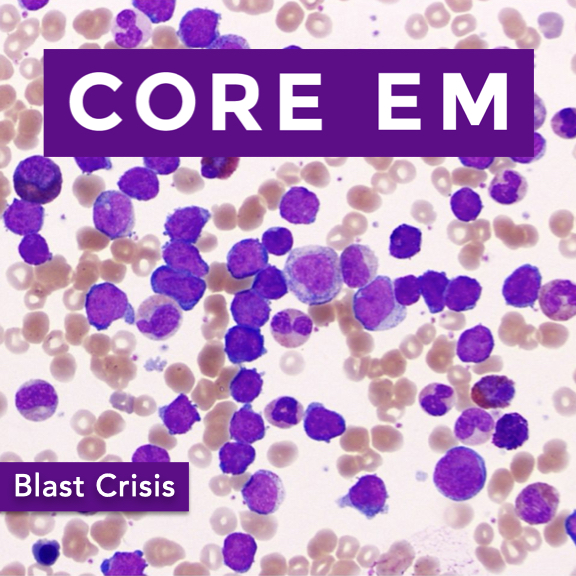
We dive into the recognition and management of blast crisis.

Hosts:
Sadakat Chowdhury, MD
Brian Gilberti, MD

Download 2 Comments Tags: ,

Show Notes

Topic Overview

  • Blast crisis is an oncologic emergency, most commonly seen in chronic myeloid leukemia (CML).
  • Defined by:
    • >20% blasts in peripheral blood or bone marrow.
    • May include extramedullary blast proliferation.
  • Without treatment, median survival is only 3–6 months.

Pathophysiology & Associated Conditions

  • Usually occurs in CML, but also in:
    • Myeloproliferative neoplasms (MPNs)
    • Myelodysplastic syndromes (MDS)
  • Transition from chronic to blast phase often reflects disease progression or treatment resistance.

Risk Factors

  • 10% of CML patients progress to blast crisis.
  • Risk increased in:
    • Patients refractory to tyrosine kinase inhibitors (e.g., imatinib).
    • Those with Philadelphia chromosome abnormalities.
    • WBC >100,000, which increases risk for leukostasis.

Clinical Presentation

  • Symptoms often stem from pancytopenia and leukostasis:
    • Anemia: fatigue, malaise.
    • Functional neutropenia: high WBC count, but increased infection/sepsis risk.
    • Thrombocytopenia: bleeding, bruising.
  • Leukostasis/hyperviscosity effects by system:
    • Neurologic: confusion, visual changes, stroke-like symptoms.
    • Cardiopulmonary: ARDS, myocardial injury.
    • Others: priapism, limb ischemia, bowel infarction.
  • Rapid deterioration is common — early recognition is critical.

Diagnostic Workup

  • CBC with differential: assess blast % and cytopenias.
  • Peripheral smear and manual diff: confirm immature blasts.
  • CMP: screen for tumor lysis syndrome:
    • Elevated potassium, phosphate, uric acid.
    • Low calcium.
  • LDH & uric acid: markers of high cell turnover.
  • Coagulation studies (PT, PTT): assess for DIC.
  • Definitive tests (done inpatient): bone marrow biopsy, flow cytometry.

Emergency Department Management

  • Resuscitation & ABCs: oxygen, IV fluids, vitals monitoring.
  • Avoid aggressive transfusions:
    • Risk of hyperviscosity with PRBCs and platelets.
  • Initiate broad-spectrum antibiotics early:
    • High suspicion for sepsis in functionally neutropenic patients.
  • Consider antifungals for prolonged febrile neutropenia.
  • Cytoreduction strategies:
    • Hydroxyurea to lower WBCs quickly.
    • Tyrosine kinase inhibitors (TKIs).
    • High-dose chemotherapy.
  • Early consultation with hematology/oncology is essential.
  • Mutation testing may guide targeted therapy.

Prognosis

  • Without treatment: median survival ~3 months.
  • With treatment:
    • Potential survival >1 year.
    • Best outcomes in patients who enter a second chronic phase and undergo allogeneic stem cell transplant.

Ethical & Logistical Considerations

  • Treatment may involve aggressive interventions with serious side effects.
  • Important to assess:
    • Patient goals of care.
    • Capacity for informed consent.
  • Resource limitations:
    • Not all hospitals have oncology services.
    • Patients may require transfer over long distances.
  • Emphasize early, transparent discussions with patients and families.

Top 3 Take-Home Points

  • Recognize early: Look for cytopenias, leukostasis, and rapid clinical decline.
  • Resuscitate appropriately: Start antibiotics; be cautious with transfusions.
  • Call for help: Early hematology/oncology involvement is essential for definitive care.

Read More

There’s a particular kind of pressure that comes with working in an emergency department, where decisions need to be both swift and sound. Core EM-Emergency Medicine Podcast exists in that space, offering a direct line to the essential knowledge and clinical reasoning that emergency medicine demands. Created by the team at Core EM, each episode feels less like a formal lecture and more like a focused conversation with a trusted colleague. You’ll hear discussions that break down critical topics, from managing common presentations to unraveling complex, high-acuity cases, all grounded in current evidence and practical reality. This podcast serves as a reliable resource for physicians, residents, and advanced practice providers looking to solidify their foundation or stay sharp on the latest evidence. It’s about cutting through the noise to deliver core content that’s immediately applicable at the bedside. Tune in for a clear, concise, and always relevant dive into the principles that define emergency care, designed to fit into a busy clinician’s life between shifts or during a commute.
Author: Language: en-us Episodes: 100

Core EM - Emergency Medicine Podcast
Podcast Episodes
Episode 141.0 – Journal Update [not-audio_url] [/not-audio_url]

Duration: 11:17
This week we discuss some recent publications relevant to EM: ADRENAL, Idarucizumab and Time to Furosemide. https://media.blubrry.com/coreem/content.blubrry.com/coreem/Podcast_Episode_141_0_Final_Cut.m4a Download Leave a…
Episode 140.0 Disutility of Orthostatics in volume Loss [not-audio_url] [/not-audio_url]

Duration: 7:23
This week we discuss the disutility of orthostatic vital signs as a diagnostic tool in patients with suspected volume loss. https://media.blubrry.com/coreem/content.blubrry.com/coreem/Podcast_140_0_Final_Cut.m4a Download…
Episode 139.0 – Ear Foreign Body Removal [not-audio_url] [/not-audio_url]

Duration: 13:06
This week we welcome back Andy Little from Doctors Hospital in Columbus, Ohio to chat about ear foreign body removal. https://media.blubrry.com/coreem/content.blubrry.com/coreem/Podcast_139_0_Final_Cut.m4a Download Leave…
Episode 138.0 – EEMCrit Pearls [not-audio_url] [/not-audio_url]

Duration: 11:07
This week we review pearls from the EEMCrit conference back in January 2018. https://media.blubrry.com/coreem/content.blubrry.com/coreem/Podcast_Episode_138_0_Final_Cut.m4a Download Leave a Comment Tags: BRASH, Hyperkale…
Episode 137.0 – How to Build a Great Presentation [not-audio_url] [/not-audio_url]

Duration: 35:11
This podcast discusses an 8 step process for building better presentations. https://media.blubrry.com/coreem/content.blubrry.com/coreem/Podcast_Episode_137_0_Final_Cut.m4a Download One Comment Show Notes Resources: P Cub…
Episode 136.0 HIV Related Infections in the ED [not-audio_url] [/not-audio_url]

Duration: 9:56
This week we discuss some pearls and pitfalls when caring for HIV+ patients in the ED. https://media.blubrry.com/coreem/content.blubrry.com/coreem/Podcast_Episode_136_0_Final_Cut.m4a Download One Comment Tags: AIDS, HIV,…
Episode 135.0 – Occult Causes of Non-Response to Vasopressors [not-audio_url] [/not-audio_url]

Duration: 10:25
This podcast reviews how clinicians should think about patients who's shock isn't responding to our typical management options. https://media.blubrry.com/coreem/content.blubrry.com/coreem/Episode_135_0_Final_Cut.m4a Down…
Episode 134.0 – Morning Report Pearls III [not-audio_url] [/not-audio_url]

Duration: 7:22
More pearls from our fantastic morning report series. https://media.blubrry.com/coreem/content.blubrry.com/coreem/Podcast_Episode_134_0_Final_Cut.m4a Download 2 Comments Tags: ALL, Altered Mental Status, Hyperleukocytosi…
Episode 133.0 – Initial Trauma Assessment [not-audio_url] [/not-audio_url]

Duration: 18:08
This week we dive in to the initial trauma assessment. https://media.blubrry.com/coreem/content.blubrry.com/coreem/Episode_133_0_Final_Cut.m4a Download Leave a Comment Tags: ABCDEs, Trauma Show Notes Take Home Points Dev…
Episode 132.0 – Air Embolism [not-audio_url] [/not-audio_url]

Duration: 8:58
This week we dive into the rare but potentially fatal, and difficult to diagnose, air embolism. https://media.blubrry.com/coreem/content.blubrry.com/coreem/Episode_132_0_Final_Cut.m4a Download 2 Comments Tags: Air Emboli…