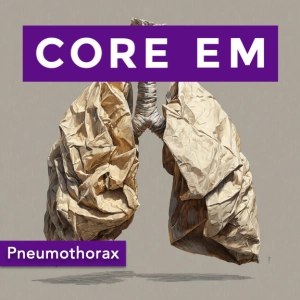
Episode 213: Pneumothorax

Episode 213: Pneumothorax

Author: Core EM September 1, 2025 Duration: 0:00

We break down pneumothorax: risks, diagnosis, and management pearls.

Hosts:
Christopher Pham, MD
Brian Gilberti, MD

Download Leave a Comment Tags: , ,

Show Notes

Risk Factors for Pneumothorax

  • Secondary pneumothorax
    • Trauma: rib fractures, blunt chest trauma (as in the case).
    • Iatrogenic: central line placement, thoracentesis, pleural procedures.
  • Primary spontaneous pneumothorax
    • Young, tall, thin males (10–30 years).
    • Connective tissue disorders: Marfan, Ehlers-Danlos.
    • Underlying lung disease: COPD with bullae, interstitial lung disease, CF, TB, malignancy.
  • Technically, anyone is at risk.

Symptoms & Differential Diagnosis

  • Typical PTX presentation: Dyspnea, chest pain, pleuritic discomfort.
  • Exam clues: unilateral decreased breath sounds, focal tenderness/crepitus.
  • Red flags (suggest tension PTX):
    • JVD
    • Tracheal deviation
    • Hypotension, shock physiology
    • Severe tachycardia, hypoxia
  • Differential diagnoses:
    • Pulmonary: asthma, COPD, pneumonia, pulmonary edema (SCAPE), ILD, infections.
    • Cardiac: ACS, CHF, pericarditis.
    • PE and other acute causes of dyspnea.

Diagnostics

  • Bloodwork: limited role, except type & screen if intervention likely.
  • EKG: reasonable given chest pain/shortness of breath.
  • Imaging:
    • POCUS (bedside ultrasound)
      • High sensitivity (86–96%) & specificity (97–100%).
      • Signs:
        • Seashore sign: normal lung sliding.
        • Barcode sign: absent lung sliding.
        • Lung point: most specific for PTX.
    • CXR
      • Sensitivity ~70–90% for small PTX.
      • May show pleural line, hyperlucency.
    • CT chest (gold standard)
      • Defines size/severity.
      • Rules out mimics (bullae, pleural effusion, hemothorax).
      • Guides intervention choice.

Management

  • First step for all: Oxygen supplementation (non-rebreather if possible).
    • Accelerates resorption of pleural air.
  • Stable vs. unstable decision point:
    • Unstable/tension PTX
      • Immediate needle thoracostomy (14-g angiocath, 2nd ICS midclavicular).
      • Temporizing until chest tube/pigtail placed.
    • Stable, small PTX (<2 cm on O₂)
      • Observation, supplemental O₂, conservative management.
    • Stable, larger PTX or symptomatic
      • Chest tube or pigtail catheter insertion.
      • Pigtail catheters: less invasive, more comfortable, similar efficacy for simple PTX.
      • Large bore tubes: indicated if associated with blood, pus, large collections.

Disposition

  • Admit all patients with chest tubes; cannot be discharged with tube in place.
  • Service responsible varies by hospital: trauma, CT surgery, MICU, etc.
  • Level of care (ICU vs. floor) depends on stability:
    • ICU if unstable course, intubated, shock physiology.
    • Stepdown/floor if stable and straightforward.

Take Home Points

  • Always broaden differential in dyspnea/chest pain → don’t anchor on asthma/COPD.
  • Exam findings + history (trauma, risk factors) crucial to raising suspicion.
  • Ultrasound is more sensitive than CXR and highly specific when lung point found.
  • Oxygen is first-line; intervention determined by size + stability.
  • Pigtail catheters increasingly favored for simple, stable PTX.
  • All patients with intervention require admission; service varies by institution.

Read More

There’s a particular kind of pressure that comes with working in an emergency department, where decisions need to be both swift and sound. Core EM-Emergency Medicine Podcast exists in that space, offering a direct line to the essential knowledge and clinical reasoning that emergency medicine demands. Created by the team at Core EM, each episode feels less like a formal lecture and more like a focused conversation with a trusted colleague. You’ll hear discussions that break down critical topics, from managing common presentations to unraveling complex, high-acuity cases, all grounded in current evidence and practical reality. This podcast serves as a reliable resource for physicians, residents, and advanced practice providers looking to solidify their foundation or stay sharp on the latest evidence. It’s about cutting through the noise to deliver core content that’s immediately applicable at the bedside. Tune in for a clear, concise, and always relevant dive into the principles that define emergency care, designed to fit into a busy clinician’s life between shifts or during a commute.
Author: Language: en-us Episodes: 100

Core EM - Emergency Medicine Podcast
Podcast Episodes
Episode 222: Local Anesthetic Systemic Toxicity (LAST) [not-audio_url] [/not-audio_url]

Duration: 0:00
We discuss this ominous complication of providing local anesthesia. Hosts: Elaine Jonas, MD Brian Gilberti, MD https://media.blubrry.com/coreem/content.blubrry.com/coreem/LAST.mp3 Download Leave a Comment Tags: Critical…
Episode 221: High-Output Heart Failure [not-audio_url] [/not-audio_url]

Duration: 0:00
We discuss the diagnosis and treatment of one of EM's paradoxes: High-Output Heart Failure. Hosts: Nicolas Gonzalez, MD Brian Gilberti, MD https://media.blubrry.com/coreem/content.blubrry.com/coreem/HOHF.mp3 Download Lea…
Episode 220: Post-ROSC Care [not-audio_url] [/not-audio_url]

Duration: 0:00
We explore how to refine and optimize care in the vital minutes following ROSC. Hosts: Jonathan Elmer, MD, MS Brian Gilberti, MD https://media.blubrry.com/coreem/content.blubrry.com/coreem/Post-ROSC_care.mp3 Download Lea…
Episode 219: Meningitis 2.0 [not-audio_url] [/not-audio_url]

Duration: 0:00
We review diagnosing and managing bacterial meningitis in the ED. Hosts: Sarah Fetterolf, MD Avir Mitra, MD https://media.blubrry.com/coreem/content.blubrry.com/coreem/Meningitis_2_0.mp3 Download Leave a Comment Tags: CN…
Episode 218: Sympathetic Crashing Acute Pulmonary Edema (SCAPE) [not-audio_url] [/not-audio_url]

Duration: 12:45
We discuss the diagnosis and management of SCAPE in the ED. Hosts: Naz Sarpoulaki, MD, MPH Brian Gilberti, MD https://media.blubrry.com/coreem/content.blubrry.com/coreem/SCAPEv2.mp3 Download Leave a Comment Tags: Acute P…
Episode 217: Prehospital Blood Transfusion [not-audio_url] [/not-audio_url]

Duration: 0:00
We discuss the shift to prehospital blood to treat shock sooner. Hosts: Nichole Bosson, MD, MPH, FACEP Avir Mitra, MD https://media.blubrry.com/coreem/content.blubrry.com/coreem/Prehospital_Transfusion.mp3 Download Leave…
Episode 216: BRUE (Brief Resolved Unexplained Event) [not-audio_url] [/not-audio_url]

Duration: 0:00
We review BRUEs (Brief Resolved Unexplained Events). Hosts: Ellen Duncan, MD, PhD Noumi Chowdhury, MD https://media.blubrry.com/coreem/content.blubrry.com/coreem/BRUE.mp3 Download Leave a Comment Tags: Pediatrics Show No…
Episode 215: Marburg Virus and Global EM [not-audio_url] [/not-audio_url]

Duration: 0:00
Lessons from Rwanda’s Marburg Virus Outbreak and Building Resilient Systems in Global EM. Hosts: Tsion Firew, MD Brian Gilberti, MD https://media.blubrry.com/coreem/content.blubrry.com/coreem/Marburg_Virus.mp3 Download L…
Episode 214: Acute Pulmonary Embolism [not-audio_url] [/not-audio_url]

Duration: 0:00
We review the diagnosis, risk stratification, & management of acute pulmonary embolism in the ED. Hosts: Vivian Chiu, MD Brian Gilberti, MD https://media.blubrry.com/coreem/content.blubrry.com/coreem/Acute_Pulmonary_Embo…
Episode 212: Angioedema [not-audio_url] [/not-audio_url]

Duration: 0:00
Angioedema – Recognition and Management in the ED Hosts: Maria Mulligan-Buckmiller, MD Brian Gilberti, MD https://media.blubrry.com/coreem/content.blubrry.com/coreem/Angioedema.mp3 Download Leave a Comment Tags: Airway S…