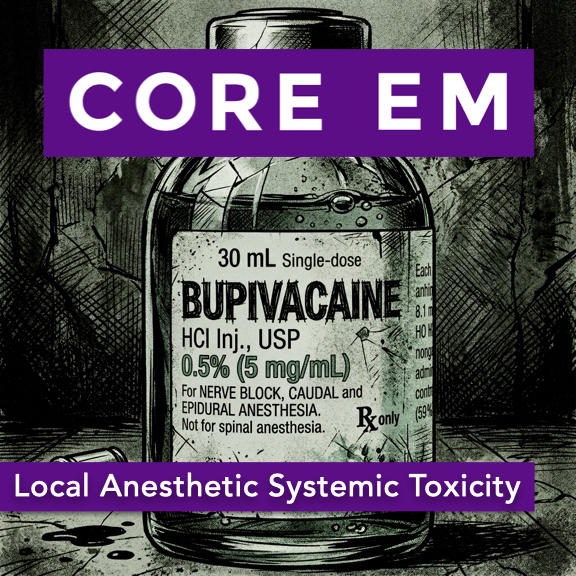
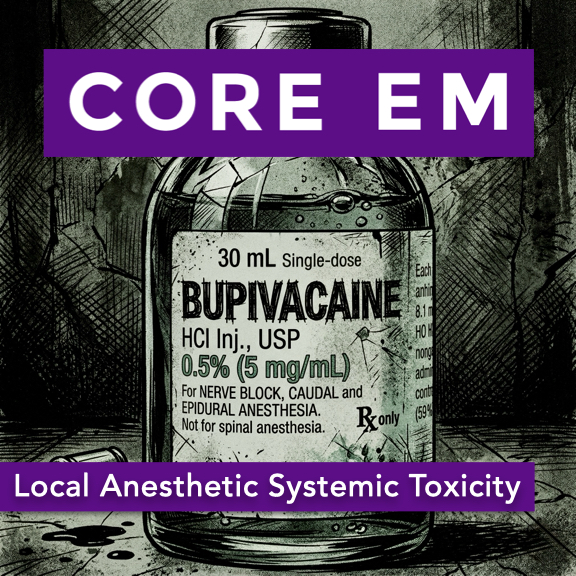
Episode 222: Local Anesthetic Systemic Toxicity (LAST)

Episode 222: Local Anesthetic Systemic Toxicity (LAST)

Author: Core EM April 7, 2026 Duration: 0:00

We discuss this ominous complication of providing local anesthesia.

Hosts:
Elaine Jonas, MD
Brian Gilberti, MD
Download Leave a Comment Tags: ,

Show Notes

I. Pathophysiology & Mechanisms

  • Definition: Systemic toxicity secondary to local anesthetic (LA) via accidental intravascular injection or excessive systemic absorption.

  • Threshold: Occurs when plasma concentration exceeds the safety threshold for cardiac and neural tissue.

  • Agent Profile: Bupivacaine (High Risk)

    • Highly lipophilic with high protein binding.

    • “Fast-on, Slow-off” Kinetics: Strong channel binding with extremely slow dissociation during diastole.

    • Myocardial Depression: Direct inhibition of release from the sarcoplasmic reticulum, impairing contractility.

    • Low CC:CNS Ratio: The dose required for cardiac collapse is very close to the dose that triggers seizures (narrow safety margin).

  • Contributing Factors:

    • Acidosis/Hypercapnia: Increases the fraction of free drug and promotes ion trapping in the brain/heart; shifts the LA-binding curve toward higher toxicity.

    • Hypoxemia: Exacerbates myocardial depression and lowers seizure threshold.


II. Risk Assessment & Prevention

Patient-Specific Risk Factors

  • Extremes of Age: Neonates (low -1-acid glycoprotein) and elderly (reduced clearance).

  • Body Composition: Low muscle mass/frailty (decreased volume of distribution).

  • Organ Dysfunction:

    • Hepatic: Reduced metabolism of amide LAs.

    • Renal: Accumulation of metabolites; risk of metabolic acidosis lowering seizure threshold.

    • Cardiac: Reduced cardiac output slows hepatic delivery/clearance; heart failure patients are more sensitive to channel blockade.

  • Pregnancy: Increased sensitivity to cardiotoxicity.

Procedural Risk Factors

  • Vascularity of Site (Highest to Lowest Risk):

    1. Intercostal blocks (highest absorption rate).

    2. Caudal/Epidural.

    3. Interfascial plane blocks (e.g., TAP block).

    4. Psoas compartment/Sciatic.

    5. Brachial plexus.

  • Technique: Large volume infiltration, lack of ultrasound, lack of incremental injection.

Prevention Mandates

  • Weight-Based Dosing:

    • Lidocaine (Plain): Max .

    • Lidocaine (with Epi): Max .

    • Bupivacaine: Max .

  • Incremental Injection: aliquots with frequent aspiration.

  • Intravascular Marker: Use Epinephrine () to detect accidental IV placement (HR increase or SBP increase ).


III. Clinical Presentation

Neurologic Phase (Early to Late)

  • Subjective: Metallic taste, tinnitus, circumoral numbness/tingling.

  • Objective: Visual disturbances, agitation, confusion, tremors.

  • Critical: Generalized tonic-clonic seizures, rapid progression to CNS depression, coma, and apnea.

  • Note: Early phases are often masked in patients receiving midazolam or propofol.

Cardiovascular Phase

  • Initial: Hypertension and tachycardia (if epi used) or transient stimulatory phase.

  • Conduction Defects: PR prolongation, QRS widening (classic sign), bundle branch blocks.

  • Dysrhythmias: Bradycardia (most common), VT/VF, PEA, asystole.

  • Contractility: Profound, refractory hypotension and cardiogenic shock.


IV. Immediate Management Algorithm

Goal: Prevent hypoxia/acidosis and sequester the toxin.

1. Initial Actions

  • Stop Injection: Immediately halt all LA administration.

  • Call for Help: Specify “LAST Protocol” and “Intralipid Kit.”

  • Airway Management:

    • .

    • Hyperventilate slightly if needed to counter respiratory acidosis.

    • Low threshold for intubation (hypoxia/acidosis rapidly worsen LAST).

2. Seizure Control

  • First-line: Benzodiazepines (e.g., Midazolam).

  • Avoid: Propofol if hemodynamically unstable (exacerbates cardiac depression).

  • Neuromuscular Blockers: May be needed for ventilation, but remember they do not stop CNS seizure activity.

3. Lipid Emulsion Therapy 20%

  • Indications: Start at first sign of serious toxicity (airway compromise, seizures, or CV instability).

  • Bolus: IV over .

  • Infusion: immediately following bolus.

  • If Instability Persists:

    • Repeat bolus (up to 2 times).

    • Increase infusion to .

  • Upper Limit: total dose.

4. Modified ACLS

  • Epinephrine: Use low doses () to avoid worsening arrhythmias and interfering with lipid rescue.

  • Antiarrhythmics: Amiodarone is preferred.

  • CONTRAINDICATED:

    • Lidocaine: (Class Ib antiarrhythmic—will worsen toxicity).

    • Vasopressin: Associated with poor outcomes in animal LAST models.

    • Calcium Channel Blockers / Beta Blockers: Exacerbate myocardial depression.

  • Refractory Arrest: Early consultation for ECMO or Cardiopulmonary Bypass (CPB).


V. Differential Diagnosis for the Peri-Procedural Patient

  • High Spinal: Ascending sensory/motor block, profound sympathectomy (hypotension/bradycardia).

  • Anaphylaxis: Urticaria, wheezing (rare with amides, more common with esters).

  • Air/Gas Embolism: Sudden dyspnea, “mill-wheel” murmur, acute right heart strain.

  • Vasovagal Syncope: Bradycardia/hypotension, usually lacks the QRS widening or seizure activity.


VI. Post-Resuscitation & Complications

  • Observation:

    • At least 2 hours after a CNS-only event.

    • At least 4–6 hours after a CV event.

  • Lipid Complications:

    • Lab Interference: Lipemia interferes with hemoglobin, creatinine, and electrolyte measurements (draw labs before ILE if possible).

    • Pancreatitis: Rare, delayed complication of high-dose ILE.

    • Fat Embolism/Overload: Rare pulmonary complications.


VII. Clinical “Red Flags” for Toxicity

  • Unexpected Agitation: In a patient who just received a block, don’t assume “anxiety.”

  • Wide QRS: Any widening of the QRS complex post-injection is LAST until proven otherwise.

  • Refractory Arrest: Standard ACLS failing in a patient who received LA. Lipid must be given.


Critical Note: LAST is a clinical diagnosis. Do not wait for serum lidocaine levels or laboratory confirmation to initiate Lipid Emulsion Therapy. Immediate correction of pH and is as vital as the lipid itself.


Read More

There’s a particular kind of pressure that comes with working in an emergency department, where decisions need to be both swift and sound. Core EM-Emergency Medicine Podcast exists in that space, offering a direct line to the essential knowledge and clinical reasoning that emergency medicine demands. Created by the team at Core EM, each episode feels less like a formal lecture and more like a focused conversation with a trusted colleague. You’ll hear discussions that break down critical topics, from managing common presentations to unraveling complex, high-acuity cases, all grounded in current evidence and practical reality. This podcast serves as a reliable resource for physicians, residents, and advanced practice providers looking to solidify their foundation or stay sharp on the latest evidence. It’s about cutting through the noise to deliver core content that’s immediately applicable at the bedside. Tune in for a clear, concise, and always relevant dive into the principles that define emergency care, designed to fit into a busy clinician’s life between shifts or during a commute.
Author: Language: en-us Episodes: 100

Core EM - Emergency Medicine Podcast
Podcast Episodes
Episode 141.0 – Journal Update [not-audio_url] [/not-audio_url]

Duration: 11:17
This week we discuss some recent publications relevant to EM: ADRENAL, Idarucizumab and Time to Furosemide. https://media.blubrry.com/coreem/content.blubrry.com/coreem/Podcast_Episode_141_0_Final_Cut.m4a Download Leave a…
Episode 140.0 Disutility of Orthostatics in volume Loss [not-audio_url] [/not-audio_url]

Duration: 7:23
This week we discuss the disutility of orthostatic vital signs as a diagnostic tool in patients with suspected volume loss. https://media.blubrry.com/coreem/content.blubrry.com/coreem/Podcast_140_0_Final_Cut.m4a Download…
Episode 139.0 – Ear Foreign Body Removal [not-audio_url] [/not-audio_url]

Duration: 13:06
This week we welcome back Andy Little from Doctors Hospital in Columbus, Ohio to chat about ear foreign body removal. https://media.blubrry.com/coreem/content.blubrry.com/coreem/Podcast_139_0_Final_Cut.m4a Download Leave…
Episode 138.0 – EEMCrit Pearls [not-audio_url] [/not-audio_url]

Duration: 11:07
This week we review pearls from the EEMCrit conference back in January 2018. https://media.blubrry.com/coreem/content.blubrry.com/coreem/Podcast_Episode_138_0_Final_Cut.m4a Download Leave a Comment Tags: BRASH, Hyperkale…
Episode 137.0 – How to Build a Great Presentation [not-audio_url] [/not-audio_url]

Duration: 35:11
This podcast discusses an 8 step process for building better presentations. https://media.blubrry.com/coreem/content.blubrry.com/coreem/Podcast_Episode_137_0_Final_Cut.m4a Download One Comment Show Notes Resources: P Cub…
Episode 136.0 HIV Related Infections in the ED [not-audio_url] [/not-audio_url]

Duration: 9:56
This week we discuss some pearls and pitfalls when caring for HIV+ patients in the ED. https://media.blubrry.com/coreem/content.blubrry.com/coreem/Podcast_Episode_136_0_Final_Cut.m4a Download One Comment Tags: AIDS, HIV,…
Episode 135.0 – Occult Causes of Non-Response to Vasopressors [not-audio_url] [/not-audio_url]

Duration: 10:25
This podcast reviews how clinicians should think about patients who's shock isn't responding to our typical management options. https://media.blubrry.com/coreem/content.blubrry.com/coreem/Episode_135_0_Final_Cut.m4a Down…
Episode 134.0 – Morning Report Pearls III [not-audio_url] [/not-audio_url]

Duration: 7:22
More pearls from our fantastic morning report series. https://media.blubrry.com/coreem/content.blubrry.com/coreem/Podcast_Episode_134_0_Final_Cut.m4a Download 2 Comments Tags: ALL, Altered Mental Status, Hyperleukocytosi…
Episode 133.0 – Initial Trauma Assessment [not-audio_url] [/not-audio_url]

Duration: 18:08
This week we dive in to the initial trauma assessment. https://media.blubrry.com/coreem/content.blubrry.com/coreem/Episode_133_0_Final_Cut.m4a Download Leave a Comment Tags: ABCDEs, Trauma Show Notes Take Home Points Dev…
Episode 132.0 – Air Embolism [not-audio_url] [/not-audio_url]

Duration: 8:58
This week we dive into the rare but potentially fatal, and difficult to diagnose, air embolism. https://media.blubrry.com/coreem/content.blubrry.com/coreem/Episode_132_0_Final_Cut.m4a Download 2 Comments Tags: Air Emboli…