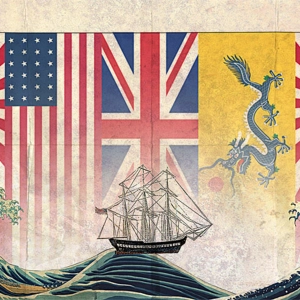
Otokichi's Long Trip Home

Otokichi's Long Trip Home

Author: DamnInteresting.com August 8, 2013 Duration: 12:24
While most of the major powers of western Europe spent the 17th, 18th, and 19th centuries racing around the world carving out empires for themselves, Japan felt threatened by the influx of foreigners and ended up spending this period as one of the most reclusive nations on the planet. In the 1630s, a series of proclamations closed the country’s borders, marking the beginning of the period now known as sakoku (‘locking the country’) or sometimes kaikin (‘sea-restriction’). Non-Japanese-citizens were not permitted on Japanese soil; potential violators were warned that they would be subject to capital punishment. Only a small amount of trade with China, Korea, and the Netherlands was permitted, and the Dutch were restricted to Dejima, an artificial island in the harbour at Nagasaki. Nor were Japanese citizens allowed to leave Japan. Even the construction of long-range ships was illegal. These measures remained in place well into the 19th century. But occasionally a group of Japanese citizens left Japan by mistake. Smaller ships were still permitted under sakoku since they played an indispensable role in the transportation of goods and people, and once in a while unpredictable forces of nature would drag one of these vessels away from the coast of Japan. In the autumn of 1832, for instance, a cargo-ship known as the Hojunmaru was transporting rice and porcelain to Edo (now Tokyo) when it ran into a storm and was blown off-course. The 15-metre-long ship was left far from shore without a rudder or a mast, meaning that there was no way to steer it. All that the crew could do was let their vessel drift on the ocean until they happened upon either another ship or a useful bit of land. For one of them in particular – 14-year-old Yamamoto Otokichi – this would prove to be only the beginning of a decades-long accidental circumnavigation of the globe.

The stories that shape our world are often hidden in plain sight, waiting for the right moment to reveal their strange and significant details. That's the territory explored by Damn Interesting, a narrative-driven podcast from the team at DamnInteresting.com. Each episode is a deep and immersive dive into a true story, told with the care and pacing of an audiobook. You'll find yourself pulled into meticulously researched accounts from the overlapping realms of science, medicine, history, and human behavior. One week might unravel a forgotten medical mystery, while the next could detail a pivotal, overlooked moment in technological history or a psychological phenomenon that explains more than we'd like to admit. This podcast is built on the conviction that reality, when examined closely, is far more compelling than fiction. The narration is clear and engaging, designed to make complex subjects accessible and to transform historical footnotes into gripping narratives. It’s for anyone with a restless curiosity about the how and why of things, offering those satisfying moments of connection where disparate facts suddenly click into place. Listening feels like uncovering a series of fascinating secrets, each story selected for its inherent ability to surprise and make you reconsider a piece of the world.

Author: Language: English Episodes: 73

Damn Interesting
Podcast Episodes
The Science of Mental Fitness [not-audio_url] [/not-audio_url]

Duration: 13:22
It’s a testament to the strength and versatility of the human brain that anyone with at least half of one tends to assume that their senses give them direct access to objective reality. The truth is less straightforward…
Nineteen Seventy Three [not-audio_url] [/not-audio_url]

Duration: 31:12
On 12 November 1971, in the presidential palace in the Republic of Chile, President Salvador Allende and a British theorist named Stafford Beer engaged in a highly improbable conversation. Beer was a world-renowned cyber…