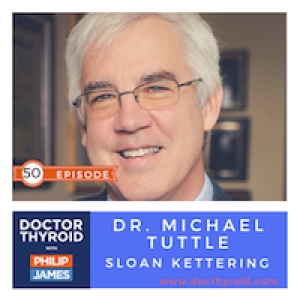
Many centers from around the world want to know how Memorial Memorial Sloan Kettering Cancer Center treats thyroid cancer. A key member of the MSKCC is Dr. Michael Tuttle.
During this interview, Dr. Tuttle discusses the following points:
- Challenges of managing thyroid cancer as outlined by the guidelines
- Scaling back care for insurance-challenged patients, and adopting a plan that gets the same result without needing the expensive tests
- Desired outcome is survival and no recurrence, a third is for no harm that would be caused by an unnecessary surgery
- Unwanted side affects of thyroid cancer include nerve damage, parathyroid damage, and infections
- RAI sometimes has unwanted side affects
- With technology, ultrasounds and biopsies, we know some cancers do not need to be treated, as they are now being found very early
- Change in ATA guidelines, low risk cancers can be considered for observation
- Two different kinds of patient profiles: Minimalist and Maximalist
- 1cm or 1.5cm?
- Patient characteristic, ultra sound characteristics, and the medical team characteristics weighs who is the most appropriate for observation
- 400 active surveillance patients currently at MSKCC
- Certain parts of the world are harder to offer observation as a treatment due to practicality, examples include Latina America where multi-nodular goiters are common, and Germany still is iodine deficient
About Dr. Tuttle, in his words:
I am a board-certified endocrinologist who specializes in caring for patients with advanced thyroid cancer. I work as part of a multidisciplinary team including surgeons, pathologists, radiologists, nuclear medicine specialists, and radiation oncologists that provides individualized care to patients treated at Memorial Sloan Kettering for thyroid cancer.
In addition to treating patients I am also actively researching new treatments for advanced thyroid cancer. I am a professor of medicine at the Joan and Sanford I. Weill Medical College of Cornell University and travel extensively both in the US and abroad, lecturing on the difficult issues that sometimes arise in the management of patients with thyroid cancer. My research projects in radiation-induced thyroid cancer have taken me from Kwajalein Atoll in the Marshall Islands to the Hanford Nuclear power-plant in Washington State to regions in Russia that were exposed to fallout from the Chernobyl accident.
I am an active member of the American Thyroid Association (ATA) and the Endocrine Society. In addition to serving on the ATA committee that produced the current guidelines for the management of benign and malignant nodules, I am also a Chairman of the National Comprehensive Cancer Network Thyroid Cancer Panel, a consultant to the Endocrinologic and Metabolic Drugs Advisory Committee of the FDA, and a consultant to the Chernobyl Tissue Bank.
- Clinical Expertise: Thyroid Cancer
- Languages Spoken: English
- Education: MD, University of Louisville School of Medicine
- Residencies: Dwight David Eisenhower Army Medical Center
- Fellowships: Madigan Army Medical Center
- Board Certifications: Endocrinology and Metabolism
NOTES
22: Avoiding Thyroid Cancer Surgery, Depending on the Size with Dr. Miyauchi from Kuma Hospital in Kobe, Japan
21: Diagnosed with Thyroid Cancer and You Say No to Surgery with Dr. Louise Davies
35: Rethinking Thyroid Cancer – When Saying No to Surgery Maybe Best for You with Dr. Allen Ho from Cedars-Sinai in Los Angeles
The American Thyroid Association