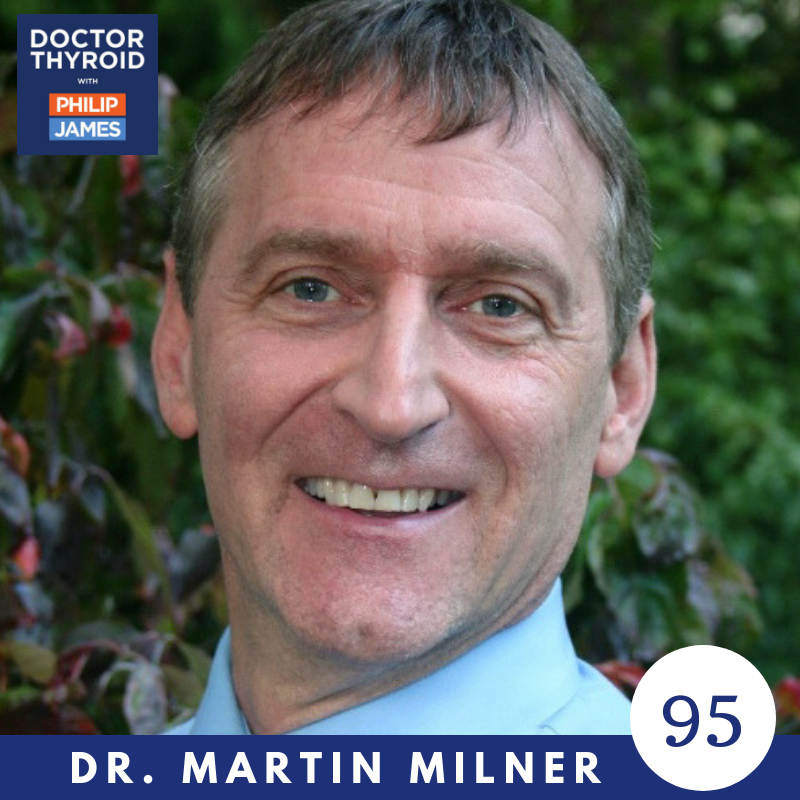
Dr. Milner is well published with texts, medical journal articles and studies in cardiology, endocrinology, pulmonology, oncology, and environmental medicine. Dr. Milner calls his practice "integrated endocrinology" balancing all the endocrine hormones using bio-identical hormone replacement and amino acid neurotransmitter precursors.
Dr. Milner's articles include treatment protocols for hypothyroidism, "Hypothyroidism: Optimizing Medication with Slow-Release Compounded Thyroid Replacement" was published in the peer review journal of compounding pharmacists, International Journal of Pharmaceutical Compounding.
In this interview, the following topics are discussed:
- Starving in the midst of plenty
- Slow release T3 and T4
- Hypothyroidism
- Hyperthyroidism or Graves Disease
- Often RAI leads to hypothyroidism
- Visiting a naturopath while being treated by traditional endocrinologist
- TSH suppression for thyroid cancer patients
- Ordering blood tests of TSH, Free T4, Free T4, and reverse T3
- Converting T4 into T3
- Slow released T3
- Manufactured T3 is not slow release
- 2005 article was published
- 150,000 pharmacist in U.S., and about 5,000 are compounding
- Slow release blends are the same T4 from Synthroid and T3 from Cytomel
- Slow release agent is hydroxypropyl melanose
- Side effects of too much T3 or T4
- The risk is compounder error or inconsistency
- Binder sensitivity is another reason for compounding
- Desiccated thyroid hormone compared to slow release
- Auto-immune disease and desiccated treatment
- Overwhelming response to slow release is when patients symptoms of hypothyroidism alleviate
- A small percentage of people do not do better on slow release
- Basel body temperatures
- 96.5 temperature in the morning, and hypothyroid symptoms is a concern in regard to treatment
- Testing temperature in the morning, ideally done using mercury thermometer
- How to use temperature testing as an indicator of hypothyroidism
- Body temp should be over 97.8 first thing in the morning
- Hypothyroidism will be overweight and difficult to lose weight, and brain fog, sluggish, dry skin, hair loss,
- Eating well, active, and weight gain
- Hypoglycemic or adrenal overload and low body temperature
- High cortisol levels
- Standard of care of Cytomel in contrast with conventional endocrinologist
- T3 has a short half life
- Half life — How long does it take a drug to bring blood levels to normal levels?
- Half life of T3 is up to 70 days
- Starving in the midst of plenty with T4
- Insurance coverage of slow release T3 — T4
- Cost of slow release T3 — T4 is approximately $40 monthly
- Most important testing for TT patient is checking parathyroid gland status — and their role in calcium function
- Important to measure calcium for TT patients
- Caution about soy, broccoli, brussel sprouts, cauliflower, and calcium and thyroid hormone
- When to thyroid replacement hormone — first thing in the morning, 1 hour before eating,
- T4 replacement before bed — advantages to more stable levels
- Slow release, combination therapy, should be taken in the morning
- Estrogen deficiency
- Brief summaries of the following symptoms: painful feet, dizziness, fatigue, hair loss, iron deficiency, chronic pain, tyrosine turning into dopamine and then adrenaline, sleep problems and anxiety and hypothyroidism, insomnia and cortisone and adrenaline at nigh and DHEA, cortisol measured throughout the day, muscle spasms,
- Avoid refined sugar and high amounts of alcohol
- Drink more water
- Caution: food and its importance: smoothies and soluble fiber — fiber interacts with nutrients. Avoid this, as it effects absorption of medications
- Emotional attachment to disease — fixation and complaining without making changes.
NOTES
International Academy of Compounding Pharmacists
75: Fat, Foggy, and Depressed After Thyroidectomy? You May Benefit From T3, with Dr. Antonio Bianco from Rush University
19: Hypothyroidism – Moving From Fat, Foggy & Fatigued to Feeling Fit & Focused with Elle Russ
Hypothyroidism: Optimizing Therapy with Slow-Release Compounded Thyroid Replacement