Blue Cliff Record Case 39: The Golden Haired Lion
A student asked Yunmen, “What is the pure and everlasting body of reality?”
Yunmen said, “A fence of flowers and healing herbs.”
The student asked, “What’s it like when I reach there?”
Yunmen said, “A golden-haired lion!”
I am landing back in Ohio after about two weeks visiting my old homes in Oregon, Great Vow Zen Monastery and Portland. I was at Great Vow for a weeklong sesshin that we call Grasses, Trees and the Great Earth—a unique retreat where we move the zendo outside, and sit in a circle together in ceremony with the Earth, Sky, Trees, Grasses and beings of the forest, meadow creek and pond.
I initially gave this series of talks in the heart of the summer, when flowers, healing herbs, tomatoes and blueberries are fruiting on the fences, in the gardens and windowsill pots of our lives.
A time of year that tropical astrologers assign to the constellation Leo, the lion—a fixed fire sign, ruled by the Sun. As Leo season ends, and we find ourselves in late summer, returning back to our own inner light, and the work that needs to be done. I offer these talks and reflections on the Golden Haired Lion, Koan Work and the Changing of the Seasons.
The ancient greek astrologers saw the sun as the heart of the cosmic animal as well as the heart of the human being. To know one’s heart was to connect to the wild, mysterious heart of the cosmos.
Lion-imagery crosses cultures. Lions have spoken to the human heart throughout antiquity we see remnants of this relationship today on the lion panel of the Chauvet Cave in France painted 30K years ago, in the image of the lion-headed dakini in Tibet, Sekhmet the Egyptian warrior-healer goddess with a lion head and in the strength card in the tarot.
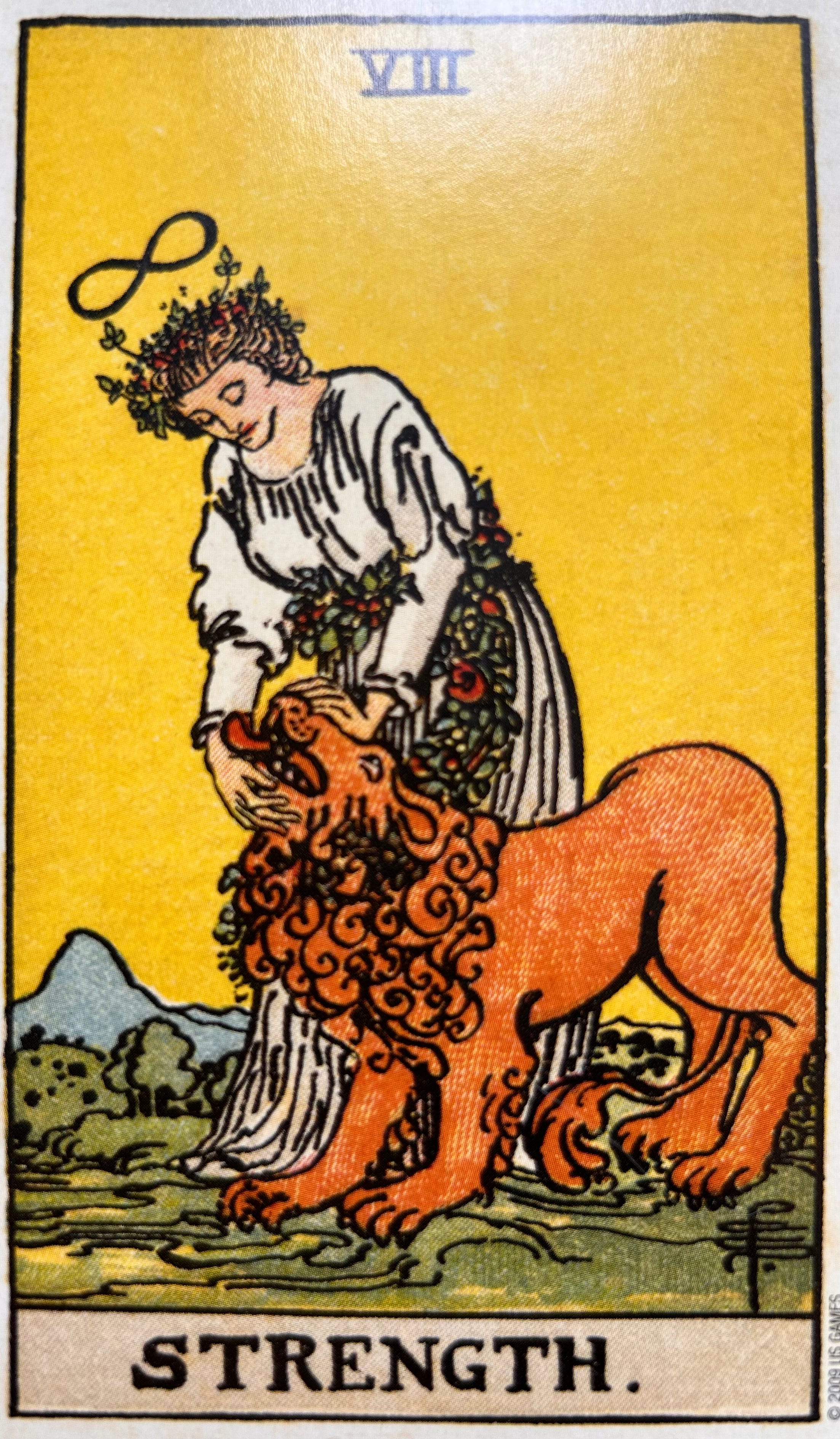
The RWS version of the strength card in the tarot is quite evocative of the imagery from this koan. A woman wearing flowers in her hair and on her dress, pets a seemingly tamed lion—framed by a bright yellow background invoking the summer sun.
Who or what are these part lion-part human beings?
Animals and nature frequent koans. I always feel like their appearance reminds us that our spiritual lives unfold within these animal bodies, within the place that we live, within our passions and desires. The appearance of a wild animal connects to our instincts. The lion to our sovereignty as well as our magical child.
So here we are again. Conversing with a Zen teacher about the body of reality. And again, the teacher points to the flowers. This time blooming together with medicinal herbs on a fence.
While the image was probably something in the immediate environment of the questioner. There are always levels of meaning and exploration within a single interaction. The questioner is asking—what is it? What is always present? Is there something that you can say to express the freedom and love of our original nature, how is it—what is it—right, here–right now?
Yunmen shares a bit of his mind by naming— the flowering fence, the medicinal herbs.
Images of beauty as well as nourishment—medicine. Alive right here in the present. Is beauty medicine? What nourishes your heart? This koan is very much a koan with heart.
Earth Dreams is a reader-supported publication. To receive new posts and support my work, consider becoming a free or paid subscriber.
Have you ever meditated on a flower? Or attended to a flower blooming over the course of days or weeks. Budding, the opening which is a process of contraction and expansion, then the full expression of its open-ness and followed by the falling petals that slowly turn to soil.
Flowers reveal nature's beauty in full display. Their sweet smells and arresting appearance attract humans as well as pollinators. Long associated with the heart, they show us something about the tender process of moving towards openness. As well as reflecting to us the nature of cycles and deep interconnection. Flowers are in-bedded in a place, they are relational.
In the Buddhist tradition the nature of mind, the pure body of reality, awareness is likened to a flower that is eternally blooming—always present. While simultaneously human life, the life of the world is —seasonal, is changing, is subject to the whims of nature, the turning of the earth, night and day and all the other beings that we share this cosmos with.
What’s it like when we realize the pure body of reality for ourselves?
A golden haired lion.
Together we share the great heart of the cosmos, like the lemniscate above the woman in the strength card—we recognize our continual inter-connection, our shared being with animal, earth, flower, night sky. We find and lose and find ourselves in the heart of our being.
In Hua-Yen Buddhism, the golden-haired lion is a symbol of inter-being, inter-penetration. Like a great hologram, it was said that each of the lion’s hairs contained the whole lion. So the lion itself was an embodiment of Indra's net. It was a symbol for the living body of reality, where everything is contained within everything else.
Majushri, the bodhisattva of Wisdom, is said to ride on this lion. Living this insight.
So the appearance of this lion in this koan is an invitation to walk through the world as such. Seeing everyone you meet, every interaction as a reflection of the whole cosmos. Similar to the gnostic belief that the divine is contained within each of us. We are of one substance, and we are utterly unique in our expressions. Our heart is both the heart of the cosmos, and our personal heart (soul/psyche) which will flower in its own way, based on the causes and conditions of our precious life.
The lion’s gaze is another teaching in the buddhist tradition. The analogy goes that if you throw a ball to a dog, the dog will run after the ball. If you throw a ball to a lion, the lion will look back at the source. As practitioner’s we train in the lion’s gaze. Instead of following every thought form that flashes through our mind, we trace the thoughts back to our embodied experience, back to awareness itself—back to the source.
We learn to gaze into the spacious source of our nature.
The images of a koan are like the images of a dream, or even a fairy tale. Where each image is us. We are questioner, we are teacher, we are flowers opening alongside medicinal herbs, we are fence, we are lion, we are the bodhisattva of wisdom.
Koans invite us to carry these images into our meditation practice and into our day. Where, like dreams, our associations carry insights into the more personal as well as archetypal dimensions of the koan.
Perhaps we will find ourselves practicing our roars, or walking with confidence, embodying courage, letting ourselves shine or take up space. Maybe we will learn more about the mythological lions from fairy tales.
Koans invite participation. Embodiment. Creativity.
What is it like to sit as a lion? To walk down the street as your lion self? To show-up at a meeting with lion-like courage or confidence, optimism? How familiar are you with your inner strength? What would it be like to practice the lion’s gaze when someone criticizes you, or when you criticize yourself?
What is it like to let yourself be accompanied by such a lion? This is something I love about koans, they offer support. Companionship. As we get acquainted with the lion of our true nature, we can imagine having them around. Perhaps like in the strength card.
Another dimension of this koan is the flower and the medicinal herbs. And so one tangible practice is to simply spend some time meditating with flowers or looking at flowers—really seeing them. Or maybe making yourself some medicinal herbal tea.
I have a few friends who as a practice always have a bouquet of flowers on their altar or table, as a way of connecting to beauty and remembering self-appreciation (one friend realized that it was a way of giving herself a gift everyday, the other said it was a small way of connecting to joy).
Last year Kennyo and I watched the early season of Twin Peaks, and there was this scene where Agent Cooper is getting pie at the dinner and he says to the sheriff Harry S Truman, “I give myself a gift everyday”.
This koan is also about that. How do you nourish your heart? How can you be generous with yourself? Can you do something generous for yourself everyday?
We might also try on some of the paradoxes these images hold. How can we be eternally blooming, and also allow all things to have their seasons? Can we sense our oneness, and allow each being to express themselves as they are?
As you can see, each koan contains a lot of teachings even within a few images. This layered aspect of koans is what makes them potent teaching tools. So notice, was there any part of the koan, any one of the images or the teachings that the image invokes that you are curious about or do you have an area of life that you feel concerned about, that you aren’t sure how to practice with—could the koan accompany you there….that might be the way to bring this teaching into your week.
…
Koan Practice and the Three Bodies of the Buddha
In this next talk, I take a deeper dive into how to work with a koan using Blue Cliff Record Case 39: The Golden Haired Lion. I provide a framework for koan practice from the teachings of the Three Bodies of Buddha—three aspects of our embodied awakened life, which are:
* Dharmakaya/Essence/Secret—koans point to our awakened nature, the ground of being, our shared light
* Sambhogakaya/Inner/Dream Body—working with koan images and energies can help us meet and work with the stuff of our own hearts and minds and empower us to cultivate the awakened qualities that the koan points to. Koan images can also act as dharma protectors, beings we can turn towards to help us meet the inner demons, distractions and deeply conditioned patterns of mind that cause suffering to others and ourselves
* Nirmanakaya/Outer/Form/Compassion Body—bringing the koan into our relationships, work we do, expression, embodiment, how we live
…
Seasons of Practice: Exploring Emptiness + Fullness
This final talk is a reflection + celebration of the end of summer and the practice opportunities that come with late Summer, a time symbolically represented by the Hermit.
…
I’m Amy Kisei. I am a Zen Buddhist Teacher, Spiritual Counselor, budding Astrologer and Artist. In my Spiritual Counseling Practice, I practice at the confluence of spirituality and psychology, integrating mind, body and spirit. I am trained in Internal Family Systems (IFS), Dream Work, Hakomi (Somatic Therapy) and Mindful Eating.
I also lead a weekly online meditation group through the Zen Community of Oregon and am leading a class series on the Zen Bodhisattva Precepts this Fall. Also if you are interested in workshopping your meditation practice join me in collaboration with Pause Meditation for a 5-week online class series called Beyond Mindfulness. More information can be found below.
Monday Night Meditation + Dharma
Every Monday 6P PT / 9P ET
Join me on zoom for 40 minutes of meditation and a dharma talk. We are currently exploring the freedom, spontaneity and love of our original nature through the teachings of the Zen koan tradition. Koans invite us into the mythos of practice awakening, gifting us with the ordinary images of our lives, they help awaken us to the wonder, intimacy and compassion of life as it is!
All are welcome to join. Drop in any time.
Zoom Link for Monday Night
Living the Questions: 16 Bodhisattva Precepts Class Series
Be patient with all that is unsolved in your heart. Try to love the questions themselves. Do not seek the answers, which can not be given to you, because you would not be able to live them. And the point is to live everything. Live the questions now. And perhaps you will then gradually…find yourself living the answer. — Rilke
Far from being a set of rules or doctrine that we must follow, the Bodhisattva precepts act as koans, inquiries that we are empowered to take into our life. They ask us to consider, what does love look like in this situation? In this relationship, how do I work with my anger? Who is it who wants to gossip, or inflate one’s self? How can I show up authentically in the world?
With the final five grave precepts, pure precepts and refuges as our guide we will explore the heart of what it means for each one of us to live a life of integrity and love. We will explore how each precept touches the personal, interpersonal, global and secret dimensions of our living.
Beyond Mindfulness: Deepening Your Meditation Practice Class Series
This workshop style course is designed to provide a map of the meditation path as well as:
* Introduce you to the five main styles of meditation (calm-abiding, concentration, heart-based practices, inquiry and open-awareness)
* Help you understand the intention of each method and how to practice it
* Help you understand how the various methods and techniques fit together and support each other
* Provide a fun, non-judgmental learning environment where you can try things out, ask questions and explore
* Give you the opportunity to work with a teacher with an extensive background in various meditation techniques
I currently live in Columbus, Ohio with my partner Patrick Kennyo Dunn, we facilitate an in-person meditation gathering every Wednesday from 7P - 8:30P at ILLIO in Clintonville through Mud Lotus Sangha. If you happen to be in Columbus, feel free to stop by. We have weekly meditation gatherings, and are offering a day of meditation in October.
This is a public episode. If you'd like to discuss this with other subscribers or get access to bonus episodes, visit
amykisei.substack.com/subscribe