Greetings Friends,
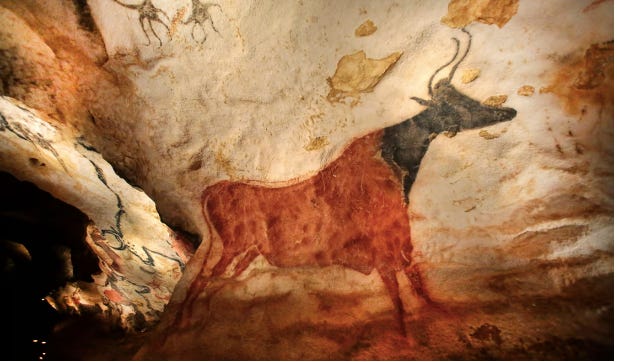
In the on-going exploration of the Ox-herding pictures, this podcast episode focuses on Kensho—the Japanese Zen Buddhist word for seeing into our true nature, which is the third of the ten ox-herding or bull-herding pictures. The image above is a bull painted in the Lascaux cave in France around 20k years ago. While maybe not as apparent to a modern person, the Ox and bull have a long relationship to human beings and in the history of religion and spirituality.
When I first encountered the cave paintings of Lascaux, I was awe-struck. They touch my artistic sensibilities and convey, at least to me, a spiritual intimacy. Painted in the dark, fertile womb of the earth—a cave—the animals within the walls portray a liveliness of both painter and animal. It is as if they share the same spirit.
In her article on Enlightenment and Awakening, Zen Buddhist Teacher Joan Sutherland tells a story of Chekhov and Tolstoy as a way of illuminating the insight of a kensho experience, she says:
How large is the self softly illuminated by the moon of enlightenment? Tolstoy and Chekhov were on a walk in the spring woods when they encountered a horse. Tolstoy began to describe how the horse would experience the clouds, trees, smell of wet earth, flowers, sun. Chekhov exclaimed that Tolstoy must have been a horse in a previous life to know in such detail what the horse would feel. Tolstoy laughed and said, “No, but the day I came across my own inside, I came across everybody’s inside.”
She goes on to describe that awakening doesn’t belong to buddhists or buddhas saying:
Awakening is autonomous, existing before there were humans, or anything else, to experience it. This is personified in Prajnaparamita, mother of buddhas, who holds the universe’s awakening, regardless of whether there are buddhas or Buddhist teachings in a particular era.
Though I have never met these artists or animals, I feel something of them even 20k after they lived. Could it be that these artists too, knew the mind before thought—the great expanse of prajna paramita? Sitting in the womb of the earth, the radiant blackness of the wisdom mother—they lost themselves as individuals and became tiger, bull, horse—the goddess herself? Portraying their likeness on these cave walls as an act of devotion, a gesture of love?
Once I came across my own inside, I came across everyone’s inside.
In her book on the Image of the Goddess Anne Baring connects these early cave painting cultures to the earliest depiction of a mother goddess that historians are aware of. Wisdom beyond wisdom, need not be gendered for it points to that which is prior to gender, body, form, all dualities—and yet, the metaphor of the great mother captures something essential. From the darkness of this cave-like womb—bull, hand, paint, tiger, woman, voice, body, me, you!
We are currently in week one of a 14-week class series I am offering on the Sacred Feminine—as I post this recording on kensho— I am feeling how deeply the two intersect for me. As a Zen practitioner Prajna Paramita—wisdom beyond wisdom—wasn’t something I immediately connected with as a feminine deity or mother goddess.
Throughout the years of practice, my practice has taken on more of a devotional flavor. As I learned more about the image and history of the goddess, prajna paramita—mother of all buddhas, I feel how her depiction helps me open to the spaciousness, compassionate, freedom of Mind’s nature.
I have a practice now of embodying the goddess, allowing my body to take the form of prajna paramita, and everything that arises in the space of awareness—body sensations, sounds, thoughts, images, feelings, emotions—are all a manifestation of prajna paramita—wisdom beyond wisdom. Inseparable for the light of awareness.
Where have you encountered the goddess?
Can you see her—right now?
When I look, she is everywhere:
In the freedom and play of The Art Ensemble of Chicago and Moor Mother’s spoken word poetry. In the oak tree still holding some of his leaves and the babbling creek running gently in spring sun, in the city lights twinkle, and the burgeoning trunk jade plant on my desk—she is everywhere, miss true nature—and gratitude, devotion, wonder and awe arise in this heart when I catch a glimpse of her various forms of compassionate expression.
Can you really see her everywhere? In everyone and everything. When my heart trembles in fear, or I feel sadness over the suffering in the world—I invite this inquiry. This too, the wisdom and compassion of our awakened nature. This too, none other than the goddess’s compassionate manifestation. This too, the spontaneous expression of the OX. For me, this is a koan worth pursuing.
With just one glance of Miss Original Face
Standing there you will fall in love with her. —Zen Master Ikkyu
Each of the ox-herding pictures has a prose teaching and poem to accompany them. Below is the image, prose and poem for the third picture sometimes called Seeing the OX or The First Glimpse of Self.
PROSE
Through sound you gain entry, by sight you face your source.
The six senses are not different, in every activity it’s plainly there.
Like salt in water or glue in paint. Raise your eyebrows—it’s just right here.
POEM
In the trees nightingales sing and sing again
Sun warms the soft wind, green willows line the bank
Here, there’s nowhere left for it to hide,
It’s majestic head and horns no artist could draw
The recorded talk is commentary on this vital stage of the path, which includes commenting on these teaching points found in the prose and poem. Please enjoy and feel free to comment. I am curious to hear about your experience of Awakening, Prajna Paramita, devotion or anything else that touched you in either this written piece or the dharma talk.
This Saturday I will be offering a daylong online meditation retreat exploring the Zen teachings of Shunyata, emptiness—an often misunderstood yet vital aspect of practice-awakening. We will be sharing teachings, guided practice sessions and recordings will be available for anyone who registers. You can learn more here.
On Sunday evening 8P ET/5P PT, I will be hosting the monthly online dream drop-in group called DreamSky. Anyone is welcome to attend, click the link to learn more.
I feel deep gratitude to be on this path of discovery with all of you!
Love,
Amy Kisei
This is a public episode. If you'd like to discuss this with other subscribers or get access to bonus episodes, visit
amykisei.substack.com/subscribe