Ep 178 Hand Injuries – Pitfalls in Assessment and Management

Ep 178 Hand Injuries – Pitfalls in Assessment and Management

Author: Dr. Anton Helman January 31, 2023 Duration: 1:06:08
The hand is anatomically complex. Having an anatomical-based approach to the assessment of patients who present to the Emergency Department is important to preserve quality of life following a hand injury. Hand injuries are the second most common injury leading to days without work. It is no surprise then that open finger injuries land in the top 10 most common diagnoses that end up in court. In this first part of our two-part series on hand injuries Dr. Matt Distefano and Dr. Arun Sayal guide us through the principles and pitfalls of assessment and management of hand injuries and answer questions such as: what is the differential diagnosis of a globally swollen hand? What is the intrinsic minus hand position? When should we suspect compartment syndrome of the hand? How should we best locate retracted lacerated tendons of the hand? What are the best ways to control bleeding of a finger tip amputation? What are the best analgesic choices? How large of a skin avulsion hand injury should we let heal by secondary intention rather than recommend a flap/skin graft? and many more...

Hosted by Canadian emergency physician Dr. Anton Helman, Emergency Medicine Cases is a trusted audio resource that feels like having a seasoned colleague by your side during a complex shift. Each episode dives deep into the nuanced, high-stakes decisions that define emergency care, moving beyond textbook summaries to explore the real-world application of the latest evidence and clinical wisdom. You’ll hear detailed discussions with leading specialists, breaking down challenging presentations, diagnostic pitfalls, and cutting-edge treatments. This podcast is designed for the practicing clinician who wants to refine their approach, whether they’re managing a critical trauma, an ambiguous abdominal pain, or a puzzling pediatric fever. The conversations are thorough and grounded, offering practical takeaways you can use immediately. For those who want to engage further, extensive show notes, quizzes, and supplementary videos are available online to solidify your learning. Tune in to stay sharp, confident, and current in the fast-paced world of emergency medicine.
Author: Language: en-ca Episodes: 100

Emergency Medicine Cases
Podcast Episodes
Ep 209 Nondisabling Stroke Recognition and Management [not-audio_url] [/not-audio_url]

Duration: 1:19:30
In this Part 2 or our 2-part podcast update on ED stroke management with Dr. Katie Lin and Dr. Walter Himmel we explore non-disabling strokes, where symptoms are mild enough that patients can continue daily activities if…
Ep 207 Sleep Strategies for Shift Work [not-audio_url] [/not-audio_url]

Duration: 1:21:04
Discover evidence-based sleep strategies for shift workers. Optimize performance, recovery, and health with tips from sleep expert Dr. Michael Mak... If you find this beneficial please consider a donation to support EM C…
Ep 206 Massive Hemorrhage Protocols 2.0 – Update on the 7 Ts [not-audio_url] [/not-audio_url]

Duration: 1:27:13
In this update to the 7 T’s of Massive Hemorrhage Protocols with Dr. Jeannie Callum and Dr. Andrew Petrosoniak, we explore the most current, evidence-informed strategies for bleeding patients, from polytrauma to obstetri…
EM Quick Hits 66 Pediatric Torticollis, Stable Wide Complex Tachydysrhythmias, Post-intubation Neurocritical Care, Hyponatremia Correction Rates, Paronychia Management, Women in EM Leader Series with Judith Tintinalli [not-audio_url] [/not-audio_url]

Duration: 1:31:24
On this EM Quick Hits podcast: Pediatric Torticollis with Dr. Deb Shconfeld, Approach to Stable Wide Complex Tachydysrhythmias with Dr. Anand Swaminathan, Post-intubation Neurocritical Care 5 best practices with Dr. Andr…
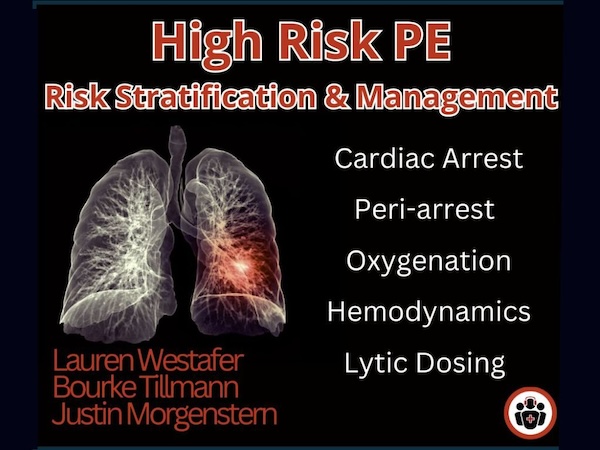
Ep 204 High Risk Pulmonary Embolism Management [not-audio_url] [/not-audio_url]

Duration: 1:24:06
There are many nuances in the management of patients with pulmonary embolism in cardiac arrest, peri-arrest or simply in shock: We need to optimize oxygenation and airway management, hemodynamic support, acid/base manage…