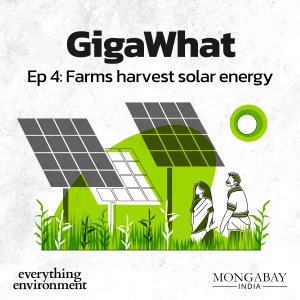
GigaWhat: Farms harvest solar energy

GigaWhat: Farms harvest solar energy

Author: Mongabay.com April 25, 2022 Duration: 18:19

What are the high hurdles for India to uplift its people and realise its potential on the world stage? Two of the most significant ones are securing food for its large population and providing enough energy to power homes and industries.

As it has always been, land, as a resource, is a precious commodity for both farming, and energy production. On the one hand, it is estimated that nearly 58 percent of India's 1.2 billion people are engaged in agriculture, which occupies 60 percent of its total land area.

On the other hand, to generate electricity, the country requires thousands of square kilometres of land for coal mines, thermal power plants, and renewable energy projects to meet its energy needs.

A 2019 study noted that fulfilling India's 2022 goal of 175 GW of renewable energy could impact agricultural areas nearly the size of Himachal Pradesh.

Solar power projects that will contribute to more than half of our 450 GW renewable energy target by 2030, require a lot of land for its most popular form of large solar parks. In places where a solar project eyes fertile and cultivated land, it could lead to social unrest from people directly or indirectly losing livelihoods. This, in turn, means delays and financial losses for energy companies.

What is the solution to this complex challenge? Agricultural and energy researchers are turning to one design-based solution to optimise land usage. The idea is to use the same plot of land to harvest crops…and energy by placing solar panels over fields. The system is called agrivoltaics.

In this episode, we will hear from some of the forerunners in agrivoltaics in India. They'll speak about the potential and roadblocks in the field. We'll discuss what this new way of looking at farmland could mean for a key stakeholder in agrivoltaics - the farmer.

Listen to GigaWhat and explore some of the biggest questions, challenges, and opportunities in India's transition from fossil fuel to clean energy sources. Mongabay-India is an online publication dedicated to bringing you stories on science and the environment in India.

Read the full Clean energy series on our website

Follow us on Twitter and Instagram 

Subscribe to our newsletter

Guests:

Nutan Kaushik, Director General, Amity Food and Agriculture Foundation

Maximilian Vorast, Research Assistant, Fraunhofer Institute for Solar Energy Systems

Shravan Sampath, CEO, Oakridge Energy

Links:

Agrivoltaics in India: Fertile Ground?

Agriculture in India

Agrivoltaics in India: Overview of operational Projects and relevant Policies

Renewable Energy and Land Use in India: A Vision to Facilitate Sustainable Development

Credits:

Host: Mayank Aggarwal

Writer and producer: Kartik Chandramouli

Audio editor: Tejas Dayananda Sagar

Copy editor: Priyanka Shankar

Podcast production assistant: Ayushi Kothari

Episode cover art: Mohit Negi

GigaWhat cover art: Pooja Gupta


From the team at Mongabay.com comes Everything Environment by Mongabay India, a podcast that digs into the complex and often overlooked stories shaping India's natural world. This isn't just about headlines; it's about connecting the dots between biodiversity, climate change, and the natural resources that underpin daily life across the subcontinent. Each episode is a deep dive, whether it's examining the real-world impacts of the country's clean energy transition, uncovering lessons from ancient paleoscience, or giving a voice to lesser-known species fighting for survival. The conversations move beyond abstract problems to focus on tangible solutions and the people on the front lines. By weaving science and news into compelling narrative, this podcast places environmental discussions exactly where they belong: central to our understanding of India's present and future. You'll hear clear analysis and on-the-ground reporting that makes intricate topics accessible, fostering a deeper appreciation for the interconnectedness of ecology, policy, and community. For anyone curious about the forces shaping our environment, this series offers essential listening.
Author: Language: English Episodes: 28

Everything Environment by Mongabay India
Podcast Episodes
Wild Frequencies #3: Us and Them [not-audio_url] [/not-audio_url]

Duration: 46:20
If we listen closely, a bird's call reflects what humans have done to its landscape, and a forest soundscape tells us about habitat health. Listen to the third episode of Wild Frequencies to learn how scientists use bioa…
Wild Frequencies #2: Know Them [not-audio_url] [/not-audio_url]

Duration: 41:10
Can we figure out animal behaviour by listening to the sounds they produce? In this episode, you'll hear from scientists who listen closely to wildlife ranging from large mammals to insects. Wild Frequencies is a three-p…
Wild Frequencies #1: Find Them [not-audio_url] [/not-audio_url]

Duration: 42:28
Most wild animals are not easy to spot. They are often hidden, camouflaged, or just not around when you are. But instead of trying to 'see' them, what if we try and 'listen' to them? After all, animals communicate. For s…
Trailer: Wild Frequencies [not-audio_url] [/not-audio_url]

Duration: 2:02
Animals communicate. And some researchers listen to what they are saying. Hosts Shreya Dasgupta and Kartik Chandramouli travelled to different parts of India and spoke to multiple scientists to hear stories of sounds fro…
Environomy #6: A Challenge Across Generations [not-audio_url] [/not-audio_url]

Duration: 22:34
In this sixth and final episode of Environomy, we will explore how India has dealt with issues related to biodiversity and climate change since the 1991 economic reforms. Since the national government has taken a strong…
Environomy #5: The One That Got Missed [not-audio_url] [/not-audio_url]

Duration: 20:37
Though farming contributes less than 20% of India's GDP, it provides livelihood support to nearly half of the country's population. It is an extremely challenging occupation, with many from the younger generation unwilli…
Environomy #4: India Buys A Fast Car [not-audio_url] [/not-audio_url]

Duration: 15:53
There are traffic jams on India's hill stations and mountain roads across the year. It wasn't always like this. Increased incomes of the Indian middle class after the 1991 economic reforms translated to improved mobility…
Environomy #3: Playing With The Pillars [not-audio_url] [/not-audio_url]

Duration: 16:04
The legislature, the executive, and the judiciary, form the three pillars of Indian democracy. The legislature consisting of the parliamentarians, and legislators are the policy makers who draw up acts and policies. The…
Environomy #2: They Came, They Rapped, They Lobbied [not-audio_url] [/not-audio_url]

Duration: 15:47
In the early 1990s, the anti-Tehri dam and anti-Narmada dam movements were India's most well-known environmental protests. It was not as if only environmental activists were involved with these movements. The development…
Environomy #1: The Middle Class Unbottled [not-audio_url] [/not-audio_url]

Duration: 10:48
How did the 1991 economic reforms impact the course of the Indian environment in the past three decades? Listen to Environomy's first episode, where we will look at how the Indian middle class acquired a distinct economi…