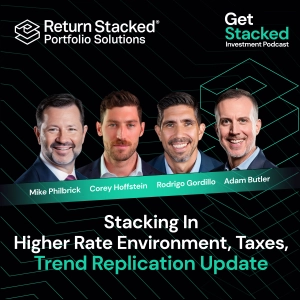
Based on our Q1 2026 commentary for the Return Stacked ETF suite, Corey Hoffstein and Adam Butler provide a detailed analysis of the strong quarter for trend following and carry, with a particular focus on the energy complex's impact. The conversation also explores the unique diversification benefits of merger arbitrage and provides a three-year retrospective on the efficacy of their trend replication models.
Topics Discussed
- Overview of the Return Stacked ETF suite's growth and the core concept of capital efficiency
- In-depth look at the trend following strategy, highlighting its three-year success in replicating the managed futures category beta
- Analysis of the Carry strategy's strong Q1 performance, primarily driven by geopolitical events affecting the energy markets
- Discussion of the Merger Arbitrage strategy as a unique diversifier against traditional credit risk
- Examination of the RSSX ETF, which stacks a risk-balanced overlay of gold and Bitcoin on U.S. equities
- Demonstration of the new Portfolio Visualizer tool for modeling and understanding Return Stacking concepts
- Explanation of why broad market diversification, not just shorting equities, provides crisis alpha in trend strategies
- Discussion on the complementary relationship between Trend and Carry strategies in different market environments
The performance data quoted above represents past performance. Past performance does not guarantee future results. The investment return and principal value of an investment will fluctuate so that an investor's shares, when sold or redeemed, may be worth more or less than their original cost, and current performance may be lower or higher than the performance quoted above.
For prospectus and performance and risks visit the fund pages.
RSST – https://www.returnstackedetfs.com/rsst-return-stacked-us-stocks-managed-futures/
RSIT - https://www.returnstackedetfs.com/rsit-international-stocks-managed-futures/
RSBT – https://www.returnstackedetfs.com/rsbt-return-stacked-bonds-managed-futures/
RSSY – https://www.returnstackedetfs.com/rssy-return-stacked-us-stocks-futures-yield/
RSBY – https://www.returnstackedetfs.com/rsby-return-stacked-bonds-futures-yield/
RSBA – https://www.returnstackedetfs.com/rsba-return-stacked-bonds-merger-arbitrage/
RSSB – https://www.returnstackedetfs.com/rssb-return-stacked-global-stocks-bonds/
RSSX – https://www.returnstackedetfs.com/rssx-return-stacked-us-stocks-gold-bitcoin/
BTGD – https://quantifyfunds.com/stackedbitcoingoldetf/btgd/
RSSX does not invest directly in Bitcoin or Gold.
Investors should carefully consider the investment objectives, risks, charges and expenses of the Return Stacked® U.S. Stocks & Gold/Bitcoin ETF. This and other important information about the ETF is contained in the prospectus, which can be obtained by calling 1-844-737-3001 or clicking here. The prospectus should be read carefully before investing.
The Return Stacked® U.S. Stocks & Gold/Bitcoin ETF is distributed by Foreside Fund Services, LLC, Member FINRA/SIPC. Foreside is not related to Tidal, Newfound, or ReSolve.
Definitions:
Duration: refers to the average life of a debt instrument and serves as a measure of that instrument’s interest rate risk. Beta: how much an investment moves vs. a benchmark (like the market). Alpha: refers to returns above that of a passive market benchmark SocGen: is a common abbreviation for Société Générale S.A. Trend Index: tracks returns from trend-following strategies, aiming to capture gains from sustained market price movements across assets. FTSE 100 Index: Financial Times Stock Exchange 100 Index DAX index: Deutscher Aktienindex is the benchmark stock market index of the Frankfurt Stock Exchange Nikkei 225 or Nikkei Stock Average is the leading stock market index for the Tokyo Stock Exchange (TSE) Alpha merger Index: tracks returns from merger arbitrage strategies, aiming to capture deal-related profits independent of the broader market.
A fund’s NAV is the sum of all its assets less any liabilities, divided by the number of shares outstanding. The market price is the most recent price at which the fund was traded.
Investments involve risk. Principal loss is possible. Unlike mutual funds, ETFs may trade at a premium or discount to their net asset value. Brokerage commissions may apply and would reduce returns. Bitcoin Investment Risk: The Fund’s indirect investment in bitcoin, through futures contracts and Underlying Funds, exposes it to the unique risks of this emerging innovation. Bitcoin’s price is highly volatile, and its market is influenced by the changing bitcoin network, fluctuating acceptance levels, and unpredictable usage trends. Not being a legal tender and operating outside central authority systems like banks, bitcoin faces potential government restrictions. The value of bitcoin has historically been subject to significant speculation, making trading and investing in bitcoin reliant on market sentiment rather than traditional fundamental analysis. Blockchain Technology Risk: Blockchain technology, which underpins bitcoin and other digital assets, is relatively new, and many of its applications are untested. The adoption of blockchain and the development of competing platforms or technologies could affect its usage. Cayman Subsidiary Risk: By investing in the Fund’s Cayman Subsidiary, the Fund is indirectly exposed to the risks associated with the Subsidiary’s investments. The futures contracts and other investments held by the Subsidiary are subject to the same economic risks that apply to similar investments if held directly by the Fund. The Subsidiary is not registered under the 1940 Act, and, unless otherwise noted in the Fund’s Prospectus, is not subject to all the investor protections of the 1940 Act. Commodity Risk: Investing in physical commodities is speculative and can be extremely volatile. Commodity-Linked Derivatives Tax Risk: The tax treatment of commodity-linked derivative instruments may be adversely affected by changes in legislation, regulations, or other legally binding authority. As a registered investment company (RIC), the Fund must derive at least 90% of its gross income each taxable year from certain qualifying sources of income under the Internal Revenue Code. If, as a result of any adverse future legislation, U.S. Treasury regulations, and/or guidance issued by the Internal Revenue Service, the income of the Fund from certain commodity-linked derivatives, including income from the Fund’s investments in the Subsidiary, were treated as non-qualifying income, the Fund may fail to qualify as RIC and/or be subject to federal income tax at the Fund level. The uncertainty surrounding the treatment of certain derivative...