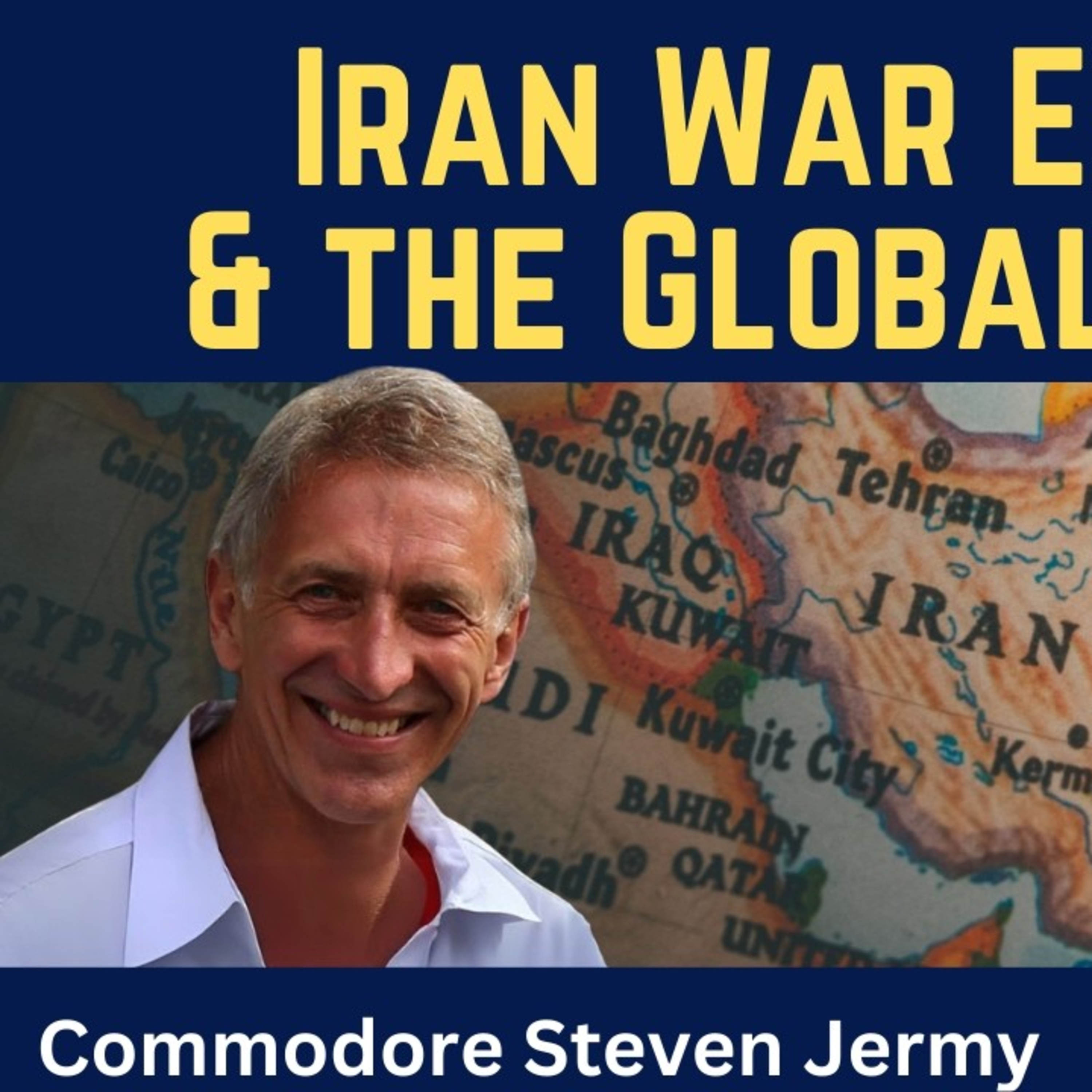
Steven Jermy: Iran War Endgame & the Global Fallout


Author: Glenn Diesen March 2, 2026 Duration: 54:02
Podcast episode
Steven Jermy: Iran War Endgame & the Global Fallout

Royal Navy Commodore Steve Jermy commanded warships in the 5th Destroyer Squadron and Britain's Fleet Air Arm. He served in the Falklands War and in the Adriatic for the Bosnian and Kosovo campaigns. Then retired after an operational tour, in 2007, as Strategy Director in the British Embassy in Afghanistan. He is the author of the book: "Strategy for Action: Using Force Wisely in the 21st Century".https://www.amazon.co.uk/Strategy-Action-Using-Wisely-Century/dp/1908134003Follow Prof. Glenn Diesen: Substack: https://glenndiesen.substack.com/ X/Twitter: https://x.com/Glenn_DiesenPatreon: https://www.patreon.com/glenndiesen Support the research by Prof. Glenn Diesen: PayPal: https://www.paypal.com/paypalme/glenndiesenBuy me a Coffee: buymeacoffee.com/gdiesengGo Fund Me: https://gofund.me/09ea012fBooks by Prof. Glenn Diesen: https://www.amazon.com/stores/author/B09FPQ4MDL


More episodes

Duration: 57:40
I had a conversation with Professor Jeffrey Sachs and Alexander Mercouris about the possibility of Trump delivering peace in the Middle East and Ukraine. Trump recently posted a video of Professor Sachs criticising the presentation of international conflicts as a struggle between democracy and authoritarianism. In the video, Professor Sachs also scolded Netanyahu and blamed Israel for America’s wars in the Middle East over the past 30 years (Netanyahu will reportedly not attend Trump’s inauguration). Trump has also recognised that NATO expansionism was the source of the proxy war in Ukraine, and has been vocal about his desire to end the proxy. These actions give some reason for cautious optimism that peace can be achieved at a time when the world appears to be heading toward major wars. The false narratives that conflict in the world derives from a struggle between democracy and authoritarianism create a dangerous Manichaean worldview. Peace then requires good defeating evil, while co…

Duration: 1:21:01
I had a conversation with Alexander Mercouris and Andrei Nekrasov - a renowned film director who made a documentary about the Magnitsky Act. Nekrasov is known for making documentaries that are very critical of the Kremlin, and he received funding in the West to make a documentary about the death of Sergey Magnitsky. The story about a ruthless Russian government that killed a whistle-blower was a perfect story for a Western audience that is consistently fed stories about international politics as a struggle between good and evil. The narrative of Magnitsky also laid the foundation for the Magnitsky Act in 2012, a set of anti-Russian sanctions that contributed to derailing relations between the West and Russia. However, when making the film, Nekrasov discovered that the story being pushed was full of lies. Nekrasov focused on the facts rather than the narrative, and the documentary was subsequently censored and banned across the West. The Magnitsky Act was a precursor to the Russiagate h…

Duration: 1:07:27
Professor Jeffrey Sachs of Columbia University is interviewed by Dan Klein about being an economist and the economics profession today. The conversation turns to his own ideological outlook and whether it has changed over the decades. The second half of the conversation is about the Deep State and US foreign policy, particularly with respect to Russia. Sachs explains why the globalists’ aim to regime change Russia and break up the Russian Federation is unjust. And he explains what it is that animates that unjust aim.

Duration: 1:31:28
I was invited by Massachusetts Peace Action to discuss the narratives used by the US and NATO to pursue a long war in Ukraine. I am very grateful to Massachusetts Peace Action for their initiatives to end the war, as the call for diplomacy has sadly been demonised as “controversial” or even treasonous over the past years.A key false narrative has been that Russia’s invasion was unprovoked, a lie that largely went unchallenged as any dissent could be portrayed as an effort to “legitimise” or even support the invasion. Once the premise of an unprovoked invasion was established, any diplomacy and negotiations could be presented as “rewarding Putin” and the only solution was a military victory. The obligatory Hitler analogy also meant that negotiations are appeasement and peace requires victory on the battlefield. The injustice and suffering of Ukrainians was weaponised as “helping Ukraine” is consistently translated into further fuelling the war and rejecting diplomacy. Much like in Afgha…

Logo
Select station
VOL