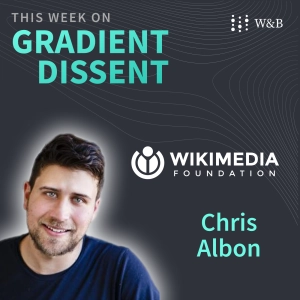
Chris Albon — ML Models and Infrastructure at Wikimedia

Chris Albon — ML Models and Infrastructure at Wikimedia

Author: Lukas Biewald September 23, 2021 Duration: 56:15

In this episode we're joined by Chris Albon, Director of Machine Learning at the Wikimedia Foundation.

Lukas and Chris talk about Wikimedia's approach to content moderation, what it's like to work in a place so transparent that even internal chats are public, how Wikimedia uses machine learning (spoiler: they do a lot of models to help editors), and why they're switching to Kubeflow and Docker. Chris also shares how his focus on outcomes has shaped his career and his approach to technical interviews.

Show notes: http://wandb.me/gd-chris-albon

---

Connect with Chris:

- Twitter: https://twitter.com/chrisalbon

- Website: https://chrisalbon.com/

---

Timestamps:

0:00 Intro

1:08 How Wikimedia approaches moderation

9:55 Working in the open and embracing humility

16:08 Going down Wikipedia rabbit holes

20:03 How Wikimedia uses machine learning

27:38 Wikimedia's ML infrastructure

42:56 How Chris got into machine learning

46:43 Machine Learning Flashcards and technical interviews

52:10 Low-power models and MLOps

55:58 Outro


Lukas Biewald hosts Gradient Dissent: Conversations on AI, a series that moves beyond theoretical discussions to examine how artificial intelligence is actually built and deployed. Each episode features a direct, unscripted talk with a leading practitioner-you’ll hear from engineers and researchers at places like NVIDIA, Meta, Google, Lyft, and OpenAI. The focus is on the tangible challenges and breakthroughs they encounter, from initial research to the complex reality of putting models into production. This isn't about abstract futures; it's a grounded look at the decisions shaping the field right now. Biewald, bringing his perspective from Weights & Biases, steers conversations toward the practical trade-offs and collaborative efforts that define modern AI work. For anyone in technology or business who wants to understand the mechanics behind the headlines, this podcast offers a rare, candid window into the process. You’ll come away with a clearer sense of how ideas become functional systems and what it really takes to operate at the cutting edge.
Author: Language: English Episodes: 100

Gradient Dissent: Conversations on AI
Podcast Episodes
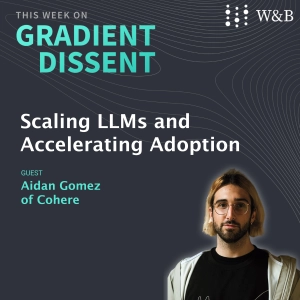
Scaling LLMs and Accelerating Adoption with Aidan Gomez at Cohere [not-audio_url] [/not-audio_url]

Duration: 51:31
On this episode, we’re joined by Aidan Gomez, Co-Founder and CEO at Cohere. Cohere develops and releases a range of innovative AI-powered tools and solutions for a variety of NLP use cases.We discuss:- What “attention” m…
Neural Network Pruning and Training with Jonathan Frankle at MosaicML [not-audio_url] [/not-audio_url]

Duration: 1:02:00
Jonathan Frankle, Chief Scientist at MosaicML and Assistant Professor of Computer Science at Harvard University, joins us on this episode. With comprehensive infrastructure and software tools, MosaicML aims to help busin…
Shreya Shankar — Operationalizing Machine Learning [not-audio_url] [/not-audio_url]

Duration: 54:38
About This EpisodeShreya Shankar is a computer scientist, PhD student in databases at UC Berkeley, and co-author of "Operationalizing Machine Learning: An Interview Study", an ethnographic interview study with 18 machine…
Jeremy Howard — The Simple but Profound Insight Behind Diffusion [not-audio_url] [/not-audio_url]

Duration: 1:12:57
Jeremy Howard is a co-founder of fast.ai, the non-profit research group behind the popular massive open online course "Practical Deep Learning for Coders", and the open source deep learning library "fastai".Jeremy is als…
Jerome Pesenti — Large Language Models, PyTorch, and Meta [not-audio_url] [/not-audio_url]

Duration: 52:35
Jerome Pesenti is the former VP of AI at Meta, a tech conglomerate that includes Facebook, WhatsApp, and Instagram, and one of the most exciting places where AI research is happening today.Jerome shares his thoughts on T…