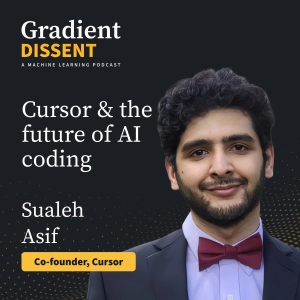
Inside Cursor: The future of AI coding with Co-founder Sualeh Asif

Inside Cursor: The future of AI coding with Co-founder Sualeh Asif

Author: Lukas Biewald April 29, 2025 Duration: 49:36

In this episode of Gradient Dissent, host Lukas Biewald talks with Sualeh Asif, the CPO and co-founder of Cursor, one of the fastest-growing and most loved AI-powered coding platforms. Sualeh shares the story behind Cursor’s creation, the technical and design decisions that set it apart, and how AI models are changing the way we build software. They dive deep into infrastructure challenges, the importance of speed and user experience, and how emerging trends in agents and reasoning models are reshaping the developer workflow.

Sualeh also discusses scaling AI inference to support hundreds of millions of requests per day, building trust through product quality, and his vision for how programming will evolve in the next few years.

⏳Timestamps:

00:00 How Cursor got started and why it took off

04:50 Switching from Vim to VS Code and the rise of CoPilot

08:10 Why Cursor won among competitors: product philosophy and execution

10:30 How user data and feedback loops drive Cursor’s improvements

12:20 Iterating on AI agents: what made Cursor hold back and wait

13:30 Competitive coding background: advantage or challenge?

16:30 Making coding fun again: latency, flow, and model choices

19:10 Building Cursor’s infrastructure: from GPUs to indexing billions of files

26:00 How Cursor prioritizes compute allocation for indexing

30:00 Running massive ML infrastructure: surprises and scaling lessons

34:50 Why Cursor chose DeepSeek models early

36:00 Where AI agents are heading next

40:07 Debugging and evaluating complex AI agents

42:00 How coding workflows will change over the next 2–3 years

46:20 Dream future projects: AI for reading codebases and papers

🎙 Get our podcasts on these platforms:


Follow Weights & Biases:


Lukas Biewald hosts Gradient Dissent: Conversations on AI, a series that moves beyond theoretical discussions to examine how artificial intelligence is actually built and deployed. Each episode features a direct, unscripted talk with a leading practitioner-you’ll hear from engineers and researchers at places like NVIDIA, Meta, Google, Lyft, and OpenAI. The focus is on the tangible challenges and breakthroughs they encounter, from initial research to the complex reality of putting models into production. This isn't about abstract futures; it's a grounded look at the decisions shaping the field right now. Biewald, bringing his perspective from Weights & Biases, steers conversations toward the practical trade-offs and collaborative efforts that define modern AI work. For anyone in technology or business who wants to understand the mechanics behind the headlines, this podcast offers a rare, candid window into the process. You’ll come away with a clearer sense of how ideas become functional systems and what it really takes to operate at the cutting edge.
Author: Language: English Episodes: 100

Gradient Dissent: Conversations on AI
Podcast Episodes
Matthew Davis — Bringing Genetic Insights to Everyone [not-audio_url] [/not-audio_url]

Duration: 43:02
Matthew explains how combining machine learning and computational biology can provide mainstream medicine with better diagnostics and insights. --- Matthew Davis is Head of AI at Invitae, the largest and fastest growing…
Clément Delangue — The Power of the Open Source Community [not-audio_url] [/not-audio_url]

Duration: 46:35
Clem explains the virtuous cycles behind the creation and success of Hugging Face, and shares his thoughts on where NLP is heading. --- Clément Delangue is co-founder and CEO of Hugging Face, the AI community building th…
Wojciech Zaremba — What Could Make AI Conscious? [not-audio_url] [/not-audio_url]

Duration: 44:27
Wojciech joins us to talk the principles behind OpenAI, the Fermi Paradox, and the future stages of developments in AGI. --- Wojciech Zaremba is a co-founder of OpenAI, a research company dedicated to discovering and ena…
Phil Brown — How IPUs are Advancing Machine Intelligence [not-audio_url] [/not-audio_url]

Duration: 57:10
Phil shares some of the approaches, like sparsity and low precision, behind the breakthrough performance of Graphcore's Intelligence Processing Units (IPUs). --- Phil Brown leads the Applications team at Graphcore, where…
Alyssa Simpson Rochwerger — Responsible ML in the Real World [not-audio_url] [/not-audio_url]

Duration: 45:29
From working on COVID-19 vaccine rollout to writing a book on responsible ML, Alyssa shares her thoughts on meaningful projects and the importance of teamwork. --- Alyssa Simpson Rochwerger is as a Director of Product at…
Sean Taylor — Business Decision Problems [not-audio_url] [/not-audio_url]

Duration: 45:41
Sean joins us to chat about ML models and tools at Lyft Rideshare Labs, Python vs R, time series forecasting with Prophet, and election forecasting. --- Sean Taylor is a Data Scientist at (and former Head of) Lyft Ridesh…
Polly Fordyce — Microfluidic Platforms and Machine Learning [not-audio_url] [/not-audio_url]

Duration: 45:55
Polly explains how microfluidics allow bioengineering researchers to create high throughput data, and shares her experiences with biology and machine learning. --- Polly Fordyce is an Assistant Professor of Genetics and…
Adrien Gaidon — Advancing ML Research in Autonomous Vehicles [not-audio_url] [/not-audio_url]

Duration: 48:02
Adrien Gaidon shares his approach to building teams and taking state-of-the-art research from conception to production at Toyota Research Institute. --- Adrien Gaidon is the Head of Machine Learning Research at the Toyot…
Nimrod Shabtay — Deployment and Monitoring at Nanit [not-audio_url] [/not-audio_url]

Duration: 33:59
A look at how Nimrod and the team at Nanit are building smart baby monitor systems, from data collection to model deployment and production monitoring. --- Nimrod Shabtay is a Senior Computer Vision Algorithm Developer a…

«1...678910
