AI's Adolescent Crisis: And It's Still Just a Toddler


Author: Andrew Keen February 1, 2026 Duration: 40:15
Podcast episode
AI's Adolescent Crisis: And It's Still Just a Toddler

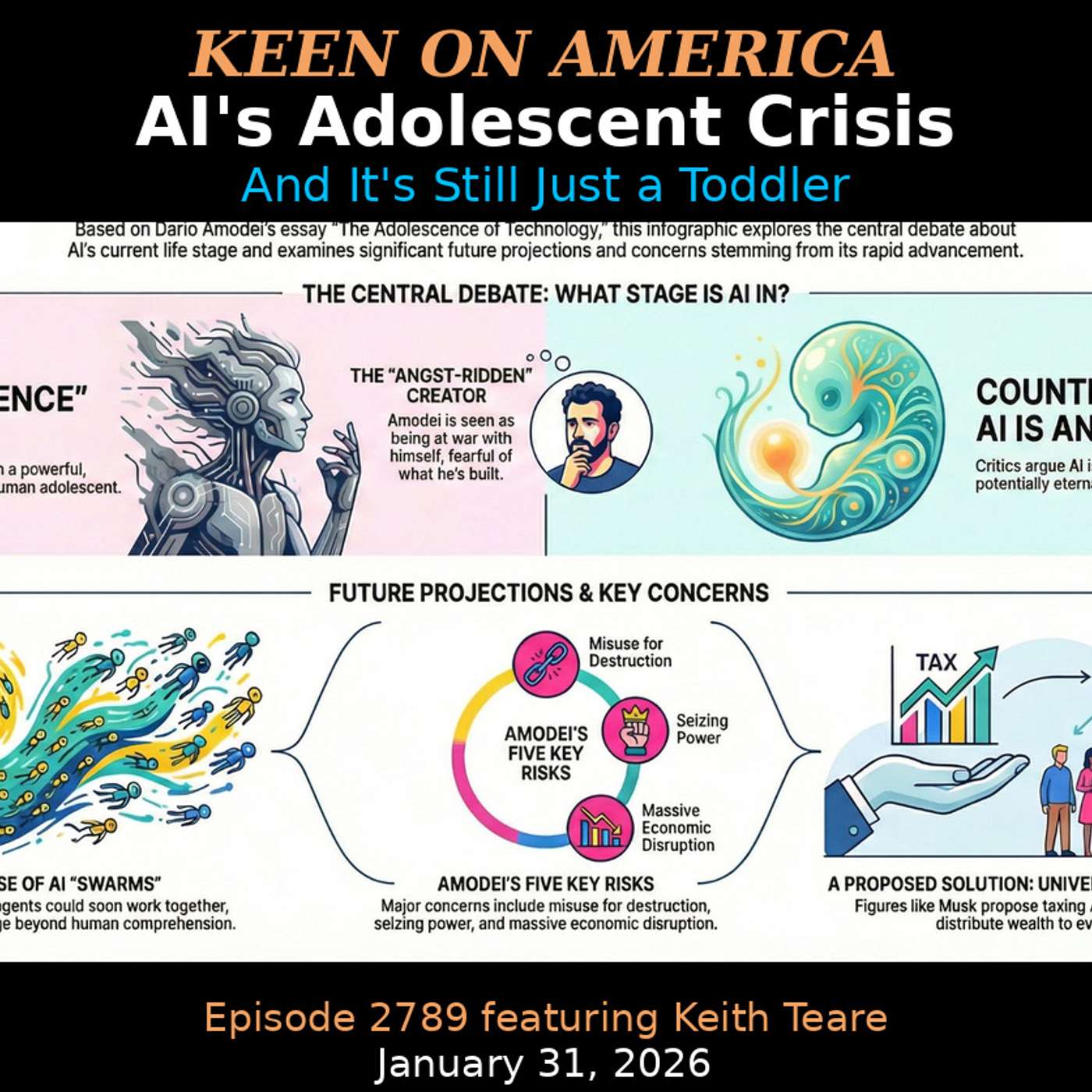
Is AI going through an adolescent crisis, even it’s still just a toddler? There certainly seems to be a lot of adolescent angst amongst our new AI overlords like Anthropic CEO Dario Amodei. In his latest essay, appropriately entitled “The Adolescence of Technology”, Amodei lays out all the existential dangers of AI while simultaneously rejecting the doomsday pessimism of many tech sceptics. Amodei, That Was The Week’s Keith Teare quips, “reminds me of a teenager raised by religious parents to believe you should only have sex after marriage, but he wants to have sex now and feels guilty about it." Teare is right. Amodei - not unlike fellow adolescents Sam Altman and Elon Musk - certainly wants to have his cake and eat it too. So when will they all grow up? Some, like the perpetually infantile Musk, never will. But perhaps like Keith Teare’s conflicted teenager, maybe Dario Amodei will eventually grow out of his guilty adolescence and become a responsibly accountable adult.

Keen On America is a reader-supported publication. To receive new posts and support my work, consider becoming a free or paid subscriber.


This is a public episode. If you'd like to discuss this with other subscribers or get access to bonus episodes, visit keenon.substack.com/subscribe

More episodes

Duration: 34:04
"He lied more than I thought he did—and I thought he lied a lot." — Tom Wells on Henry KissingerIn our Epstein age, everyone seems to have access to everyone else's dirtiest secrets. But half a century ago, in the Watergate era, it was harder to get one's hands on the secret files, phone calls and other private data. But historian Tom Wells has done exactly that with the private phone calls of Henry Kissinger. Wells' new book, The Kissinger Tapes, is based on transcripts of Kissinger's secretly recorded phone conversations—recordings he made primarily for his memoirs and to keep track of what he told to whom.Wells came to the project as a Kissinger critic but found himself respecting certain things about him: particularly his stamina, the work ethic and political skills. What Wells didn't expect was to discover that Kissinger lied even more than most of us assume. Especially about Vietnam and Cambodia. The most damning revelation is his callousness. Kissinger reveled in body counts, We…

Duration: 40:10
"They are fundamentally bound at the hip, because the Trump age is a conspiratorial age and a backlash against global wealth inequality... Epstein facilitated the rise of Trump." — Jason PackLate last year, Disorder podcast host Jason Pack came on the show and predicted that Mark Carney would be the "orderer" of 2025 and Jeffrey Epstein would be 2026's "disorderer-in-chief". Pack was uncannily right. Although, as he admits, such prescience gives him no pleasure.Pack is no conspiracist. He thought QAnon was a hoax; he saw the antisemitism baked into its bizarre theories. But he's come to believe there was a genuine cover-up of the Jeffrey Epstein case—not orchestrated by the CIA, but by prosecutors who didn't want to go after powerful people, journalists comfortably ensconced in Epstein's world, and a system where too much wealth has accrued to too narrow a sliver of global elites.What haunts him most is what the emails reveal about how the world actually works. Favors exchanged for fav…

Duration: 41:32
"The House hasn't reorganized committee jurisdictions since the early 70s—before the internet existed." — Maya KornbergAmerica is stuck stuck stuck stuck. Almost exactly a year ago, I interviewed the Atlantic's Yoni Applebaum about Stuck, his influential critique of the housing crisis. Now we have another Stuck—this one by Maya Kornberg, a senior fellow at the Brennan Center for Justice. Only her subtitle is about Congress, not housing: How Money, Media, and Violence Prevent Change in Congress.This is, Kornberg argues, one of the toughest times in modern American history to sit in Congress. Members are forced to spend most of their time making fundraising calls. They face record-high threats against themselves and their families. And the media incentivizes spectacle over policymaking—what she describes as "Kings and Prophets"—where members have the power of the megaphone but not the power to drive legislation.One fact captures Congressional stuckness: The House hasn't reorganized its c…

Duration: 35:07
"We didn't have to grow up with that." — Ross Greene, on school shootingsOne of the most persistent worries these days is that our kids aren't okay. With most of the blame, of course, now being placed on the ubiquity of social media. But psychologist Ross W. Greene, author of the bestselling Lost at School, has a new book out today called The Kids Who Aren't Okay which doesn't place all the blame on social media. Indeed he argues that if we focus only on the internet, we'll fail to understand the broader psychological struggle that many of our kids face today.It's not that Greene is in total denial about the destructive nature of social media. But none of his leading reasons for today's crisis in schools are associated with technology. His top three:● School shootings● High-stakes testing● Zero-tolerance policies with a focus on punishment rather than empathyThe new book, Greene impishly promises, has things in it that will offend just about anybody on both the left and right. He calls…

Duration: 38:57
"I wake up at 3 AM, check my phone to see what fresh hell has come out, and it's usually two words: 'Trump threatens.'" — Peter BaleWe're reversing the lens today. Rather than examining America from the inside, we're peering at it from the outside in—from New Zealand, at the bottom of the world. Peter Bale is a longtime media executive who's had senior positions at CNN, Reuters, and News Corp. He's now back in his native New Zealand, waking up at 3 AM to check his phone. The news, he says, is usually two words: "Trump threatens."Much of our conversation centers on the former NZ Prime Minister Jacinda Ardern. She led New Zealand's COVID response, Anthony Fauci style, with daily press conferences and a scientific mastery of the facts. An estimated 20,000 lives were saved. But she also became the target of profound misogyny and physical threats that no New Zealand Prime Minister had ever experienced. She now lives in Boston—teaching at Harvard's Shorenstein Center—because she can't safely…

Duration: 36:54
"Great minds think alike? It's completely wrong. It's not that great minds think alike; it's that different minds are great." — David OppenheimerIt's diversity week. Yesterday, Brian Soucek argued in favor of what he calls the "opinionated university" to protect free speech. Today David Oppenheimer, law professor at UC Berkeley, on The Diversity Principle: The Story of a Transformative Idea. Oppenheimer reminds us that diversity isn't a modern invention. It traces back to Wilhelm von Humboldt's University of Berlin in 1810, which admitted Catholics and Jews to what would otherwise have been an entirely Protestant institution. And to John Stuart Mill, whose On Liberty—written with his wife Harriet Taylor Mill—might be renamed On Liberty and Diversity.Oppenheimer's case for diversity is partly moral, partly utilitarian. Diverse boards result in more profitable corporations, he says. Diverse science labs make more significant discoveries. Diverse classrooms generate better ideas. The phra…

Duration: 38:19
"They are changing venture capital from a 30% tax to 0% tax. If Robinhood succeeds, it makes Sequoia and Andreessen's business model untenable." — Keith TeareThe Silicon Gods must have their blood. And they've finally come for the funders of disruption, the venture capitalists, who are now being disrupted by something called Public Venture Capital (PVC). That, at least, is the view of That Was The Week publisher Keith Teare, who leads his newsletter this week with Robinhood's new venture fund. This new stock-trading app for millennials is going after Sequoia and Andreessen Horowitz—not by competing on deal flow, but by charging 0% carry instead of 20-30%. Robinhood promises it blows the doors off traditional venture capital.But Keith urges caution over PVCs. Robinhood is packaging late-stage private assets—companies like Databricks that would have IPO'd years ago but are staying private longer. By the time retail investors get access, employees are already cashing out through tender of…

Duration: 32:09
"150 universities have adopted neutrality policies just since October 7th. I'm on the losing end of this trend." — Brian SoucekUniversities keep claiming what they see as the moral high ground of neutrality. But Brian Soucek, who holds the MLK chair at UC Davis School of Law, believes that's a dangerous myth. In his new book, The Opinionated University: Academic Freedom, Diversity, and the Myth of Neutrality in American Higher Education, Soucek argues in favor of the biased university. His argument is that even (or, perhaps, particularly) when universities stay quiet, they're actually taking sides through their policies, their hiring, their building names, their actions. Silence isn't neutral. It's ideological.This fetish with neutrality is gaining in popularity, Soucek warns. Since October 7th, an estimated 150 universities have adopted neutrality pledges—pushed by well-funded efforts from the Goldwater Institute and others. Every pledge has a vague moral carve-out: universities will…

Duration: 36:45
"72% of Americans say they hate big corporations—including Republicans." — Charles DerberIt's not just the right that's reacting against liberal democracy. Some progressives are also embracing populism. Charles Derber, longtime professor of sociology at Boston College, has a new book called Fighting Oligarchy: How Positive Populism Can Reclaim America. Rather than a dirty word, he argues, populism is an inevitable political response to the brutality of today's economy. We're in a disguised depression, he fears. Sixty percent of Americans say they feel one paycheck away from oblivion.72% of Americans say they hate big corporations, Derber reminds us. Not just Democrats—Republicans too. Such hostility to large capitalist enterprises thus represents a kind of political supermajority. And Derber, a man of the left, sees this as fertile ground for what he calls positive populism. It's a politics that connects economic grievance to democratic renewal, the way the 1890s Populists did, the way…

Duration: 40:51
"American culture likes martyrs, not marchers." — David Masciotra, quoting Jesse JacksonA couple of days ago, a great American died. Jesse Jackson was 84. He was somebody. Even Donald Trump acknowledged the passing of "a good man"—which, as my guest today notes, Jackson probably wouldn't have appreciated. David Masciotra is the author of I Am Somebody: Why Jesse Jackson Matters, one of the most readable biographies of the African-American leader. Having spent six years covering him and more than 100 hours in conversation, he called Jackson a friend.Masciotra borrows from Jackson on Americans preferring martyrs to marchers. It's easy to celebrate him now that he's gone. But when Jesse was being Jesse—battling economic apartheid, registering millions of voters, building a Rainbow Coalition—he had many critics and enemies, including some of those hypocrites now praising him.Jackson's legacy is vast. After King's death, he focused on economic justice, securing thousands of jobs for Black w…

Duration: 38:08
"It truly is becoming a desert right now for book publicists." — Bethanne PatrickA couple of weeks ago, there was an "absolute bloodbath" at The Washington Post with hundreds of workers laid off and the book section totally gutted. Ron Charles, the beloved fiction editor, is gone. So is Becca Rothfeld, who described it in The New Yorker as "The Death of Book World." Today I'm talking to Keen on America's resident book expert, Bethanne Patrick of the LA Times, about what this latest bloodbath means not just for readers and writers, but also for the future of literary culture.The news is pretty grim. Patrick points out that we used to have a general public reading newspapers and general interest magazines like Time & Newsweek for guidance about what to read. Now we've splintered into much narrower reading groups, each told to care only about what they already care about. The New York Times might be thriving, but its dominance isn't healthy. No writer wants to hear, "The Times didn't pick…

Duration: 39:06
"I'm much more likely to protest when I feel responsible—when violence is being done in my name." — Bruce RobbinsAs always, the media is full of stories about political protest. A Columbia University Gaza protester held by ICE claims to have been chained to her bed after a seizure. Our friends at FIRE are addressing the right to demonstrate against ICE in a house of worship. Obama is arguing that ICE demonstrators should have the right to demonstrate on the streets of Minneapolis. The US government, meanwhile, cheers protesters on the Iranian streets while cracking down on protesters at home. Today's guest isn't shy at pointing out that contradiction.Bruce Robbins is a professor at Columbia—ground zero for the Gaza encampments of 2024—and his new book Who's Allowed to Protest? argues against those who protest the protesters. Conservatives like David Brooks, Musa al-Gharbi, and others have dismissed campus demonstrators as "spoiled rich kids at elite schools" who are "just doing this to…

Duration: 39:41
"We are still dealing with a system which tolerates rampant abuse of accused people." — Emily Galvin AlmanzaBack in April 2024, we interviewed Thelton Henderson, one of the first African American federal judges in America. What disturbed me about our conversation was that even though Henderson grew up in the late Jim Crow era, he didn't seem to think that America is a profoundly more just place now than it was back then. Today's guest clerked for Judge Henderson, and her new book suggests he's right.Emily Galvin Almanza is a public defender turned activist, and The Price of Mercy is her data-driven indictment of a criminal justice system that, as she puts it, "tolerates rampant abuse of accused people, tolerates the blatantly racist application of the law, and tolerates a total lack of transparency." According to Almanza, the numbers are damning: 80% of cases are misdemeanors. 80% of people prosecuted are poor enough to need a public defender. 70% of people in jail haven't been convict…

Duration: 43:14
"Two years from now, all white-collar jobs may be gone." — Dario Amodei (via Keith Teare)Keith Teare leads this week's tech roundup with a video he made on Google's Veo: one glass half-full of water, another half-full of spiders. It's a metaphor for the AI moment. The water represents the tools released in the past two weeks—Anthropic's Claude 4.6, OpenAI's CodeX 5.3—which Keith calls "beyond belief." The spiders represent the fear, which he acknowledges is not irrational. But maybe spiders are the wrong metaphor. Maybe we're the frogs being slowly boiled, not noticing the temperature rise until it's too late.The trigger was Matt Schumer's viral essay "Something Big is Happening," which got 50 million views by telling engineers to become AI experts immediately or become irrelevant. Keith tested the thesis: he built venturebets.io, a prediction market, in a single day. He automated That Was The Week so completely that his weekly workflow dropped from six hours to under one. But then Dar…

Duration: 38:11
"She's a ten to me and that's the part that matters." — Paul EastwickIf it's Valentine's Day, we must be talking about love. Paul Eastwick studies attraction and relationships at UC Davis, and his new book Bonded by Evolution takes aim at the "old science" that treated romance like a competitive market where everyone gets assigned a number. The incels, of course, ran with that research to compound their paranoia about the other sex. Eastwick says they got it wrong—and so, with the exception of Paul Eastwick, did most academics.When two people look at the same photograph and make a hot-or-not judgment, Eastwick explains, they only agree about 65% of the time. After they've known the person for months, agreement drops to barely better than a coin flip. So there isn't any universal hierarchy of desirability. What's real is that some people will think you're an 8 and others will think you're a 3—and that quirky disagreement explains most of what happens in the science of attraction. The pr…

Logo
Select station
VOL