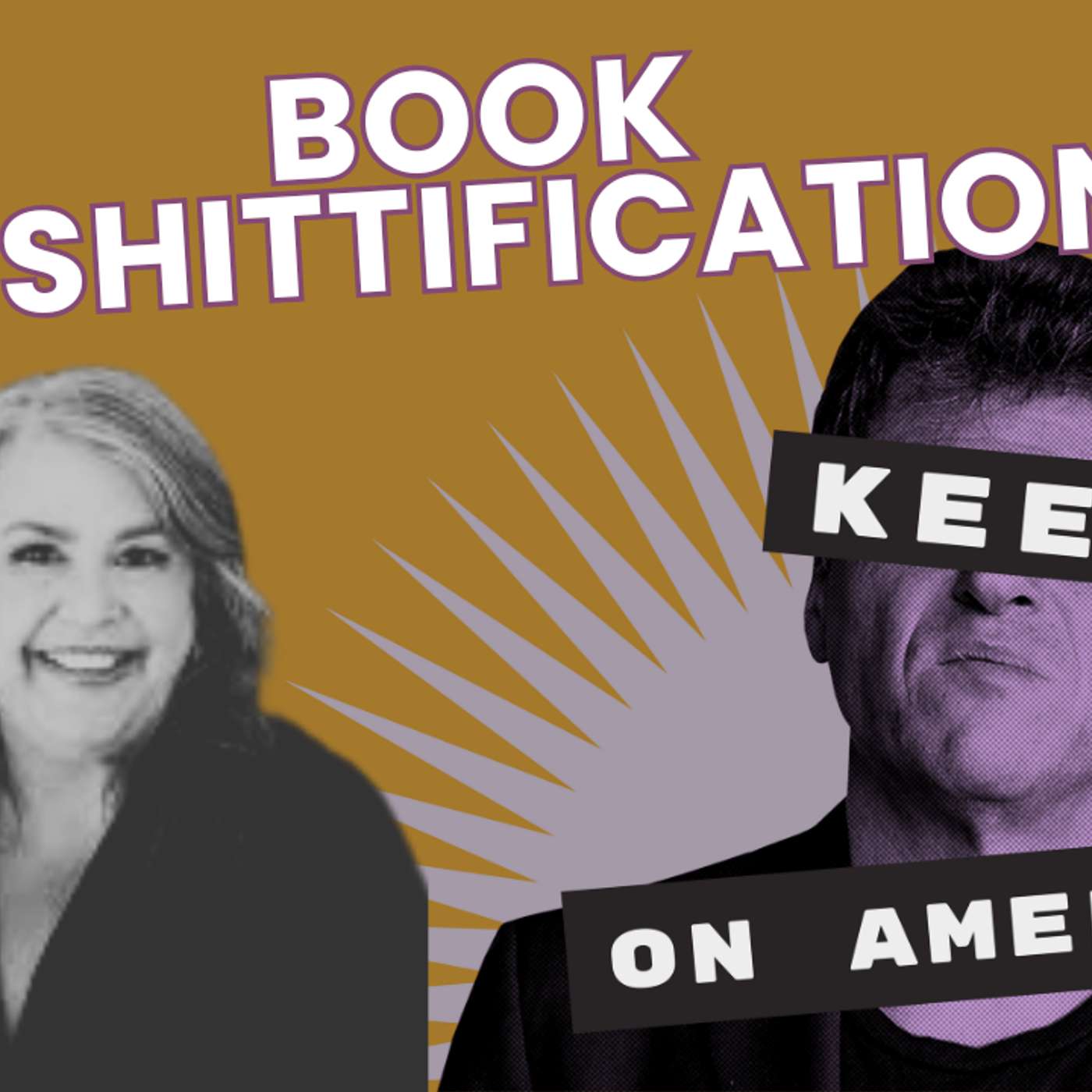
Books Are Dying (Again): Bethanne Patrick on the Enshittification of the Book Biz


Author: Andrew Keen February 18, 2026 Duration: 38:08
Podcast episode
Books Are Dying (Again): Bethanne Patrick on the Enshittification of the Book Biz

"It truly is becoming a desert right now for book publicists." — Bethanne Patrick

A couple of weeks ago, there was an "absolute bloodbath" at The Washington Post with hundreds of workers laid off and the book section totally gutted. Ron Charles, the beloved fiction editor, is gone. So is Becca Rothfeld, who described it in The New Yorker as "The Death of Book World." Today I'm talking to Keen on America's resident book expert, Bethanne Patrick of the LA Times, about what this latest bloodbath means not just for readers and writers, but also for the future of literary culture.

The news is pretty grim. Patrick points out that we used to have a general public reading newspapers and general interest magazines like Time & Newsweek for guidance about what to read. Now we've splintered into much narrower reading groups, each told to care only about what they already care about. The New York Times might be thriving, but its dominance isn't healthy. No writer wants to hear, "The Times didn't pick up your book, so there won't be a review at all." Meanwhile, mass-market paperbacks are dying and while Patrick is unsentimental about their physical quality, she nonetheless bemoans the demise of a mainstream reading culture.

There is, however, some good literary news. Spotify has struck a deal with Bookshop.org to sell physical books—enabling us to click a link while listening to a podcast and then buy the book, with proceeds supporting independent bookstores. And audiobooks are booming. Patrick defends them vigorously, citing research that shows listening to them stimulates the same part of the brain as the act of reading. When her husband discovered audiobooks, Patrick reports, he started reading longer books and, perhaps not uncoincidentally, more women novelists.

And then, last but certainly not least, there's AI. ElevenLabs is doubling down on AI-generated audiobooks—cheaper, faster, and increasingly hard to distinguish from human narrators. Patrick is conflicted. She narrated Life B, her own memoir, and loved it. But the middle market is disappearing from audiobooks too: soon we'll have winner-take-all celebrity narrators at the top, crappy AI bots at the bottom, and nothing in between. It's the enshittification of books. Jeff Bezos is presumably fine with all of this. Someone's taking care of the bottom line somewhere—maybe his delightful new wife's plastic surgeon.


About the Guest

Bethanne Patrick is the book critic of the LA Times and author of the memoir Life B: Overcoming Double Consciousness. She has written for The Washington Post, NPR, and numerous other publications. She is Keen on America's resident book expert.

References

People mentioned:

●      Ron Charles was the fiction books editor at The Washington Post. Patrick counts him as a dear friend. He has since started his own Substack.

●      Becca Rothfeld wrote "The Death of Book World" for The New Yorker and is author of All Things Are Too Small. She was also laid off from the Post.

●      Colleen Hoover is the self-published author of It Ends with Us. Patrick notes she's "doing just fine without mass-market paperbacks."

●      Maria Adelmann is the author of The Adjunct, which Patrick is currently reading and recommends.

Publications and companies mentioned:

●      The Washington Post gutted its book coverage in what Patrick calls "a big blow for the literary world."

●      Bookshop.org is partnering with Spotify to sell physical books, with proceeds benefiting independent bookstores.

●      ElevenLabs is an AI company doubling down on AI-generated audiobooks with various tiers of service.

●      Libby is the app where many young readers now discover audiobooks through their libraries.

About Keen On America

Nobody asks more awkward questions than the Anglo-American writer and filmmaker Andrew Keen. In Keen On America, Andrew brings his pointed Transatlantic wit to making sense of the United States—hosting daily interviews about the history and future of this now venerable Republic. With nearly 2,800 episodes since the show launched on TechCrunch in 2010, Keen On America is the most prolific intellectual interview show in the history of podcasting.

Website

Substack

YouTube

Apple Podcasts

Spotify


Chapters:

  • (00:00) - Introduction: The Washington Post bloodbath
  • (02:57) - Maybe Jeff Bezos's wife's plastic surgeon
  • (03:35) - Do we need generalized criticism?
  • (05:55) - The end of mass-market paperbacks
  • (09:51) - Colleen Hoover is doing just fine
  • (10:55) - Is New York Times dominance good?
  • (13:21) - Flocking to Substack
  • (15:38) - The LA Times and California stories
  • (17:02) - Spotify's deal with Bookshop.org
  • (20:50) - Are audiobooks real reading?
  • (23:59) - ElevenLabs and AI audiobooks
  • (28:33) - Enshittification and the shrinking middle
  • (31:26) - Social media's uncertain future
  • (35:12) - What Bethanne is reading


More episodes

Duration: 47:03
The Music Man was a 1957 Broadway show written by Meredith Willson, a musician from the small Iowa town of Mason City. The popular play (and later movie) featured a con man called Harold Hill who ripped off the naive people of River City, a fictional small town based on Mason City. Nearly seventy years later, Josiah Hesse, another Iowan from Mason City, sees the Music Man narrative replaying itself. As Hesse notes in his autobiographical new book, On Fire For God, today's Harold Hills are the megachurch salesmen who descend on small American towns to rip off the local community with their religious claptrap. "They know how to prey on people's fears," Hesse argues about these evangelical preachers, "how to locate the thing that's changing, that's new, and offer something that hearkens back to another era, a pure era of American wholesomeness." As another observant American midwesterner, Mark Twain, once quipped: "History doesn't repeat itself, but it rhymes."Keen On America is a reader-supported publication. To receive new posts and support my work, consider becoming a free or paid subscriber. This is a public episode. If you'd like to discuss this with other subscribers or get access to bonus episodes, visit keenon.substack.com/subscribe

Duration: 54:43
Few biographers can claim to know what it feels like to be Thomas Jefferson more than the Charlottesville-based historian Andrew Burstein. The author of many books about Jefferson, Burstein’s latest, Being Thomas Jefferson, offers an “intimate history” of the great man. From Jefferson’s views on love and race to his take on mortality, Andrew Burstein gets inside America’s most controversial and misunderstood Founding Father. And what he finds at the end of his voyage inside Jefferson is an intellectual Don Juan. “Jefferson’s language is his legacy,” Burstein concludes. “He wrote with a musical cadence, poetically, at a time when most political writers did not understand what he did about seducing the reader”.Keen On America is a reader-supported publication. To receive new posts and support my work, consider becoming a free or paid subscriber. This is a public episode. If you'd like to discuss this with other subscribers or get access to bonus episodes, visit keenon.substack.com/subscribe

Duration: 39:13
There was a time in the mid 20th century, the literary historian Gayle Feldman reminds us, when the book business was cool. Back then, New York publishing resembled Silicon Valley tech and the Mark Zuckerberg of his day was the Random House founder Bennett Cerf. In her new biography of Cerf, Nothing Random, Feldman tells the story of this celebrity entrepreneur, noting that he helped pioneer the publishing industry’s venture capitalist style business model which enabled hit authors like Ayn Rand or Dr Seuss to finance start-up writers like Cormac McCarthy. Those were the days, a slightly wistful Feldman reminisces. She’s right. If only today’s corporate publishing industry could recapture some of that Cerfian magic. Then books might become cool again. Keen On America is a reader-supported publication. To receive new posts and support my work, consider becoming a free or paid subscriber. This is a public episode. If you'd like to discuss this with other subscribers or get access to bonus episodes, visit keenon.substack.com/subscribe

Duration: 47:31
Trump’s Gazan dream is to overlay the complex human history with his own narcissistic real-estate fantasy. But for Maia Carter Hallward, co-author of a new contemporary history of Gaza, this once vibrant Mediterranean entrepôt linking Africa, Asia and Europe is now defined more by nightmare than dreams. “In peace studies, we talk about positive peace, which has rights, liberties, the ability to reach human potential - and we talk about negative peace, which is the absence of war,” Carter Hallward says. “I would say we have none of those in Gaza right now.” No negative peace, no absence of war. For Carter Hallward, that - alongside the more than 70,000 dead Palestinians - captures today’s Gazan tragedy. Keen On America is a reader-supported publication. To receive new posts and support my work, consider becoming a free or paid subscriber. This is a public episode. If you'd like to discuss this with other subscribers or get access to bonus episodes, visit keenon.substack.com/subscribe

Duration: 35:40
What if the right isn’t wrong - or, at least, totally wrong, about education? That seems to be the conclusion of James Traub, a liberal educationalist, who has spent the last year visiting the civics programs of American high schools. Neither the 1619 Project nor Trump’s 1776 Report seems to be the message of Traub’s account of these travels, The Cradle of Citizenship. Schools can help save our democracy, Traub concludes, by equipping American students to think their way through the complexities of their nation’s history. The point of a good education, he concludes, is to foster thinking rather than moral outrage or virtue seeking. More Homer in the classroom, and less social media. Those are James Traub’s old school principles for our new century. This is a public episode. If you'd like to discuss this with other subscribers or get access to bonus episodes, visit keenon.substack.com/subscribe

Duration: 37:39
Timing is everything. The versatile American journalist Kenneth Rosen was last on the show in early 2021 talking about troubled teens. Since then, Rosen has travelled extensively in the Arctic and has just published Polar War, a narrative about the chilling costs to both America and the world of the new Cold War in the Arctic. Timing is, indeed, everything, especially in the book business. But Rosen’s travelogue of melting icecaps and vanishing indigenous cultures offers an alternative take on the media’s current geo-strategic obsession with Greenland. "I worry most about the indigenous communities and their ways of life. This is the sustenance lifestyle that will be eradicated—something that we'll lose as a country and as humanity,” Rosen warns. “It's only a matter of time before the snow and ice melts forever." And when it’s gone, it’s gone. Then timing will be nothing. Keen On America is a reader-supported publication. To receive new posts and support my work, consider becoming a free or paid subscriber. This is a public episode. If you'd like to discuss this with other subscribers or get access to bonus episodes, visit keenon.substack.com/subscribe

Duration: 41:06
Will Trump be removed by the 25th Amendment? No, it’s never going to happen - not after Jan 6 or Venezuela or Greenland or any other mad foreign or domestic adventure. That, at least, seems the conclusion of Rebecca Lubot, author of Keeping a Finger on the Button, a timely new analysis of the 25th Amendment. But the real question isn't about the nuclear button—it's about who controls the White House. And the way to do that is through new Congressional or judicial initiatives. The 25th Amendment was passed in what now feels like the halcyon 1960s. Trump has created an entirely new political reality in America. Congress needs to respond accordingly with a new Constitutional Amendment for our 21st century Imperial Presidential age. This is a public episode. If you'd like to discuss this with other subscribers or get access to bonus episodes, visit keenon.substack.com/subscribe

Duration: 45:53
The great John Maynard Keynes explained it a century ago. In his 1930 essay, "Economic Possibilities for our Grandchildren," Keynes predicted that the future would be defined by economic abundance rather than scarcity. But such a cornucopian future, Keynes warned, would create societies teetering perpetually on the brink of a nervous breakdown. Keynes' vision has been updated by Niskanen Center SVP Brink Lindsey in his new book, The Permanent Problem. Today's societies, the Thailand-based Lindsey observes, are all on the verge of nervous breakdowns triggered by economic prosperity rather than poverty. So the challenge today, he notes with his own Keynesian flourish, is transforming this mass plenty into mass human flourishing. This is a public episode. If you'd like to discuss this with other subscribers or get access to bonus episodes, visit keenon.substack.com/subscribe

Duration: 48:33
Back in 2018, the New York Times reporters Katie Benner and Erica L. Green exposed the disturbing reality of the T.M. Landry college prep school in rural Louisiana. Celebrated as a “miracle” institution that successfully sent underprivileged black students to elite colleges, Benner and Green uncovered a miserable school that doctored college applications and bullied its students. Seven years later, Benner and Green have written Miracle Children, a book as much about race, education and false promises in contemporary America as it is about T.M. Landry itself. While Benner and Green’s narrative won’t please everyone, it should be required reading for those on both the left and right who peddle magical educational solutions to historically complex social problems.Keen On America is a reader-supported publication. To receive new posts and support my work, consider becoming a free or paid subscriber. This is a public episode. If you'd like to discuss this with other subscribers or get access to bonus episodes, visit keenon.substack.com/subscribe

Duration: 31:58
WTF will happen in 2026? Over the last week, we’ve been running a series of interviews about the promise and peril of the new year. And in this new weekly magazine-style KEEN ON AMERICA show, we feature highlights of conversations with Charles Kupchan, Julia Hobsbawm, Keith Teare, Jason Pack, Jim Goldgeier, Chris Schroeder and Soli Ozel. And I end the show with some thoughts from the David Masciotra interview about my own thoughts on the upcoming year. That’s it for previews of 2026. Now let’s see what really happens. Keen On America is a reader-supported publication. To receive new posts and support my work, consider becoming a free or paid subscriber. This is a public episode. If you'd like to discuss this with other subscribers or get access to bonus episodes, visit keenon.substack.com/subscribe

Duration: 45:18
If Darwin’s evolutionary theories couldn’t kill America’s faith in God, then what could? That’s the message in Daniel K. William’s new book, The Search for a Rational Faith. Americans, Williams argues, have always sought to combine scientific knowledge with Christian apologetics. From the Founding Puritans to John Adams, Harriet Beecher and Martin Luther King, Americans have clung to the idea that enlightenment doesn’t undermine faith. That’s why thoughtful people - or, at least, thoughtful Americans - believe in God. “Without religion as a moral constraint, any sort of moral anarchy would be theoretically possible. In the world of the atomic bomb, there had to be some form of transcendent thinking,” Williams argues. “Religion has not been simply an anti-liberal reactionary force, but actually has been central to the American story and to America’s human rights project.”Keen On America is a reader-supported publication. To receive new posts and support my work, consider becoming a free or paid subscriber. This is a public episode. If you'd like to discuss this with other subscribers or get access to bonus episodes, visit keenon.substack.com/subscribe

Duration: 38:17
Hold onto your collars. The AI-generated crisis of work is here, and the storm will concentrate on white-collar workers from the professional economy. According to Julia Hobsbawm, founder of Workathon.io, these workers are about to experience the dismal reality of blue-collar redundancy. 50% of the US workforce will be freelance by 2030, some experts warn, making this transition the biggest shift in the nature of work since the Industrial Revolution. Humans can't be completely replaced by machines, Hobsbawm says. But enough will be replaced to create mass suffering — the same conditions that generated the revolutionary movements of the 19th century.Keen On America is a reader-supported publication. To receive new posts and support my work, consider becoming a free or paid subscriber. This is a public episode. If you'd like to discuss this with other subscribers or get access to bonus episodes, visit keenon.substack.com/subscribe

Duration: 55:15
Happy New Year everyone! As the final show of 2025 and first for 2026, we turned the tables and had me interviewed by the formidable David Masciotra. As you will see, my reading of 2025 is more optimistic than many of my guests. And my sense about 2026 is that it will be a happier year for America than 2025 (which isn’t saying much). As I explain to David, I suspect the zeitgeist is shifting back to a cautious optimism about the American future. Despite all the doom-mongering, 2025 was actually an exciting year for movies, books, and music — the artistic world being at least as vibrant and diverse as it was twenty years ago. That said, I warn about the medieval wealth gap between rich and poor, Trump’s pride in willful cruelty to immigrants, and the increasingly chasmic divide between young and older Americans.This is all speculative, of course. But what I can promise is that this show will remain a daily broadcast featuring America’s leading commentators. So stay tuned. I can guarantee that 2026 will be an exciting year for all KEEN ON AMERICA viewers, listeners and readers. Keen On America is a reader-supported publication. To receive new posts and support my work, consider becoming a free or paid subscriber. This is a public episode. If you'd like to discuss this with other subscribers or get access to bonus episodes, visit keenon.substack.com/subscribe

Duration: 45:56
We live in transitional times. "The old is dead and the new cannot be born—this is the time of monsters," Antonio Gramsci famously wrote. But today, as the West declines and the East rises, these may equally be times for middle powers like Turkey. That, at least, is the view from Istanbul of the Turkish commentator Soli Özel, who sees an opportunity for regional powers to become more influential players in the international system. Expect more international empowerment of states like Turkey, Brazil, and India in 2026, Özel suggests. Today's emerging multipolar world is, indeed, not just a time for monsters, but also for middle-ranked powers.Keen On America is a reader-supported publication. To receive new posts and support my work, consider becoming a free or paid subscriber. This is a public episode. If you'd like to discuss this with other subscribers or get access to bonus episodes, visit keenon.substack.com/subscribe

Duration: 41:30
For Jason Pack, presenter of the Disorder podcast, the person of the year for 2025 was the Canadian Prime Minister, Mark Carney. But for 2026, Pack predicts, the person of the year will be a resurrected Jeffrey Epstein (or, at least, the Epstein scandal). Orderers vs Disorderers: the dialectic driving our age of upheaval. The Canadian Prime Minister, for Pack, is a hero. "Carney stood up to Trump and said, Great, you want to punish us? Punish us," Pack says. Whereas the conspiracy theorists stoking the Epstein paranoia are the bad guys. "The more that we in the mainstream attempt to say it was just a sex scandal, the more that people on the extreme left and right are gonna gain in power," Pack warns. So it's Carney vs Epstein. The hard center vs the extreme left and right. Order vs disorder. If only the future was that dialectically simple.Keen On America is a reader-supported publication. To receive new posts and support my work, consider becoming a free or paid subscriber. This is a public episode. If you'd like to discuss this with other subscribers or get access to bonus episodes, visit keenon.substack.com/subscribe

Logo
Select station
VOL