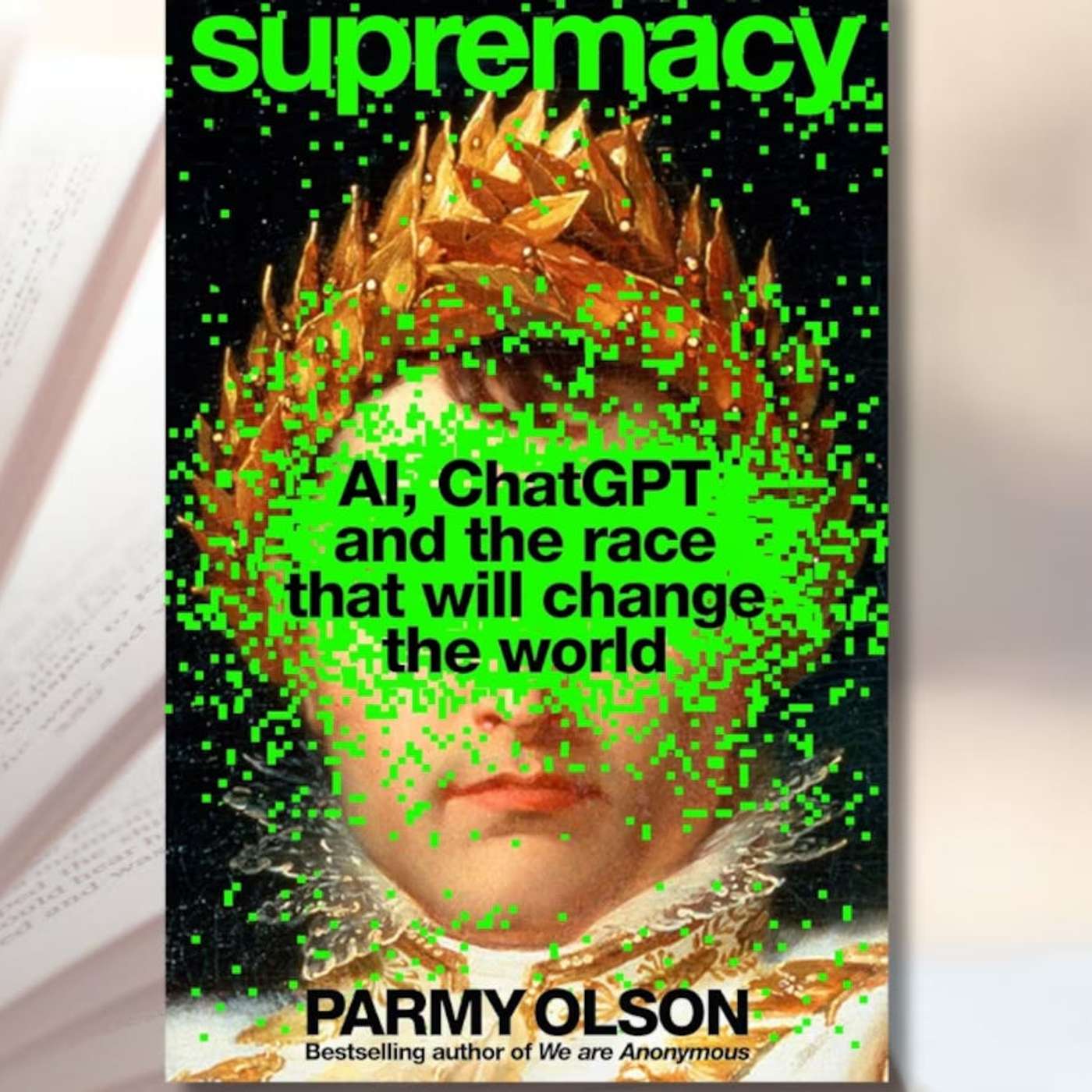
It’s the race that will change the world. In Supremacy, one of the FT’s six short-listed best business book of the year, Bloomberg columnist Parmy Olson tells the story of what she sees as the key battle of our digital age between Sam Altman’s OpenAI and Demis Hassabis’ DeepMind. Altman and Hassabis, Olson argues, are fighting to dominate our new AI world and this war, she suggests, is as much one of personal style as of corporate power. It’s a refreshingly original take on an AI story which tends to be reported with either annoyingly utopian glee or equally childish dystopian fear. And Olson’s narrative on our brave new AI world is a particularly interesting take on the future of Alphabet, DeepMind’s parent corporation, which, she suggests, might, in the not too distant future, have Demis Hassabis as its CEO.
“There's a very human story behind the development of AI.” -Parmy Olson
TRANSCRIPT:
AK: Hello, everybody. A few weeks ago, about three weeks ago, the Nobel Prizes were awarded. And it was the year for AI and physics. John Hopfield and Geoffrey Hinton, Geoffrey Hinton being known as the godfather of AI. Hinton had worked for Google for a while, and then in chemistry, the prize went to three scientists, including Demis Hassabis and John Jumper of Google DeepMind. Hassabis is a remarkable fellow on many different levels. One person who, I think, follows Hassabis with a great deal of care and interest is my guest today, Parmy Olson. She's a London-based Bloomberg opinion columnist and the author of a very intriguing new book, Supremacy: AI, ChatGPT, and the Race That Will Change the World. Parmy is joining us from the Bloomberg office in London. Parmy, would it be fair to call this new book, which has actually been shortlisted for the F.T. Business Book of the Year Award, one of the six books on the shortlist, is it fair to call this book a kind of parallel narrative of Demis Hassabis at DeepMind and of course, Sam Altman at OpenAI? Is that the narrative of your book?
PARMY OLSON: That's a big part of it. I wanted to tell the story of the AI boom and some of the possible risks that could come from AI, particularly around the control of AI, by talking about the humans behind it. So, I think there's a very human story behind the development of AI. And so, that's why I structured the first half of the book as a tale about the careers and lives and accomplishments, and failures as well, of Demis Hassabis and Sam Altman, including their rivalry.
AK: Yeah, it's interesting and kind of ironic given that AI's about smart machines. Some people fear that it might turn us humans into footnotes, some people have suggested that AI is our last invention. And Hassabis has always been presented as the good face, the nice guy, obviously a genius, but at the same time quite reasonable. Whereas, of course, Altman is a much more controversial figure. It's not quite Elon Musk, but he's certainly closer to being like Musk than Hassabis. Is that a fair generalization, or do you reveal that Hassabis is actually a rather more complicated figure than his public persona suggests?
PARMY OLSON: Yes, we could say that. I mean, first of all, I would say that publicly, in terms of how both men position themselves and come across, I think Hassabis comes across as a nice guy and someone who is very scientifically minded and very focused on pushing ahead scientific frontiers and discovery, whereas Sam is much more of a business person. You could see him more as a capitalist, someone who really wants to grow his power and influence. Demis is a little bit more driven by prestige. He has wanted, for years, to win a Nobel Prize. That was very much a—
AK: Who doesn't, Parmy? We all want Nobel prizes, except most of us, we're not going to be considered, I think, by the committee.
PARMY OLSON: Sure, but which CEOs actually sit down with their engineers and say "this is how we're going to measure success, is going to be winning 2 or 3 Nobel Prizes over the next ten years"? It was an actual concrete metric for success within his company. So, prestige was very important to him. I think in both cases, though, both men—and this was a thing I really wanted to get across with the book—is that both men had these very big humanitarian ideals around building powerful AI. Demis would talk about using it to—when they eventually build AGI, which is artificial general intelligence, or AI that surpasses our brains, and it can solve all sorts of problems that we can't solve, for example, curing cancer or solving climate change. He would often talk about that in interviews, and Sam wanted to do the same thing, but for a slightly different reason. He wanted to bring abundance to humanity and elevate the wealth of everyone and just improve everyone's well-being and lives. But what ended up happening over the years, of course, is on their journeys to trying to build AGI, the economics of that endeavor were such that they had to align themselves with larger tech companies. And those those objectives, as humanitarian goals, ultimately faded into the background. And they both, whether you see one is more Machiavellian than the other, I don't think really either of them had that kind of intent, but both ended up helping to enrich and extend the power and wealth of the world's largest tech companies, the world's largest de facto companies.
AK: And those, of course, are Google and OpenAI.
PARMY OLSON: And Microsoft.
AK: It's interesting that you focus, initially, on the ethics in terms of comparing Hassabis and Altman. The reviews of the book, Parmy, of course, have been very good. As I suggested, you are on the shortlist for the F.T. Book of the Year. But a couple of reviewers, The LA Times, suggested that you didn't address—you yourself as the author—didn't address the ethical questions associated with a AI, and The Wall Street Journal reviewer concurred. Is that, I won't say a fair criticism, but do you think that that was part of your job, or given that you were focusing on two remarkable individuals, Hassabis and Altman, with very clear ethical goals, for better or worse (some people might suggest that some of those ethics aren't for real), that it wasn't your job as an author to get involved in making judgments on yourself?
PARMY OLSON: Oh, but I completely disagree with that analysis, because—and I mean, I would say that as the author, of course, pushed back against those reviews—but in the middle of the book—
AK: The reviews were good. It was just that one—
PARMY OLSON: Oh, sure. Yeah. Okay. But the there's a whole section in the middle of the book which talks about the ethics of AI, and AI research, and why academic research into AI is not looking into the ethics of and measuring the success of AI in terms of well-being for humans, fairness, justice, those sorts of things being measured by capability and power and growth, because the academic field that researches artificial intelligence is completely funded by big tech. And that has been increasingly the case over the last ten years. And a few years ago, there were some researchers at Google who warned about the ethical problems that were inherent in the design of these large language...