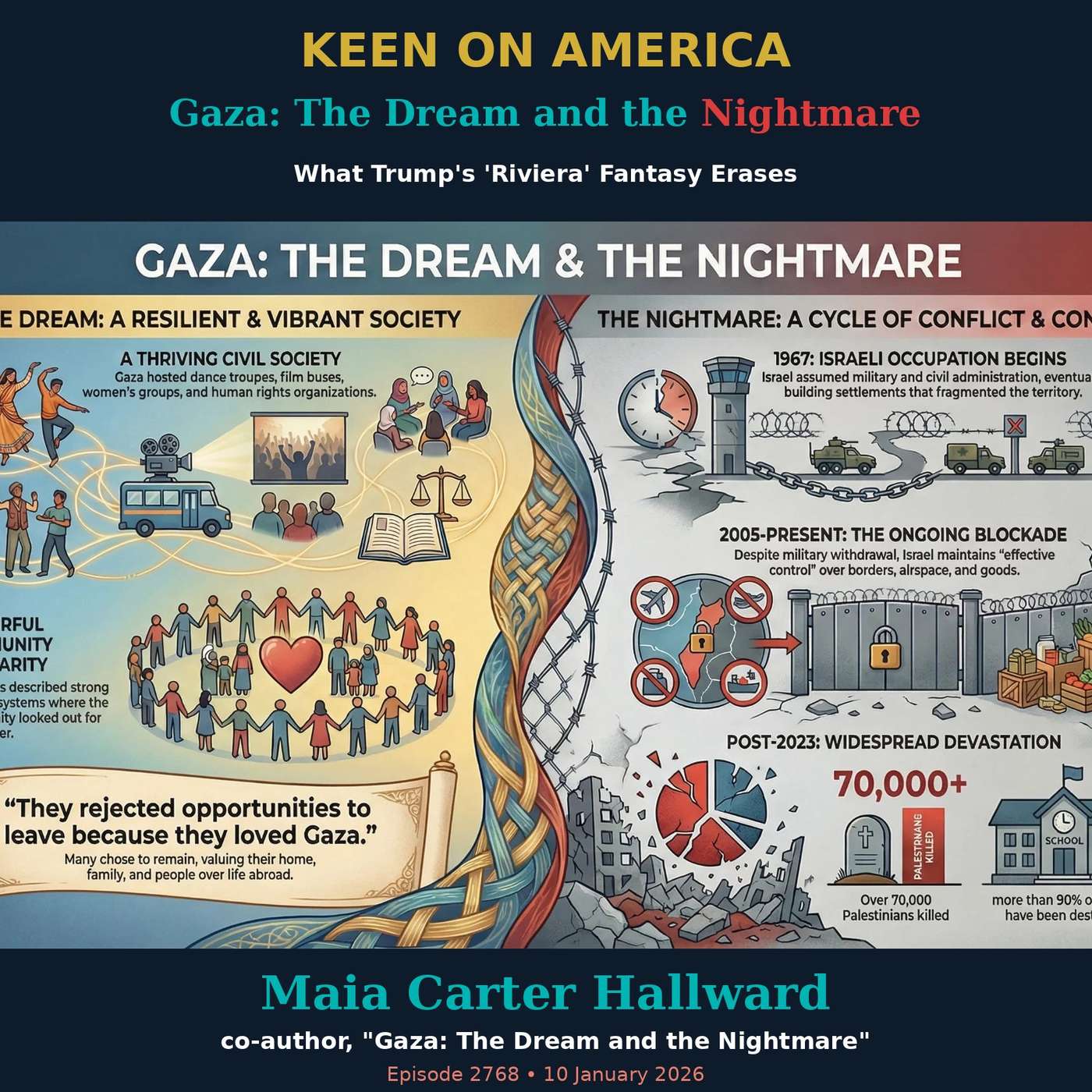
Gaza: The Dream and the Nightmare
Trump’s Gazan dream is to overlay the complex human history with his own narcissistic real-estate fantasy. But for Maia Carter Hallward, co-author of a new contemporary history of Gaza, this once vibrant Mediterranean entrepôt linking Africa, Asia and Europe is now defined more by nightmare than dreams. “In peace studies, we talk about positive peace, which has rights, liberties, the ability to reach human potential - and we talk about negative peace, which is the absence of war,” Carter Hallward says. “I would say we have none of those in Gaza right now.” No negative peace, no absence of war. For Carter Hallward, that - alongside the more than 70,000 dead Palestinians - captures today’s Gazan tragedy.
Keen On America is a reader-supported publication. To receive new posts and support my work, consider becoming a free or paid subscriber.
This is a public episode. If you'd like to discuss this with other subscribers or get access to bonus episodes, visit keenon.substack.com/subscribe
Episode 2221: Talia Lavin on how the Christian Right is Taking Over America
Episode 2220: Nobel Prize Winning Economist Simon Johnson on Technology & Inequality
Episode 2219: Joel Edward Goza on why Reparations is the Central Civil Rights Issue of the 2020s
Episode 2218: Timothy Shenk explains the fate of liberal politics in the illiberal age of Harris and Trump
Episode 2217: Why Google should hire Chris Lehane, Silicon Valley's Master of the Message
Episode 2216: Neal Baer on the Promise and Peril of CRISPR
Episode 2215: Tavis Smiley on why black men are more likely to vote for Donald Trump than black women
Episode 2214: Arlie Russell Hochschild on How to Listen to America
Episode 2213: Charles and Lily Bock on fathers, daughters and missing mothers
Episode 2212: Jim Wallis on the False White Gospel threatening America
Episode 2211: Why in the AI Age, Big Tech is going to get significantly BIGGER
Episode 2210: Carissa Carter and Scott Doorley explain how to design the future
Episode 2209: Michael Morris on how the cultural instincts that divide us can also help bring us together