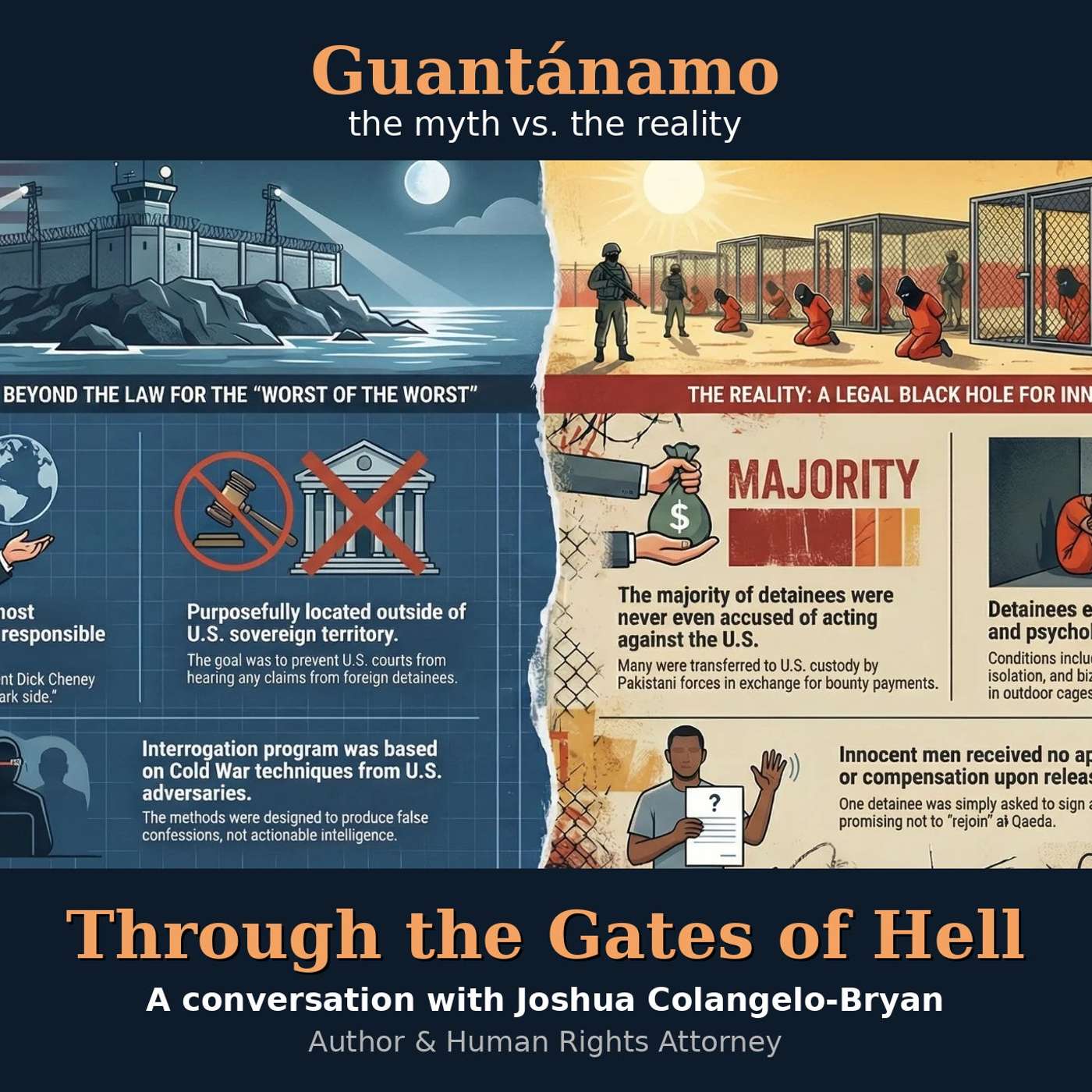

Guantanamo: The Myth vs the Reality
Dick Cheney died four weeks ago, but his dark legacy lives on—quite literally—at Guantanamo Bay. The human rights lawyer Joshua Colangelo-Bryan was among the first attorneys to enter the notorious prison in 2004, and what he found there shattered every official justification for its existence. The “worst of the worst”? Most detainees were never even accused of acting against America. Many were simply sold to the Americans for bounties. The sophisticated interrogation program? Techniques copied from Chinese and Soviet methods designed to extract false confessions, not intelligence. In his new book Through the Gates of Hell, Colangelo-Bryan tells the story of his unlikely friendship with Jaber Mohammed, a Bahraini detainee who spent years in captivity for the crime of being an Arab man in the wrong place (Afghanistan) at the wrong time (post 9/11). Released without apology or compensation—just a form asking him not to “rejoin” organizations he’d never belonged to—Jaber now lives in Saudi Arabia with four children, focusing less on bitterness and more on those rare moments when American guards showed him unexpected kindness. As the Trump administration revives the “worst of the worst” rhetoric against immigrants and once again sends people to Guantanamo, Colangelo-Bryan’s account is a warning from recent history: demonize a racial or religious group, and you will inevitably destroy innocent lives. The gates of hell have once again been opened. Will they ever be closed?
This is a public episode. If you'd like to discuss this with other subscribers or get access to bonus episodes, visit keenon.substack.com/subscribe
Dale Kretz: What Progressives Can Learn From the General Failure of the American State to Address the Legacy of Slavery After the Civil War
Paul Magnone on How to Make Smart Business Decisions In Our Age of Big Data: Don't Rely Exclusively on Either Your Intuition or Your Information
Kieran Setiya: How Philosophy Can Help Us Find Our Way in a Life of Infirmity, Loneliness, and Failure
Nancy Marie Brown on the Wisdom of the Hidden Folk: How Iceland's Elves Can Save the Earth
Hillary Chute on Maus Now: Why Art Spiegelman's Classic Remains As Relevant Today As It Was When First Serialized in 1980
Jennifer Brown: Can American Capitalism Be Radically Transformed by Leaders Who Create Inclusive Cultures Where Everyone Can Thrive?
Erika Hayasaki on Somewhere Sisters: The Complex Story of Adoption, Identity, and the Meaning of Family
Daniel Pick on Brainwashed: A New History of Thought Control
Lynn Melnick: What Dolly Parton Can Teach Us About Surviving the Trauma of Drug Addiction and Sexual Violence
Allison Gilbert on Elsie Robinson, America's Most Popular Female Writer Who You've Never Heard Of
Bruce Carruthers on the Economy of Promises: How Trust, Power, and Credit Have Shaped America Over the Last Two Hundred Years
Ainslie Hogarth: A Profane, Insane, Hilarious, and Disgusting Horror Novel About a Mother-In-Law from Hell
Namwali Serpell on Grief and Its Association With Religion and Writing