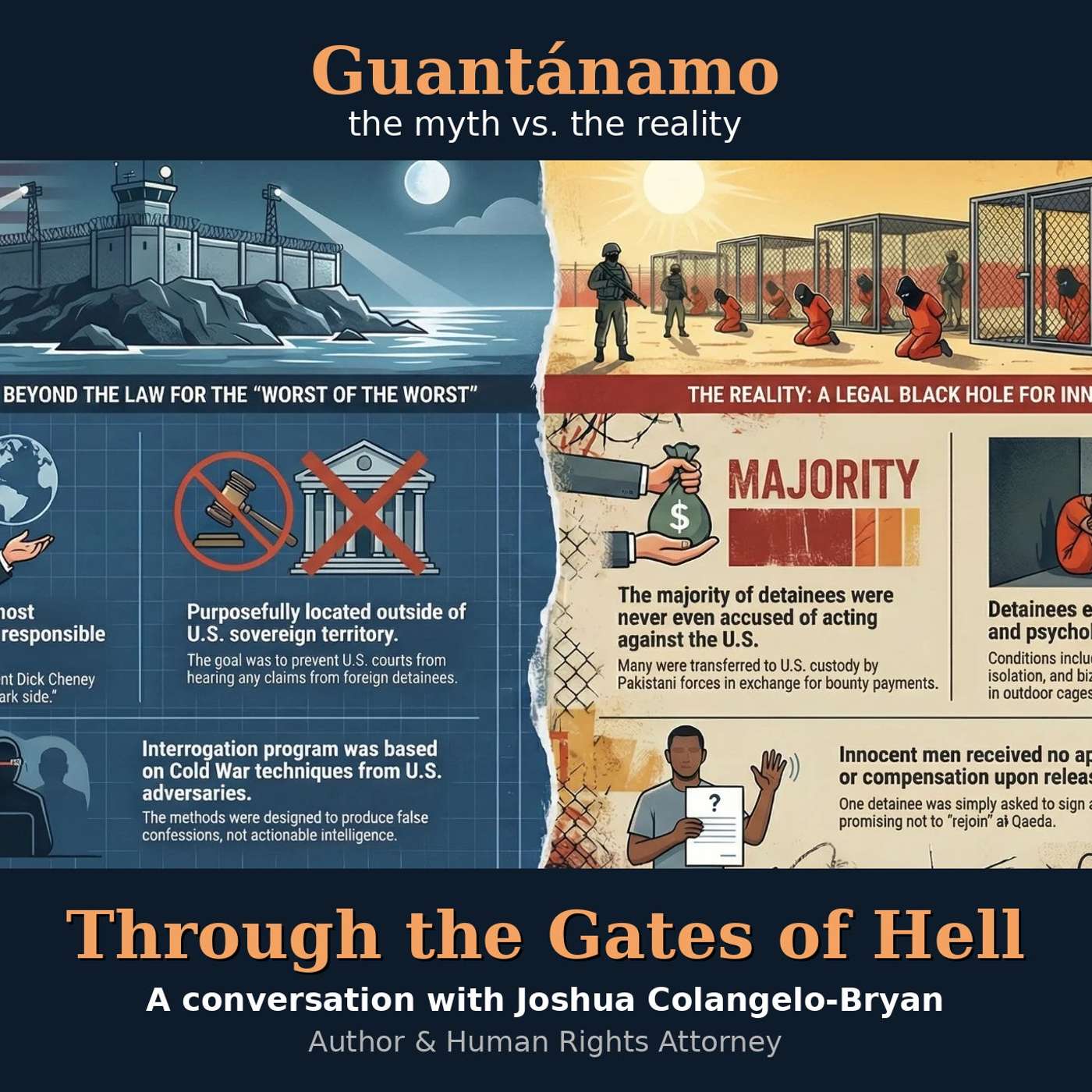

Guantanamo: The Myth vs the Reality
Dick Cheney died four weeks ago, but his dark legacy lives on—quite literally—at Guantanamo Bay. The human rights lawyer Joshua Colangelo-Bryan was among the first attorneys to enter the notorious prison in 2004, and what he found there shattered every official justification for its existence. The “worst of the worst”? Most detainees were never even accused of acting against America. Many were simply sold to the Americans for bounties. The sophisticated interrogation program? Techniques copied from Chinese and Soviet methods designed to extract false confessions, not intelligence. In his new book Through the Gates of Hell, Colangelo-Bryan tells the story of his unlikely friendship with Jaber Mohammed, a Bahraini detainee who spent years in captivity for the crime of being an Arab man in the wrong place (Afghanistan) at the wrong time (post 9/11). Released without apology or compensation—just a form asking him not to “rejoin” organizations he’d never belonged to—Jaber now lives in Saudi Arabia with four children, focusing less on bitterness and more on those rare moments when American guards showed him unexpected kindness. As the Trump administration revives the “worst of the worst” rhetoric against immigrants and once again sends people to Guantanamo, Colangelo-Bryan’s account is a warning from recent history: demonize a racial or religious group, and you will inevitably destroy innocent lives. The gates of hell have once again been opened. Will they ever be closed?
This is a public episode. If you'd like to discuss this with other subscribers or get access to bonus episodes, visit keenon.substack.com/subscribe
Orna Ophir: How a Pathology of "Schizophrenia" Might Reflect a Broken Society As Much as a Broken Mind
Leah McLaren: A Daughter's Memoir of a Mom Who Passed Down Her Trauma and Made Their Lives Impossible to Disentangle
Alice Mah on Plastics, the One Word That Best Describes Our Global Environmental Crisis
Harald H.H.W. Schmidt: Why "The End of Medicine As We Know It" Will Make All of Us Healthier and Happier
Ariel Ezrachi: How Cities, Rather Than Big Tech, Should Be the Engine for a More Equitable Digital Future
Monique Roffey: The Common Sense of Magic Realism and Why The Mermaid of Black Conch is a "Caribbean Novel"
Maureen Perry-Jenkins on Work Matters: How Parents' Jobs Shape Children's Well-Being
Saleem H. Ali: Do We Need a Science Party to Confront Existential Problems Like Global Warming?
Ari Mittleman: Does Criticism of Israel Inevitably Make One Guilty of Antisemitism?
Albert Fox Cahn: How Digital Surveillance In a Post-Roe America Isn't Substantively Different From Xi's China or Putin's Russia
Donald Robertson: Why the Graphic Novel Is an Ideal Form to Capture the Timeless Philosophy of Stoicism
Jacob M. Grumbach: Why the Crisis of American Democracy Is As Much a State and Local As a National Problem
Karen Cerulo and Janet Ruane: How We Can't Escape Social Class, Gender, or Culture in How We Dream