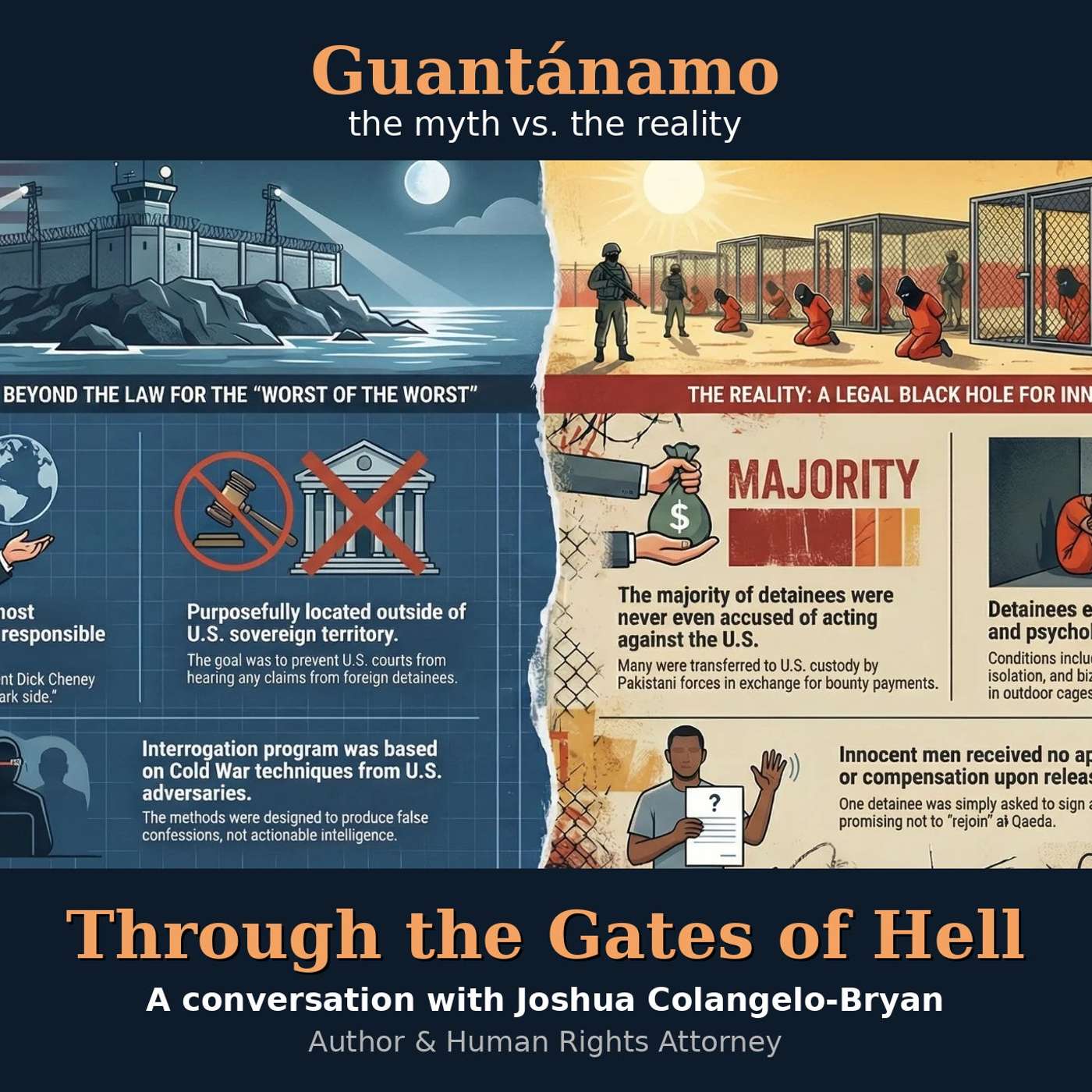

Guantanamo: The Myth vs the Reality
Dick Cheney died four weeks ago, but his dark legacy lives on—quite literally—at Guantanamo Bay. The human rights lawyer Joshua Colangelo-Bryan was among the first attorneys to enter the notorious prison in 2004, and what he found there shattered every official justification for its existence. The “worst of the worst”? Most detainees were never even accused of acting against America. Many were simply sold to the Americans for bounties. The sophisticated interrogation program? Techniques copied from Chinese and Soviet methods designed to extract false confessions, not intelligence. In his new book Through the Gates of Hell, Colangelo-Bryan tells the story of his unlikely friendship with Jaber Mohammed, a Bahraini detainee who spent years in captivity for the crime of being an Arab man in the wrong place (Afghanistan) at the wrong time (post 9/11). Released without apology or compensation—just a form asking him not to “rejoin” organizations he’d never belonged to—Jaber now lives in Saudi Arabia with four children, focusing less on bitterness and more on those rare moments when American guards showed him unexpected kindness. As the Trump administration revives the “worst of the worst” rhetoric against immigrants and once again sends people to Guantanamo, Colangelo-Bryan’s account is a warning from recent history: demonize a racial or religious group, and you will inevitably destroy innocent lives. The gates of hell have once again been opened. Will they ever be closed?
This is a public episode. If you'd like to discuss this with other subscribers or get access to bonus episodes, visit keenon.substack.com/subscribe
Hopwood DePree: What One American Learnt From Restoring His Family's English Castle
Aaron Friedberg: Why China, Not Russia, Is Our Greatest Threat And What We Should Do About It
Sasha Issenberg: What America's Long Struggle for Same-Sex Marriage Can Teach Us About the Possibility of Gun Control
Erin Swan: How a First Novel About America's Vanished Earth Took 6 Years to Write and 30 Years to Plan
Nirit Weiss-Blatt: Why the Techlash Has Gone Too Far
Helene Munson on Hitler's Boy Soldiers: Can Germans Ever Forget the Second World War?
Kerri Arsenault and Bathsheba Demuth: How to Tell Effective Stories About the Environment
Jon Taffer: Why the Real Power of Conflict Is About Respect Rather Than Violence
Hal Weitzman: Why Delaware Is At the Root of Everything That Is Wrong With America
George Stevens, Jr.: Remembering (And Mourning) The Golden Age of Hollywood and Washington D.C.
Dov Seidman: How to Make American Capitalism Moral (Or, At Least, Try To)
Marcus Buckingham: Why Work Sometimes Does, Indeed, Love Us Back
Arthur Grace: Photographing Communism(s) and What Life Really Looked Like in Cold War Eastern Europe