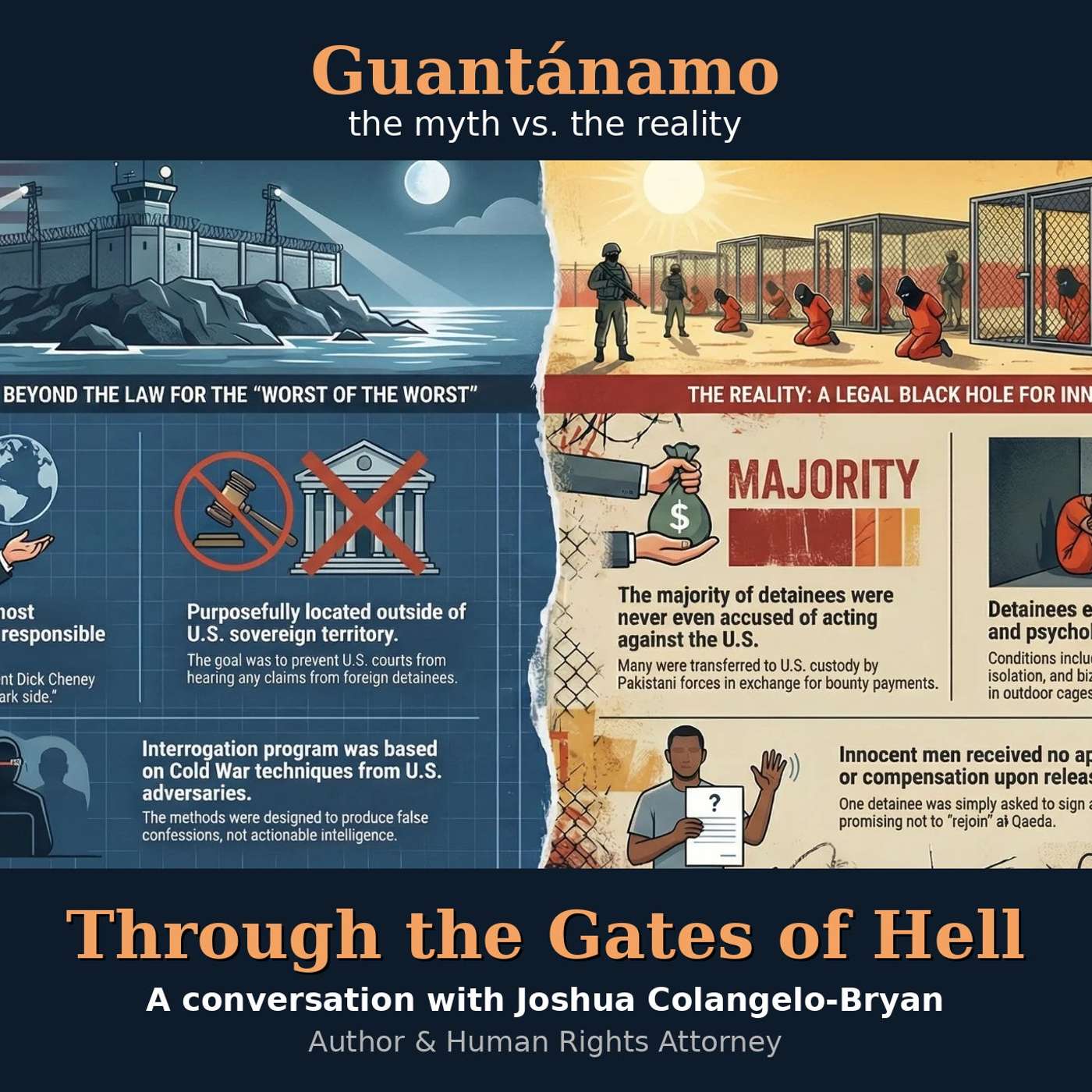

Guantanamo: The Myth vs the Reality
Dick Cheney died four weeks ago, but his dark legacy lives on—quite literally—at Guantanamo Bay. The human rights lawyer Joshua Colangelo-Bryan was among the first attorneys to enter the notorious prison in 2004, and what he found there shattered every official justification for its existence. The “worst of the worst”? Most detainees were never even accused of acting against America. Many were simply sold to the Americans for bounties. The sophisticated interrogation program? Techniques copied from Chinese and Soviet methods designed to extract false confessions, not intelligence. In his new book Through the Gates of Hell, Colangelo-Bryan tells the story of his unlikely friendship with Jaber Mohammed, a Bahraini detainee who spent years in captivity for the crime of being an Arab man in the wrong place (Afghanistan) at the wrong time (post 9/11). Released without apology or compensation—just a form asking him not to “rejoin” organizations he’d never belonged to—Jaber now lives in Saudi Arabia with four children, focusing less on bitterness and more on those rare moments when American guards showed him unexpected kindness. As the Trump administration revives the “worst of the worst” rhetoric against immigrants and once again sends people to Guantanamo, Colangelo-Bryan’s account is a warning from recent history: demonize a racial or religious group, and you will inevitably destroy innocent lives. The gates of hell have once again been opened. Will they ever be closed?
This is a public episode. If you'd like to discuss this with other subscribers or get access to bonus episodes, visit keenon.substack.com/subscribe
All of a sudden, there was all this freedom: David Winer on the origins of blogging, the self-publishing technology that has profoundly shaped the first quarter of the 21st century
If Life isn't a Movie, then How Should We Make Movies about Life? Olivia Rutigliano on Jean-Luc Godard's 1963 controversial film, "Le Mepris" (Contempt)
The Terrifyingly Exciting Promise of Nuclear Fusion: Matthew Moynihan on radically disruptive technology that, he promises, can conquer climate change and take us to Mars in a month
The Future of Money, Jobs, Climate and Failure: Andrew Hill on the Financial Times' best 15 business books from 2023
Dry Powder for a Dying Digital Economy? Keith Teare on the deepening venture capital crisis, how the innovators dilemma holds back Big Tech innovation, and why Substack is trying to reinvent the online media ecosystem
Did MTV Kill American Democracy? Kathryn Cramer Brownell on cable television and the fragmenting of America from Watergate to Fox News
Literary Insurrections and Memetic Apocalypses : Rion Amilcar Scott on the rise and (perhaps) fall of Black Twitter
The Scottish Coal-Miner's Daughter Who Took on the Bulgarian Cryptoqueen: Jennifer McAdam on her battle to take down Ruja Ignatova and her $27 Billion OneCoin Scam
The Seven Best Novels of the Summer: Bethanne Patrick on the literature of love, nostalgia, young call girls and valiant women
The Subversive Story of the B-52s: Scott Creney on one of the most iconic bands in American popular musical history
Feeding the AI Beast: Michael Wooldridge on the vast quantities of online data that have trained ChatGPT to mimic human language
Why America is Facing its greatest "Moral Moment "since the Civil War: Peter Wehner on the accountability of the Republican Party for Trump
Why We Need to Reoccupy Reality: Douglas Rushkoff on the Untethering of America between 2013 and 2023