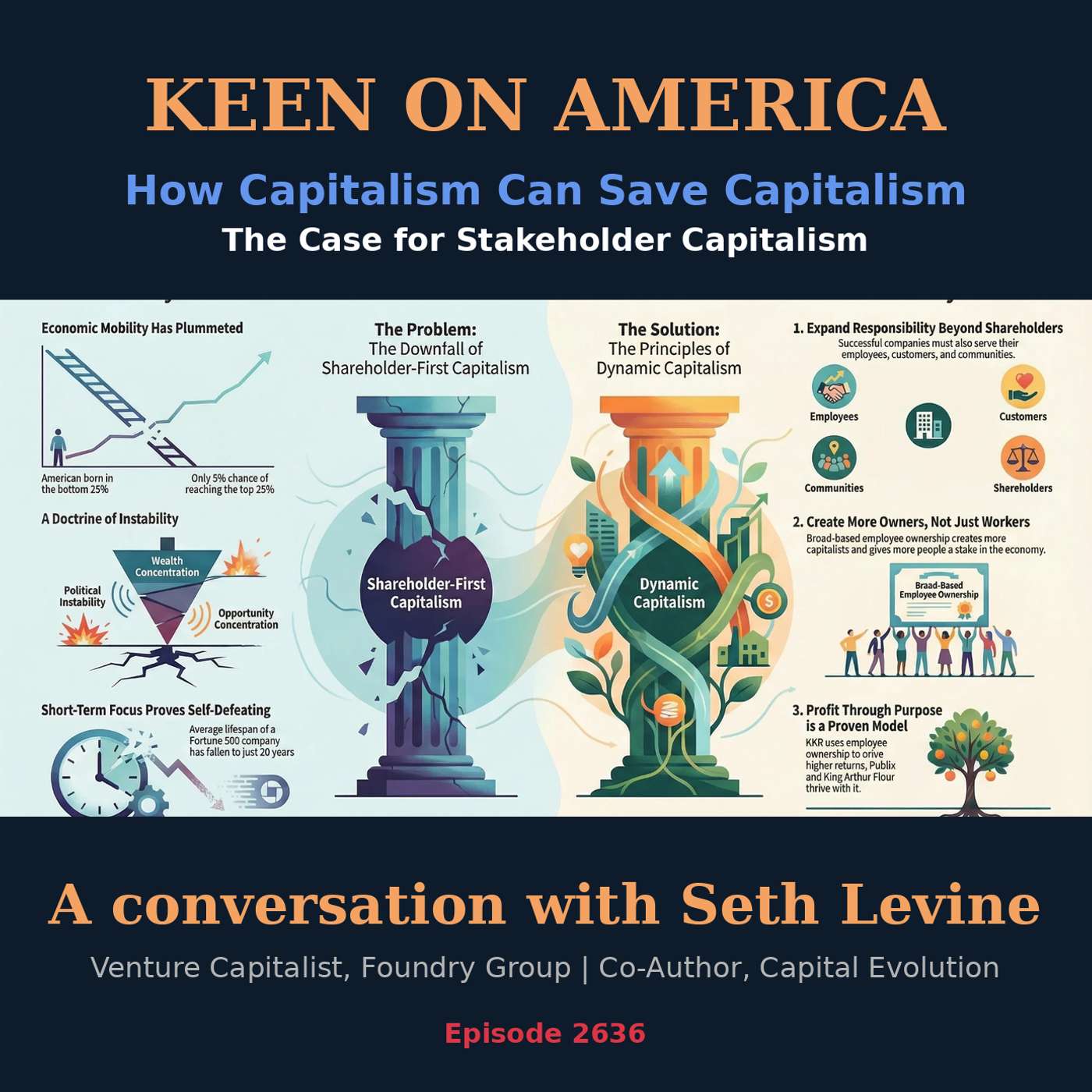
How Capitalism Can Save Capitalism: The Case for Stakeholder Capitalism
The American economy is a numbers game and those numbers are becoming more and more unfair. “30 years ago, if you were born in the bottom 25th percentile of wealth, you had about a 25% chance of dying in the top 25th percentile.” notes the venture capitalist Seth Levine. “Today you’ve got a 5% chance.” So what to do? What Levine wants is more rather than less capitalism. As he argues in his new co-authored (with Elizabeth MacBride) book, Capital Evolution, “if we want more people to have a stake in the economy, more people have to have a stake in the economy.” Thus the case for what he calls stakeholder capitalism. Only capitalism can save capitalism, Levine argues. Whether that’s Davos-style tautology or the way to right the wrongs of American capitalism is a more complicated question.
This is a public episode. If you'd like to discuss this with other subscribers or get access to bonus episodes, visit keenon.substack.com/subscribe
Episode 2245: Is it really "not hard" to be a billionaire these days?
Episode 2244: Tim Wu on how to decentralize capitalism
Episode 2243: Nick Bryant on why Trump 2.0 is as historic as the Fall of the Berlin Wall
Episode 2242: Ian Goldin on the past, present and future of migration
Episode 2241: Gaia Bernstein on the Threat of AI Companions to Children
Episode 2240: Ray Brescia on how our private lives have been politicized by social media
Episode 2239: Frank Vogl on why Trump's financial deregulation is likely to lead to another global economic crash
Episode 2238: What to make of J.D. Vance's speech at the Paris AI Summit
Episode 2237: Matthew Karp explains how progressives can successfully bulldoze America
Episode 2236: Colum McCann and Dianne Foley on what a mother said to her son's ISIS executioner
Episodes 2235: Jeffrey Toobin on whether we all deserve second chances
Episode 2234: Walter Mosley on Easy Rawlins, King Oliver and the history of fictional black American detectives
Episode 2233: John Kay on why (almost) everything we are told about business is wrong