Mount Rushmore: America's Most Monumental Contradiction
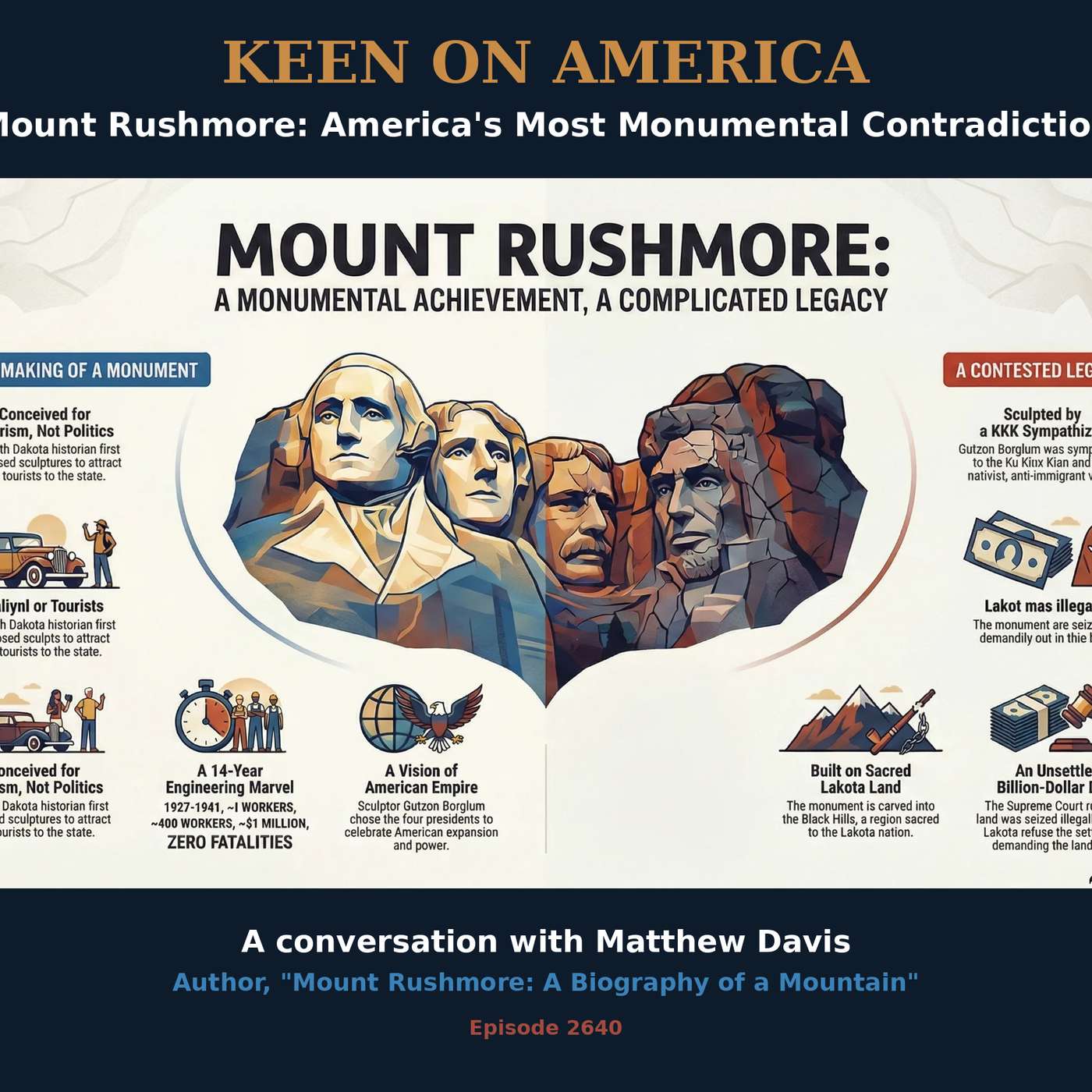
Mount Rushmore, with its images of four Presidents carved into the Black Hills of South Dakota, is America’s most identifiable monument. It might also be its most monumental contradiction — which is saying a lot, given the country’s gaping contradictions. According to Matthew Davis, the mountain’s biographer, the history of the Rushmore project captures both the remarkable engineering achievements of early 20th-century America and the country’s bloody colonial and racist past. So Mount Rushmore, Davis suggests, is indeed as American as cherry pie. Only that pie and those cherries aren’t quite as sweet as the MAGA crowd might like to think.
Keen On America is a reader-supported publication. To receive new posts and support my work, consider becoming a free or paid subscriber.
This is a public episode. If you'd like to discuss this with other subscribers or get access to bonus episodes, visit keenon.substack.com/subscribe
Exposing Hollywood's most notorious interwar celebrity spy
What chance peace in Israel?
How to write a #1 global bestseller
How Tucker Carlson's Putin interview captures today's "new, new media" revolution
Uncovering the world's mightiest (and tiniest) narco-state
in defense of cultural liberalism
Do nations have psychologies and can they experience collective trauma?
After Rape
Born in Blood: Scott Gac explains why violence is the defining feature of American history
Can the American university survive the 21st century? Nicholas Dirks explains why American universities need to reinvent themselves in our winner-take-all age of social media and AI
How to Win the Global Battle to Power our Lives? Ernest Scheyder on the new economic war between China and the West to control critical minerals like lithium, copper and cobalt
Why Scientific Truth Might Be Infinitely Weirder Than Scientific Fiction: Mike Chen on "A Quantum Love Story"
Should Elon Musk have publicly visited Auschwitz? Keith Teare on Musk, X, Instagram and the breakdown of civility in our social media age