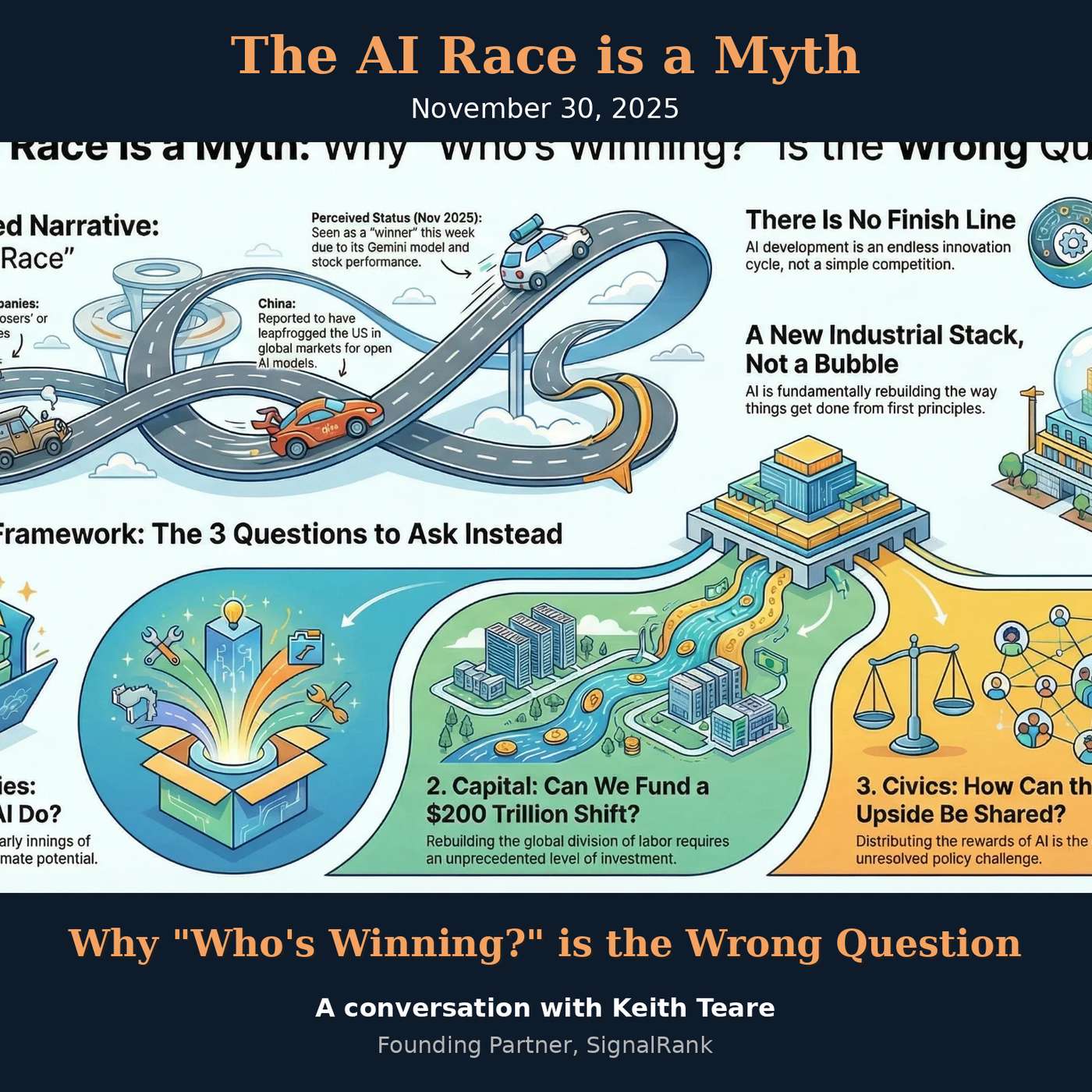
Today’s $3 trillion investment in AI is not only rational and beyond inevitable - it’s “predestined”. At least according to That Was The Week newletter publisher and techno-determinist Keith Teare. Exuberance is not only required, Keith argues, but absolutely essential in today’s AI mad gold rush. And he’s particularly critical of all skeptics - from traditional tech naysayers (like myself) to mainstream publications like The Economist - which are all a touch questioning of today’s unprecedented boom. What if the $3 trillion AI investment tsunami goes wrong? The Economist asks. But for Keith, it can’t possibly go wrong. The investment has already been made, he argues, and the resultant technology will inevitably benefit humanity. He envisions a world where AI adds $20 trillion to global GDP by 2035, where a kid in rural Africa with an Android phone can access the world's best AI, and where economic growth hits an unprecedented 20% annually. I think this type of teleological argument adds up to about $3 trillion worth of madness. But what do I know?
1. The Scale Defense: $3 Trillion is Actually Small Teare argues the massive AI investment looks rational when measured against projected returns - $20 trillion added to global GDP by 2035, potentially creating $400 trillion in company value (at 20x multiples). His math: even if the investment seems huge, the predicted gains are exponentially bigger.
2. AI's Business Model Advantage Over Previous Tech Booms Unlike the internet (which relied on advertising and attention-grabbing) or early TV (which devolved into reality shows), AI operates on subscriptions and API usage. Teare believes this model doesn't require undermining human outcomes to generate profit - making it fundamentally different from past transformative technologies.
3. Individual Failures Don't Equal Systemic Collapse While specific companies (like Perplexity at $20B valuation) might fail, Teare argues the overall AI ecosystem is "failure-proof" because trained models retain their value even if companies go bankrupt. He compares it to the Channel Tunnel - the infrastructure survived financial collapse and eventually thrived.
4. The "Western Suicide Wish" Cultural Diagnosis Echoing Elon Musk and Alex Karp, Teare sees Western civilization as increasingly "ashamed" of Enlightenment values - viewing humans as problems rather than solutions. He argues AI represents a return to human agency and innovation as answers to global challenges.
5. Content Creators Face a Reckoning The decline of web traffic (8% this year) signals the end of advertising-based content monetization. Creators must either embrace quality/subscription models or find ways to integrate with AI systems through attribution and linking - but the traffic-based economy is dying.
Keen On America is a reader-supported publication. To receive new posts and support my work, consider becoming a free or paid subscriber.
This is a public episode. If you'd like to discuss this with other subscribers or get access to bonus episodes, visit
keenon.substack.com/subscribe