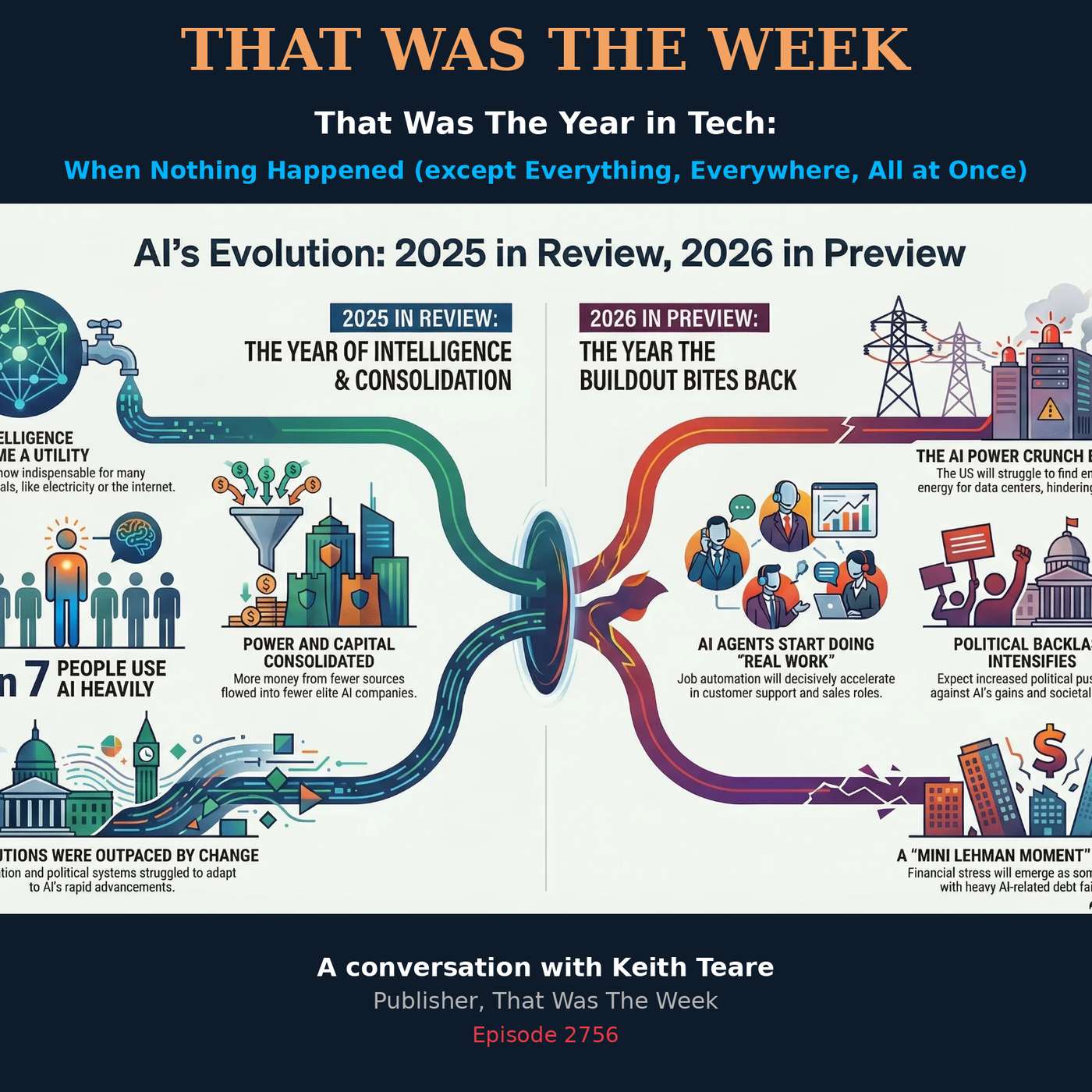
25 years after serving as the bridge between the Web 1.0 and 2.0 revolutions, Google stands at the vortex of another technological revolution. The company's new AI mode threatens to destroy the "simple bargain" that has sustained the web since 2005 — Google’s deal with websites which sent them traffic in exchange for indexing their content. Unlike traditional search results with links, Google’s revolutionary new AI Mode delivers knowledge directly from training data, eliminating the traffic pipeline that media companies depend on. As That Was The Week’s Keith Teare and I discuss, this marks the end of the Web 2.0 era and the beginning of the AI age, fundamentally changing how information flows online. By eating the Web 1.0 internet, Google established itself as the dominant Web 2.0 power. The multi-trillion-dollar question now is whether today’s AI revolution will eat Google.
Five Takeaways
* Google Was the Web 2.0 Bridge - Though its hard to determine if Google was really a Web 1.0 or 2.0 business, the company clearly served as the crucial bridge between these two eras, evolving from a pure search engine to a centralized monetization platform that dominated the web for two decades.
* The "Simple Bargain" is Breaking - Google's 20-year social contract with websites (free content indexing in exchange for traffic referrals) is ending as AI mode delivers answers directly without sending users to source sites.
* AI Mode Eliminates Links - Google's new AI search produces results from training data rather than indexed links, meaning no traffic flows to original content creators—fundamentally breaking the web's economic model.
* Search Quality Declined After 2010 - Google morphed from scientific link-counting to revenue-focused curation as social media grew, with the top third of search results becoming advertising rather than organic results.
* Google Faces a Binary Choice - The company must choose between traditional search mode (with links and traffic) or AI mode (pure knowledge delivery), as trying to mix both models with advertising would damage the AI users’ expectations.
Keen On America is a reader-supported publication. To receive new posts and support my work, consider becoming a free or paid subscriber.
This is a public episode. If you'd like to discuss this with other subscribers or get access to bonus episodes, visit
keenon.substack.com/subscribe