Trump 0.2: The Failing Revolution
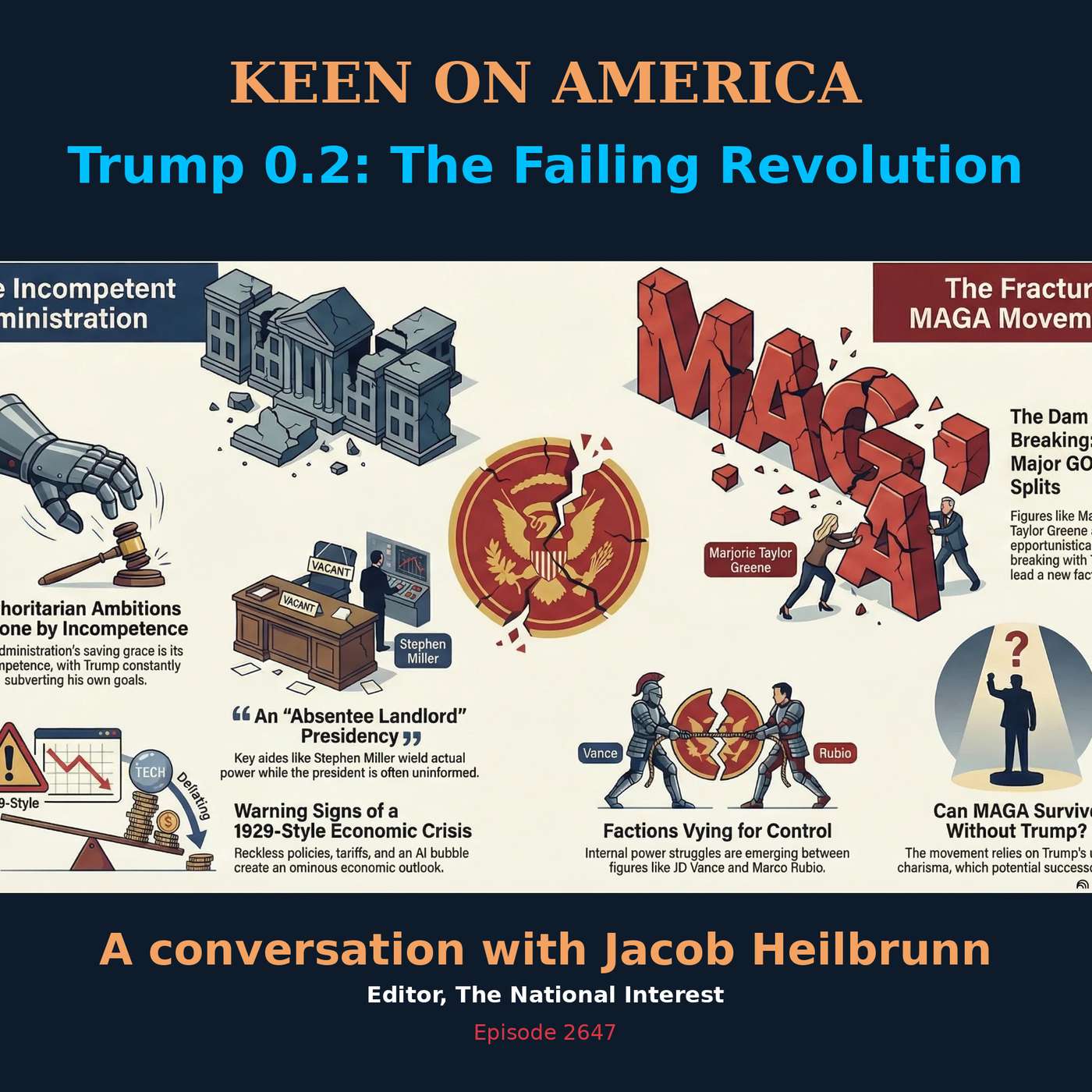
The 2025 Trump was supposed to be a more refined version of the 2017 original. But according to National Interest editor Jacob Heilbrunn, Trump 2.0 has fizzled into Trump 0.2. 2025 will be remembered, Heilbrunn argues, as the beginning of the end of Trump’s authoritarian aspirations. MAGA has fractured, the administration is incompetent, and Trump himself is running what Heilbrunn calls an "absentee landlord" presidency. And things, Heilbrunn predicts, are only going to get worse. In 2026, he suspects, there will be a serious economic downturn—even an AI-triggered 1929-style crash—that will only formalize the dismal failure of Trump's second regime. Perhaps. Although Trump always seems most resilient after being written off by DC pundits like Heilbrunn. The old pugilist, albeit only a “quasi-Caesar”, still has a few more rounds in him. Three more years, to be exact.
Keen On America is a reader-supported publication. To receive new posts and support my work, consider becoming a free or paid subscriber.
This is a public episode. If you'd like to discuss this with other subscribers or get access to bonus episodes, visit keenon.substack.com/subscribe
When fictional characters turn out to be more authentic than real people: Lang Leav on anti Asian racism in Australia and her love of the early internet as a place where she could escape how she looks
How Bill Clinton betrayed progressive ideas and capitulated to the right: Nelson Lichtenstein on the failure of the Clinton presidency and the transformation of American capitalism
Five Elemental Ways of Building a Sustainable Future: Stephen Porder on how five core elements changed earth's past and will shape our future
If you want to understand America, you have to understand basketball: Rich Cohen on the 1987-1988 NBA's "greatest season"
Imagine an AI that customizes a musical soundtrack of our lives: Niclas Molinder on the opportunities and threats that AI offers the creative community
AI as our Guttenberg moment: Moritz Schularick, the President of the Kiel Institute for the World Economy, on the economic significance of today's AI revolution
AI as our Oppenheimer moment: Benedikt Franke, CEO of the Munich Security Conference, on the geo-political significance of today's AI revolution
One year that changed the world: Ludwig Ensthaler on the short but revolutionary history of Generative AI
There will be no stock market on a dead planet: Sandrine Dixson-Decleve on how to transform extractive capitalism into a regenerative model of equitable economic progress
Why truthful stories about nature should have neither beginnings nor endings: Martin Puchner on telling circular environmental stories
Why there is hope in the soil: Jan-Gisbert Schultze on the transformational promise of regenerative agriculture
What, exactly, is circular economics? Martjin Lopes Cardozo on the current state of the circular economy
The Age of the Sustainable City: Ian Goldin on how to make the 21st century city the heart of a new circular economy