Why Smart People Still Believe in God
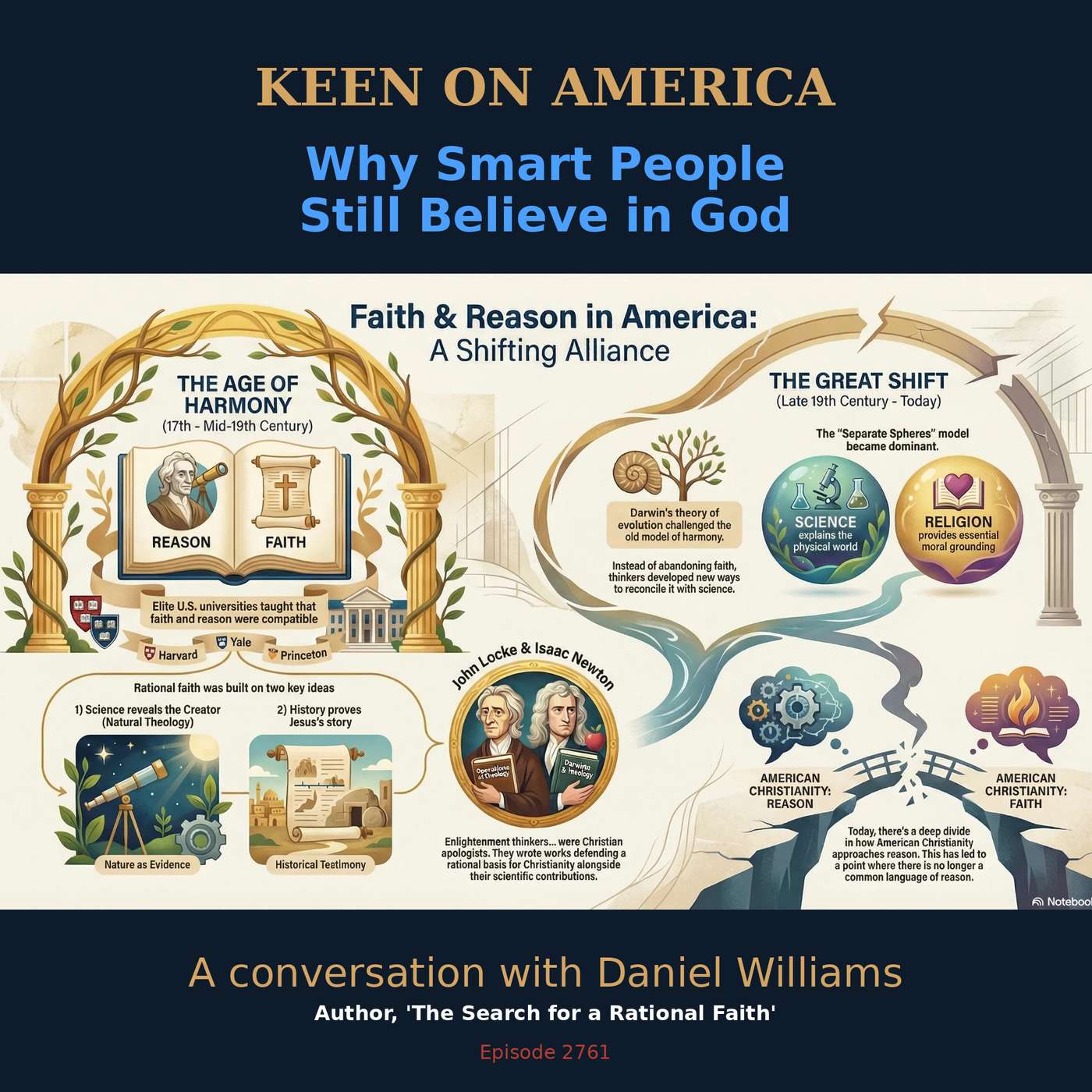
If Darwin’s evolutionary theories couldn’t kill America’s faith in God, then what could? That’s the message in Daniel K. William’s new book, The Search for a Rational Faith. Americans, Williams argues, have always sought to combine scientific knowledge with Christian apologetics. From the Founding Puritans to John Adams, Harriet Beecher and Martin Luther King, Americans have clung to the idea that enlightenment doesn’t undermine faith. That’s why thoughtful people - or, at least, thoughtful Americans - believe in God. “Without religion as a moral constraint, any sort of moral anarchy would be theoretically possible. In the world of the atomic bomb, there had to be some form of transcendent thinking,” Williams argues. “Religion has not been simply an anti-liberal reactionary force, but actually has been central to the American story and to America’s human rights project.”
Keen On America is a reader-supported publication. To receive new posts and support my work, consider becoming a free or paid subscriber.
This is a public episode. If you'd like to discuss this with other subscribers or get access to bonus episodes, visit keenon.substack.com/subscribe
In defense of literary flyover country: Peter Slen on Willa Cather's "My Antonia", the 1918 novel that captured the ideal of immigrant middle America
Orwell and his women: Bethanne Patrick on new feminist takes on George Orwell - the man , the husband and the writer.
Guilty by seven crimes and death by a thousand verticals: Keith Teare on Sam Bankman-Fried and Palo Alto, Elon Musk and Rishi Sunak, and Space X and X
How to get more women in science right now: Lisa Munoz on implicit bias, leaky pipelines, tokenization and other explanations for the persistent gender gap in science
Did the KGB really invent the idea of the Palestinian nation in the 1960s? Pierre Rehov on Iranian financed sleeper-cells in US universities and why he admires Hamas' "evil mind"
Overcoming the politics of black grief and white grievance in America today: Juliet Hooker on why American democracy is in desperate need of an radical expansion of its political imagination
A remarkable American hero at a time in which many Americans are no longer comfortable with the heroic ideal: Ronald C. White on the life of Joshua Lawrence Chamberlain, the unlikely hero of Gettysburg
The problem with stories about the Holocaust is that they are told by the survivors: Daniel Finkelstein on the extraordinary coincidences enabling the survival of his mum and dad from both Hitler and Stalin
Zero to Zero: William Deresiewicz on what happens when the price of online content is driven down to zero
Where have all the Democrats gone? Ruy Teixeira on why the Democratic Party needs to tone down the volume on cultural issues if it's to rediscover its soul
How this month's "almost miraculous" Polish election might be a hopeful sign for democracy everywhere: Maciej Kisilowski on the promise and peril of representative democracy in a post authoritarian Poland
Does today's climate change crisis represent an existential threat to humanity? Antonello Provenzale contextualizes the contemporary crisis within a history of climate change from the earth origins to the Anthropocene
An enigmatic city teetering on the edge of the world: John Kampfner on Berlin, a city of ghosts and memories where he can still smell the Wall